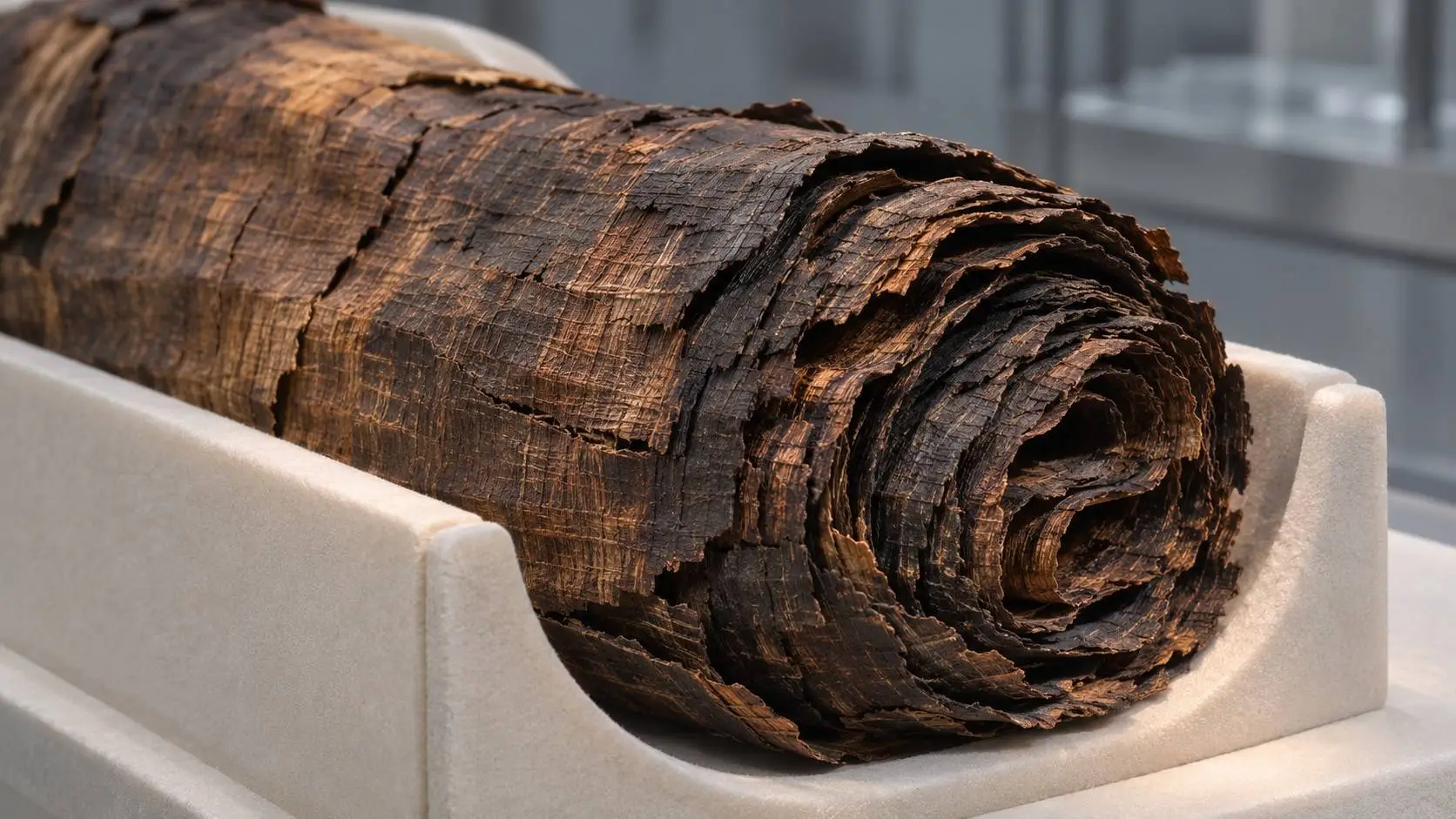
A carbonized roll with brittle, layered edges rests in a pale conservation cradle. AI-generated editorial illustration by AI World Today.
A scroll buried by Vesuvius can still hold writing almost two thousand years later. Opening the fragile roll can destroy it. The Vesuvius Challenge used X-rays to map the inside and machine learning to find traces of ink. Scholars used those traces to read Greek text that had long been out of view.
The first problem is to get a view of the papyrus. The next is to find the ink. The last is to work out what the faint strokes say. Each step calls for a different skill. A mistake in an early step can change what a reader sees at the end.
Why an ordinary photo can’t see the text
Think of a rolled sheet of paper. From outside, you can see the top layer and the ends of the roll. Most of the sheet is out of sight. Researchers can’t peel back the layers of a burned scroll the way you might unroll a poster.
They can put the scroll in an X-ray scanner. The result is a 3D map of the object. Oxford’s account of its work on PHerc. 172 describes how a team scanned the scroll at Diamond Light Source. The scanner let the team look at parts of the object sealed inside the roll.
The map still shows a roll. Its sheets can be bent, crushed, or torn. On a scan, two layers may sit close enough to be hard to tell apart. A team has to figure out which bits of the scan are part of the same sheet before it can show that sheet flat.
How researchers unroll a scroll on screen
A person can trace part of a sheet through the scan. The work can also draw on software to find and follow surfaces. The team then projects a view of that surface onto a flat image. This is what the project calls virtual unwrapping. The real scroll stays rolled up.
It matters which layer the team follows. If a trace jumps onto the next sheet, part of the image comes from the wrong place. An ink model could flag marks from both layers. The image might look sharp, and the words could still be wrong.
The flat view helps the team check its work. People can compare the image with the scan and adjust the trace where it maps the wrong sheet. Each good patch gives the team more space to look for strokes.
What the ink model looks for
Old ink and the burned papyrus beneath it can look much alike on a scan. Even where a team has a clear view of a sheet, the ink can be hard to spot. A model can learn from small patches where the locations of ink marks are known.
The project’s guide to ink detection shows how a team can match ink seen on a loose piece of papyrus with its scan. It also describes a method for sealed scrolls. The team marks clear predicted strokes by hand. It keeps some areas out of training to see how well the model works on a fresh patch.
The model can then help mark areas on the flat view where ink is likely to be present. A scholar checks whether those marks look like letters and what words they can make out. This is a good case of a narrow AI task making careful human work possible. For background on the tools used for such work, see our guide to Nvidia GPUs and AI infrastructure.
What the first grand prize team read
The team behind the challenge named the 2023 Grand Prize winners on February 5, 2024. Youssef Nader, Luke Farritor, and Julian Schilliger won the $700,000 prize. Their entry showed more than 2,000 characters across 15 columns.
Specialists in ancient writing reviewed the text. A technical team looked at the methods. The result gave researchers a way to read substantial parts of one sealed scroll. Each new section still needed the same work of mapping, tracing, and checking.
What happened after the award
In February 2025, Oxford reported progress on one of the scrolls in its Bodleian Libraries, PHerc. 172. The team found that the ink was easier to see in scans of this scroll than it had been in some of the other scrolls. Two rolls can pose very different problems, even when they came from the same site.
On June 25, 2026, the University of Kentucky reported two further milestones. Teams had recovered more than 70 columns from PHerc. 172 and unwrapped the part of PHerc. 1667 that still survives. The university also reported newly read works linked to the Greek thinker Philodemus.
What survives still sets the limit. When a piece is gone, a scan can’t tell the team which words were on it. When a piece remains, a new scan or a better trace can give scholars a fresh chance to make out the writing.
Why the marks still matter
Imagine you can see a curve and part of a straight line where you expect a letter. You may already have guessed how the word ends. Before you fill in the gap, look at the faint marks again. Could more than one letter fit? Is the edge of a crack close by? Could the stroke come from another sheet?
A reader has to weigh those questions for each line. The model can direct attention to a patch. A scholar can then check the shape of the stroke, compare it with other letters on the same sheet, and ask someone else to read it.
Much of this work moves in small steps. A clear letter can help a scholar place a word or tell where a line ends. A few more lines can give a sense of what the writer is talking about. Those gains add up even when some gaps are still there.
Other AI projects start with different clues. A language model trained on pre-1931 books and other text begins with words that people can already read. With a sealed scroll, the first task is to turn something that can be measured inside the roll into a view of marks on a sheet.
The most lasting change may be access to a source. A scholar can read, compare, and dispute a proposed line while the papyrus stays intact. Find more of the work that led to such tools in our AI history collection.

Popular news

AWS lets AI agents buy select tools on the developer’s cloud bill
Human clues helped AI agents mimic supply-chain decisions
Cline-Bench tests coding agents three times on real software tasks
ElevenLabs moves to buy Kotoba for its Japanese voice AI

The $93.5 billion Anthropic IPO leads this week in AI