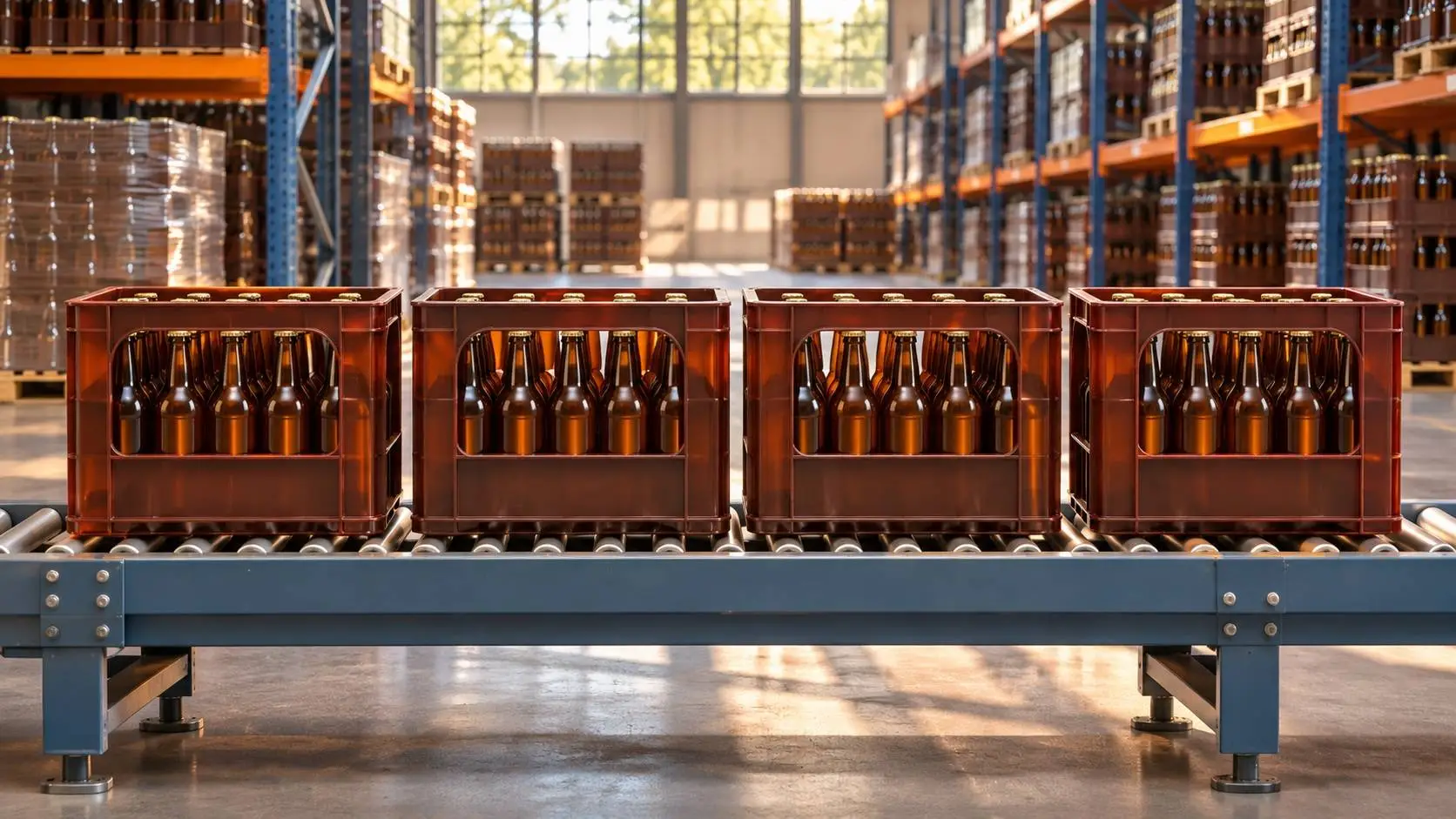
Reusable beverage crates line a short roller conveyor in a light-filled distribution warehouse. AI-generated editorial illustration.
AI agents got closer to the way people run a supply chain after researchers gave them clues about common human mistakes. The test used a game in which four players order and ship beer. The researchers wanted to see whether the agents could copy the way people make choices as a group.
Hongan Zhu and Babak Heydari used agents based on seven models. As Northeastern University’s account of the research explains, each agent saw only one part of the chain. The team compared their orders with results from earlier studies with people.
Why a small change can grow into a large one
The beer game gives players four jobs: retailer, wholesaler, distributor, and factory. Each one has to decide what to order or ship. Goods take time to arrive, and each player sees only part of what is going on.
Say shoppers start to buy more. The store asks for more stock. A supplier can see the larger order without knowing whether sales at the store have changed for good. It might raise its own order by more. The factory can end up seeing swings much larger than the original change at the store.
Researchers call that spread the bullwhip effect. The game lets them watch how it takes shape. It also gives them clues about where people may order too much or forget to count stock that is already on the way.
How the team brought the agents closer to people
On their own, some of the agents put in large orders even after demand had stopped going up. The team then gave them descriptions of how people tend to estimate demand and respond to a shortage or surplus. The clues came from earlier work on how people play the game.
Across 231 sessions described by Northeastern, the agents moved closer to the human benchmark. Some got close to it. The point of this test was to copy what people do, including their mistakes, so the most efficient way to keep the shelves full was a different target.
The group also tried hints about what the players might feel, such as pressure to order more. The university’s account describes that as a separate round of testing. The authors’ code and data make the setup available for other teams to inspect.
What the result says about using agents in research
The good fit in some runs comes with a clear source of help. The agents had rules drawn from what researchers already knew about people in this game. If the agents are moved to a new task, another test would be needed to see whether those same clues still help.
It is also worth looking at how the job of each player changes the result. A factory gets a different view of demand from a store. A match in the total beer ordered can still leave room for very different choices at each step.
Studies like this can give researchers a place to try ideas before a bigger study with people. The human data still give them a way to check how well a simulation works. Our guides to how agents receive information and take action and how to set limits on agent actions cover some of the choices that go into a bounded test.

Popular news
AWS lets AI agents buy select tools on the developer’s cloud bill
Cline-Bench tests coding agents three times on real software tasks
ElevenLabs moves to buy Kotoba for its Japanese voice AI

Claude Code vs Cursor: Try the Same Fix in Both

US House lawmakers launch a bipartisan caucus on AI safety