
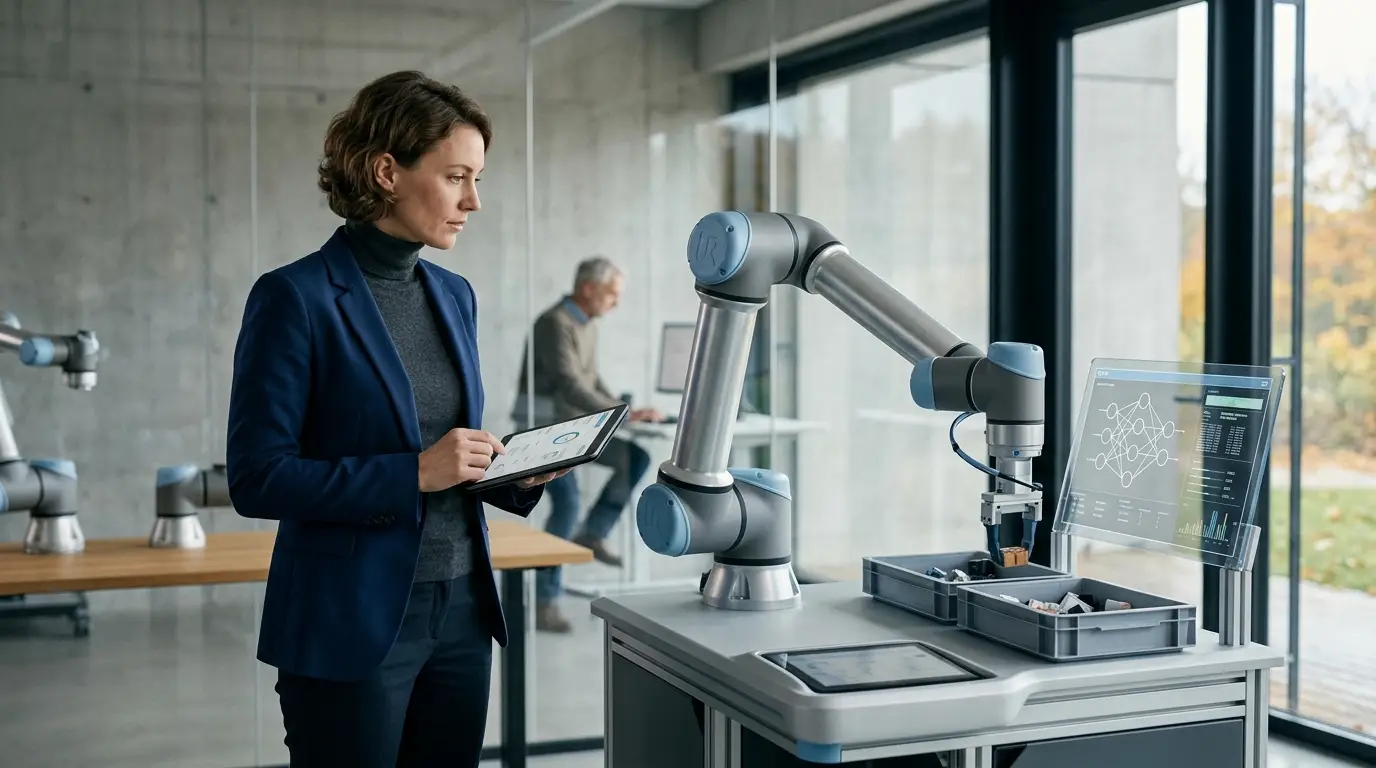
A head-mounted camera and folded aprons at a textile packing station. Editorial illustration.
In the textile city of Karur, India, workers are paid to film tasks such as folding and packing aprons. The footage becomes training data for robots. It gives some workers a new source of pay and raises a harder question about where tomorrow’s factory and office jobs will go.
Economics Explained argues that this shift could put India’s economy on a path to decline. The evidence points to a more specific risk. Firms may need fewer workers for some tasks they now send abroad. India’s software exports still grew last year.
Why robot makers pay for footage of simple tasks
A camera worn on the head records the work from the person’s point of view. That helps a robot maker see how objects move and what happens between each step. In a textile shop, that can mean how someone keeps an apron flat as they fold it or how they stack the finished bundle.
Appen lists more than 700 hours of commercial work in one dataset. The company says it used head-mounted cameras and motion sensors. Objectways offers similar data collection for tasks such as cooking, stocking shelves and assembling goods. Camera footage can help a robot learn a task. The machine still has to do the job safely and at a pace a shop can use.
For workers in Karur, the choice can be immediate. NPR reported that one textile worker earned about $2.60 an hour for recording. That is one person’s rate. It tells us why a worker might take the extra pay today, while leaving open how steady the work will be.
A factory job can move before a robot arrives
Picture a US buyer that sends packing work overseas. If it can buy a machine that does the same job close to home, it may place fewer orders abroad. The overseas factory can lose work even if it keeps doing every step by hand. To make that switch, the buyer still has to weigh the cost of the machine, the time it takes to fix and how well it handles new goods.
Automation is also growing in India. The International Federation of Robotics says Indian factories installed almost 10,500 industrial robots in 2025, up 15% from the year before. China installed about 354,000 that year. These counts cover industrial robots, including fixed equipment. They do not tell us how many jobs were lost or how many machines can do the work shown in Karur.
India’s software exports are still growing
The pressure looks different in an office. AI can draft a support reply or help a developer fix code. If the client pays by the hour, fewer hours on each ticket can mean less work to bill. That same firm can still take on new clients or sell the work needed to put AI tools in place.
The Reserve Bank of India’s annual survey found that software services exports rose 8.2% to $221.4 billion in the year to March 2026, excluding sales through overseas affiliates. The survey puts IT services at $147 billion, up from $131.3 billion. Business process outsourcing moved much less, from $55.8 billion to $56 billion. These figures measure sales abroad. They do not show how many people got hired.
The question to watch is where the new work lands. Training data pays people to show a machine how to do a task. Running and fixing that machine creates a different set of jobs. Whether those jobs grow in the same places, and pay enough to replace the work that comes under pressure, is still open.
AI World Today has also covered the tools factory robot makers are building and Microsoft’s new cloud region in India. They show two ways that AI investment can reach the country.


Popular news

Good Morning AI | Anthropic slips, Claude reviews code and Tidal sets a cutoff

Maxon Plus brings editable AI models into Cinema 4D

AI stocks slide again as Nvidia falls and Ambarella sinks 20.6%
Anthropic closes below its $83 IPO price as Nvidia and chip stocks fall

Google DeepMind’s new AI exam asks if models can get the easy stuff right