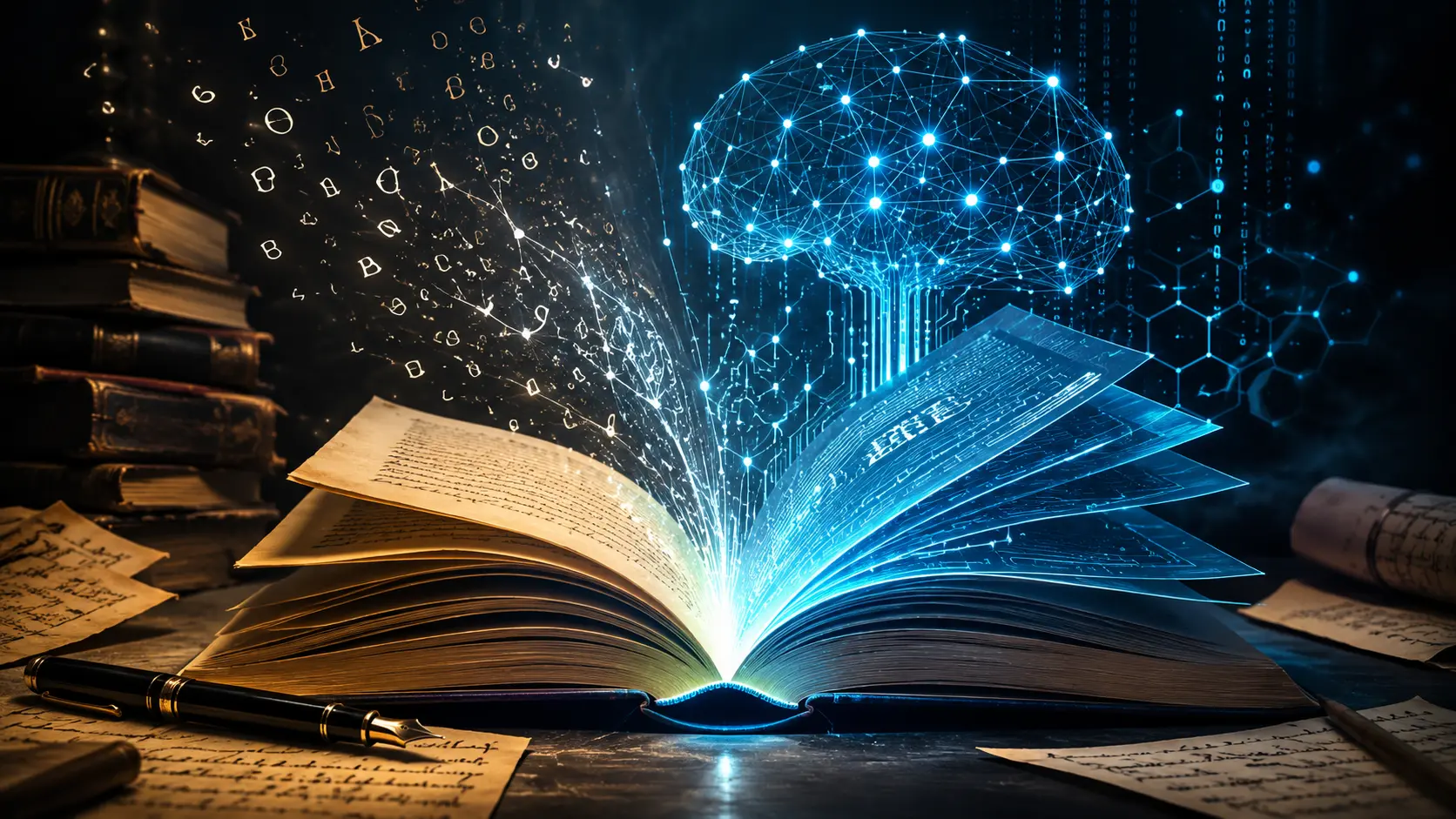
From outspoken skeptics to avid AI adopters: twelve prominent authors, CEOs, and thinkers explain how artificial intelligence is reshaping writing, creativity, and the future of authorship.
AI is transforming the writing process faster than almost any other creative field. Some hail it as a revolutionary assistant; others warn of shrinking originality, creativity, and human depth. Notably, the debate isn’t just for AI researchers and tech firms—it’s increasingly driven by authors, journalists, publishers, and philosophers.
In an extensive series of conversations with leading thinkers and writers, opinions diverge sharply. From OpenAI’s Sam Altman to journalist Ezra Klein and economist Tyler Cowen: everyone agrees AI is here to stay, yet almost no one believes human authorship will disappear.
1. Sam Altman: “AI gives writers a bigger canvas”
OpenAI CEO Sam Altman is, unsurprisingly, one of AI’s loudest champions. Still, he stresses that AI isn’t meant to replace human creativity. He sees it as a powerful tool that helps writers develop ideas faster, gather information, and refine their drafts.
Altman compares AI to past leaps like the word processor or the internet. Those innovations radically changed how writers work—without making writers obsolete.
“The words are still my own. The research is still my own. The facts are still my own.”
In Altman’s view, authors remain responsible for their content. AI mostly accelerates the path from idea to finished piece.
He sees a second benefit too: AI lowers the barrier to getting started.
“AI simply accelerates all of that and gives me a far bigger canvas.”
Why it matters
Altman embodies Silicon Valley’s optimism: AI isn’t a rival to writers but a tool that offloads repetitive work, freeing people to focus on creativity, strategy, and originality.
2. Ezra Klein: “The danger is thinking you understand”
Journalist Ezra Klein uses AI almost daily. Yet he refuses to let it write his articles or analyses.
For Klein, strong journalism doesn’t come from collecting information as fast as possible, but from spending hours reading sources, connecting dots, and forging original insights.
“Having AI summarize a book for me is a disaster.”
He calls summaries dangerous—not because AI is always wrong, but because they can trick you into thinking you understand a text without wrestling with it.
Knowledge changes you only when you engage with it directly, he argues.
“It’s more dangerous to think you’ve read something that you haven’t than to not read it at all.”
For him, AI is a better search engine. Nothing more, nothing less.
Why it matters
Klein hits a core AI dilemma. As more thinking gets outsourced, users may get answers without learning to think deeply. His critique targets not the tech itself, but how we use it.
3. Tyler Cowen: “Smart questions make AI truly intelligent”
Where Ezra Klein keeps AI at arm’s length while writing, economist Tyler Cowen does the opposite.
He uses AI constantly while reading books, historical documents, and academic papers—not for ready-made answers, but to craft better questions.
“I’m smarter about the thing in the final analysis.”
Cowen treats AI like an interactive partner that keeps surfacing new angles.
Many users, he says, get too little out of AI because they ask vague questions.
“They’re asking it questions that are too general.”
To really benefit, you need to add context, probe critically, and challenge the model.
Why it matters
Cowen’s view shows AI doesn’t automatically deliver better outcomes. Quality depends heavily on the user. Good prompts aren’t a trick—they’re a new literacy.
4. David Perell: “I now have the world’s smartest editor”
Writer and entrepreneur David Perell is one of the interview’s most enthusiastic AI users. He doesn’t see AI as a ghostwriter, but as an always-on editor.
When he’s unsure about an argument, a phrase, or an article’s structure, he asks AI to critique it.
"I now have the world's greatest editor."
According to Perell, AI also helps him uncover his own blind spots.
He even asks language models to write a ruthless critique of his articles before publication.
"Please criticize this op-ed. And do not hold back."
That way, weak arguments surface before readers spot them.
Why it matters
Perell represents a fast-growing group of professional writers who don’t use AI to write for them, but to level up their own work. In that role, AI acts more like an editor, sparring partner, and fact-checker than an author.
5. Robert Macfarlane: "AI has no feeling—and no real art"
For British author Robert Macfarlane, AI’s limit isn’t intelligence—it’s human experience. He acknowledges that language models can produce convincing prose, but insists that art ultimately springs from feelings, memories, and lived experience.
Macfarlane argues AI can mimic emotion brilliantly, but never truly feel it.
"AI will never have feeling. AI will have the simulacrum of feeling."
In other words, AI can only imitate emotion. The words may sound real, but, he says, they’re not rooted in a personal life.
Macfarlane also rejects the idea that great art only comes from suffering. Still, he sees human experience as the fuel of creativity.
"All the writing that moves me is made of feeling and time, of which AI has neither."
Why it matters
Macfarlane speaks for a growing group of writers who don’t dismiss AI for technical reasons, but because they believe literature is more than well-formed sentences. A novel, poem, or essay gains meaning because a human—shaped by life—wrote it.
6. Douglas Murray: "I never let AI write for me"
Journalist and author Douglas Murray uses AI far more selectively than many peers. He treats language models mainly as a tool to quickly gather legal or historical background.
When he tackles a topic outside his specialty, he asks AI for context. But he always writes the final text himself.
"I don't let it write for me. I want the writing to be my own."
For Murray, writing isn’t just about the end product; it’s about ownership. Even if AI could craft sharper lines, he wants to keep his own voice.
He also leans on AI most while reading and researching.
"Most of all, I use AI when I read things."
He sees AI as an interactive layer of secondary literature that helps connect sources faster.
Why it matters
Murray shows AI doesn’t automatically mean less human work. Experts often deploy the tech with precision—without giving up the creative process.
7. Paul Kingsnorth: "Writing isn’t a job you outsource"
Writer Paul Kingsnorth is one of the sharpest AI critics in the debate. For him, writing isn’t a production line—it’s personal, almost spiritual.
His answer to why he won’t use AI is strikingly blunt.
"Why would I? It'd be like hiring someone to have sex for you."
Kingsnorth says writing is about the physical and emotional act of making. Handing that to a machine, he argues, strips the craft of its essence.
He concedes AI can help with administrative or legal documents, but draws a hard line at creativity.
"For anything creative... why would I want to use it when it's the very creative language that I like?"
Why it matters
Kingsnorth represents writers who reject AI on principle—not because the tech is bad, but because they believe the value of art lies in the human act of making it.
8. David Perell: "AI is the best cure for writer’s block"
While Perell has called AI an ideal editor, he also uses it another way: to beat the fear of the blank page.
He often dictates thoughts to AI or asks for alternative phrasings when he’s stuck.
"AI is an anxiety antidote."
For Perell, AI gets ideas on the page faster. The real writing starts after that: rewriting, sharpening, refining.
He stresses that AI never takes over the entire job.
"I'm still cooking the meal. AI is just an exceptionally sharp knife."
He uses that analogy often. To him, AI is like a sharp kitchen knife: a powerful tool, but the chef still decides what ends up on the table.
Why this matters
Perell’s view mirrors how many professional writers now use AI. Not as a creativity replacement, but as a tool to draft faster, stress-test arguments, and deliver stronger copy.
9. The publisher: "Use AI as a tool, not as the author"
Publishers are grappling with AI too. In the interview, a veteran publisher explains that AI works well as a research assistant or sparring partner—as long as a human demonstrably creates the final content.
He sees particular upside for nonfiction writers who need to sift through large volumes of information quickly.
"If you use it as a tool... a great example would be a research assistant."
In his view, AI can surface connections in minutes that might take a writer days or weeks. That doesn’t make the system the author.
In fact, he says publishers will keep expecting writers to be transparent about how AI was used.
"The author makes a representation that the work is their sole creation."
Why this matters
The AI debate isn’t just about creativity—it’s about trust. Readers want to know who truly wrote a book, while publishers must decide how much AI use is acceptable without blurring authorship.
10. AI and copyright: who owns an AI-written book?
Beyond creativity, copyright looms large. The interviewed publisher notes that laws in many countries lag behind the tech.
A fully AI-written work often receives no copyright protection in many jurisdictions.
"Our copyright law does not protect things created by AI."
That creates a practical problem, he argues. Why would a publisher invest in a book that anyone can copy immediately?
The boundary is anything but clear.
"There's no clear line for this and that's the problem."
Why this matters
The legal fight will be at least as important as the technology in the coming years. Writers, publishers, software companies, and lawmakers will all need to decide when a text still counts as human-made.
11. AI makes average writing better—but unique writing harder
One striking takeaway: AI writes competent, often predictable prose.
The interviewees agree language models produce grammatically strong, logically structured text. But a distinct voice often goes missing.
"It's good writing. It's bad in the sense that it is so generic."
The comparison to tools like Grammarly comes up often. These systems polish grammar and readability, but can sand down a writer’s unique style.
Writer Robert Macfarlane even calls that a risk.
"It hurts distinctiveness and individuality that underlies so much great writing."
Why this matters
As AI gets better at flawless prose, the value in writing shifts. Not correctness, but originality, style, and personality become the traits that set human authors apart.
12. One conclusion unites all twelve thinkers
Despite their differences, one pattern stands out.
Almost no one expects AI to replace writers outright. Even the biggest advocates consistently talk about human–machine collaboration.
Some call AI an editor.
Others call it a research assistant.
Still others compare it to a word processor or a search engine on steroids.
But almost no one calls AI a real author.
"I'm still cooking the meal."
David Perell’s line may sum up the entire conversation. AI can suggest ingredients, give feedback, and speed the work—but the writer remains responsible for the story.
Tyler Cowen also sees the future as a partnership.
"Some humans will become masters of the tools."
The writers who learn to master AI, he says, will ultimately stand out.
Conclusion: AI reshapes the process, not why we write
The twelve conversations reveal a far more nuanced AI debate than usual. There are vocal skeptics who fear AI will erode human creativity. There are optimists who see the biggest productivity leap since the internet. And there’s a large middle that uses AI daily—but draws firm lines.
Notably, almost everyone lands on the same core message: use AI to speed research, sharpen ideas, and improve drafts—but never outsource the full thinking to a machine.
As AI gets better at clean, convincing text, the premium shifts to what’s hard to automate: originality, lived experience, curiosity, and a recognizable voice.
That may be the biggest lesson across all twelve talks. The future of writing isn’t about whether AI is used, but how writers keep their human creativity front and center in an era when machines are learning to write.

Popular news

AI Stocks Plunge: Meta Loses 9% as ASML Also Slides

Phishing Emails Are Now Trying to Trick the AI in Your Inbox

Google gives entrepreneurs AI help with branding and bookkeeping
Claude Duet Keeps Working After You Close Your Laptop

Indeed: Employers Value References More as AI Enters the Hiring Process
Claude Hides Secret Messages in Images—and Can Read Them Back
Latest comments
Loading