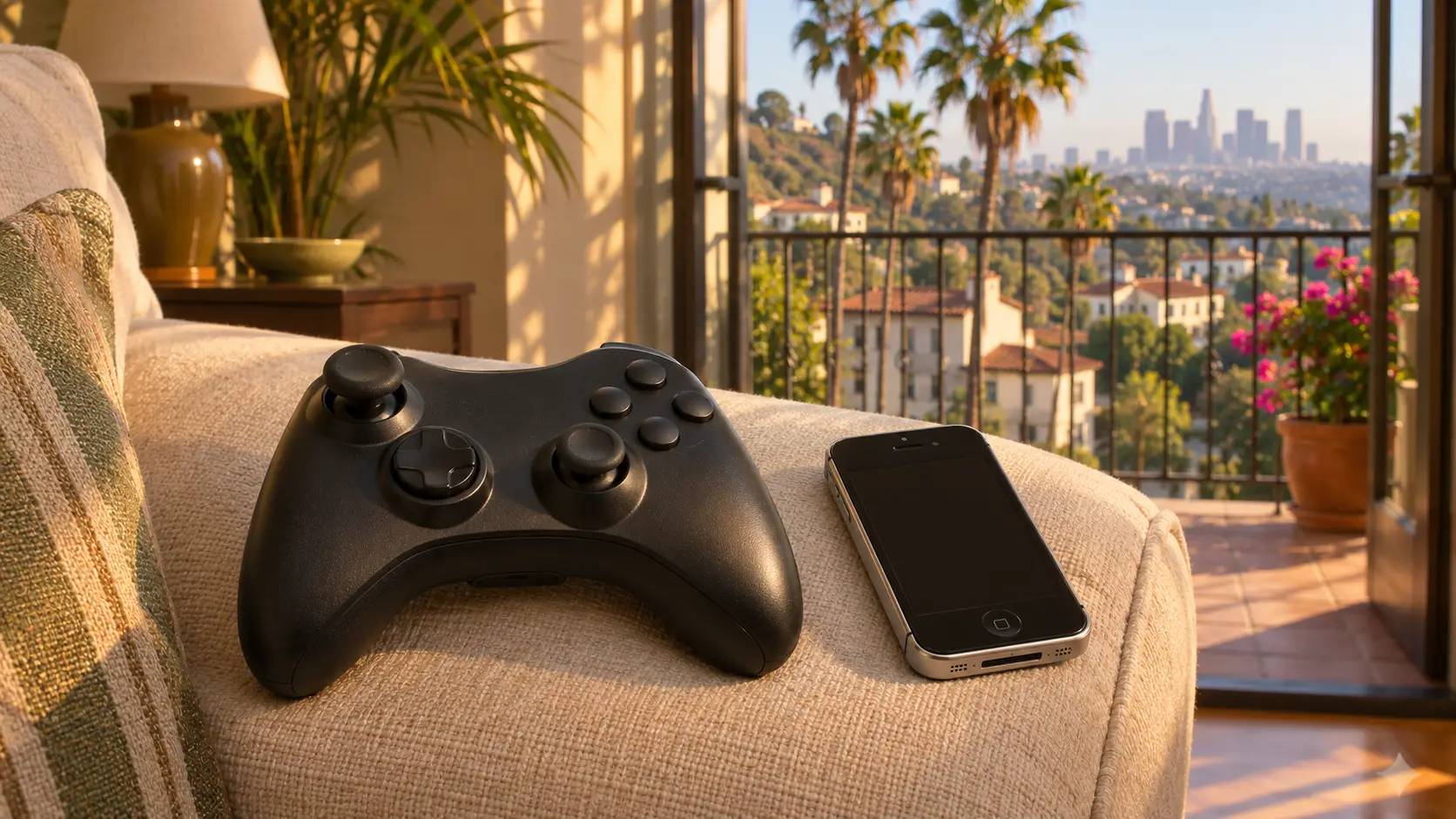
GTA 5 arrived before OpenAI existed and more than nine years before ChatGPT. AI could already beat quiz champions, recommend your next film and write a baseball report. The game's launch date captures a turning point when familiar services were getting smarter and deep learning was starting to show its potential.
Rockstar released Grand Theft Auto V on September 17, 2013, for PlayStation 3 and Xbox 360. Siri had been part of the iPhone for almost two years, while researchers were building on an image-recognition breakthrough achieved with gaming graphics cards.
Our recent experiment asking four AI models to predict GTA 6's story offers a useful reason to rewind. Here is what someone could actually use, and what researchers had demonstrated, when GTA 5 reached players.
Your phone could already answer back
Apple introduced Siri with the iPhone 4S in October 2011. By GTA 5's launch, asking a phone to set a reminder, send a message or check the weather was an established possibility. Siri could also use information such as a contact's name or the user's location to act on a request.
Google was exploring a more proactive approach. Google Now, announced in June 2012, showed cards with useful information: traffic before the commute, the weather before leaving home or a favorite team's score.
Other AI systems worked quietly inside familiar products. Netflix reported in 2012 that 75 percent of viewing came from some form of recommendation. Its algorithms helped decide which films and series each member would encounter.
Google Translate already supported more than 70 languages by May 2013. It used statistical patterns to translate words and phrases. Google would begin deploying its new neural translation system in 2016, initially for Chinese to English.
Some demonstrations were more spectacular. IBM Watson had beaten Ken Jennings and Brad Rutter at Jeopardy! in February 2011, answering naturally phrased questions without an internet connection during the contest. Google's experimental self-driving fleet had logged more than 300,000 test miles by August 2012, with employees able to take over at the wheel.
Two gaming graphics cards helped change image recognition
The researchers behind AlexNet had delivered a major result the previous year. Alex Krizhevsky, Ilya Sutskever and Geoffrey Hinton used deep neural networks to identify objects in photographs, winning the 2012 ImageNet competition.
Their winning entry recorded a top-five error rate of 15.3 percent, against 26.2 percent for the runner-up. In that measurement, an answer counted as correct if the right category appeared among the system's five predictions.
The hardware detail makes the result especially striking from a gaming perspective. Training one of the networks took roughly five to six days on two Nvidia GTX 580 graphics cards, each with 3 GB of memory. The best competition result combined several networks.
GPUs could carry out many calculations in parallel, making them useful for the demanding mathematics of neural networks. Our guide to why GPUs became central to AI explains that connection between graphics hardware and machine learning.
Google's famous cat experiment explored another part of the problem. In 2012, researchers trained a large neural network on unlabeled images from YouTube videos. One part of the network learned to respond strongly to cats, even though nobody had supplied cat labels during training.
That experiment used 16,000 processor cores. Learning from unlabeled material offered a way to use huge collections of images without first asking people to annotate each one.
Computers were already writing match reports
Northwestern University's StatsMonkey project could turn baseball data into a written report. Developed in 2009, it used box scores and play-by-play information to identify important players, key moments and suitable story angles.
That involved editorial choices about which events deserved attention. Its abilities depended on a defined subject and structured match data, giving it a much narrower remit than an open-ended writing assistant.
Neural networks were generating content too. In August 2013, researcher Alex Graves published research demonstrating a system that generated text and realistic handwriting. It could produce handwriting based on a supplied text sequence, with different writing styles.
Researchers were also improving how computers represented words. The word2vec research published in 2013 described efficient ways to represent words as lists of numbers, allowing relationships and similarities to appear in that mathematical space. It helped researchers work with language patterns at scale.
Read also

OpenAI and the transformer were still in the future
Several names now associated with AI had yet to become part of the story. OpenAI did not exist. DeepMind was still independent; it joined Google in 2014.
Even within 2013, the date matters. DeepMind's influential Atari paper came later that year. The following milestones show how much of the technology associated with today's chatbots developed after GTA 5 arrived.
| Milestone | When it followed |
| DeepMind's Playing Atari with Deep Reinforcement Learning paper | Submitted to arXiv on December 19, 2013 |
| OpenAI's public introduction | December 11, 2015 |
| The transformer paper, Attention Is All You Need | First submitted on June 12, 2017 |
| The work behind the first GPT model | June 11, 2018 |
| DALL·E's introduction | January 5, 2021 |
| ChatGPT's launch | November 30, 2022 |
ChatGPT eventually put a conversational interface in front of a broadly useful language model. As early reactions to its launch show, even then its appeal was not obvious to everyone.
There is one particularly fitting footnote to GTA 5's release day. On September 17, 2013, Tomas Mikolov, Quoc Le and Ilya Sutskever submitted a paper on connecting word representations across languages. They were investigating how those connections could help expand dictionaries and translation tables.

Popular news
OpenAI Launches GPT-6.2 Astra and Sol for ChatGPT Work, Codex and the API
Fed Governor Warns AI Agents Could Accelerate Bank Runs
Tencent Launches Hy4 Flash With Lower API Prices for Everyday AI Work
Microsoft Brings MAI Code 2 and MAI Code 2 Flash to GitHub Copilot
Ollama Not Using Your GPU? A Step-by-Step Troubleshooting Guide