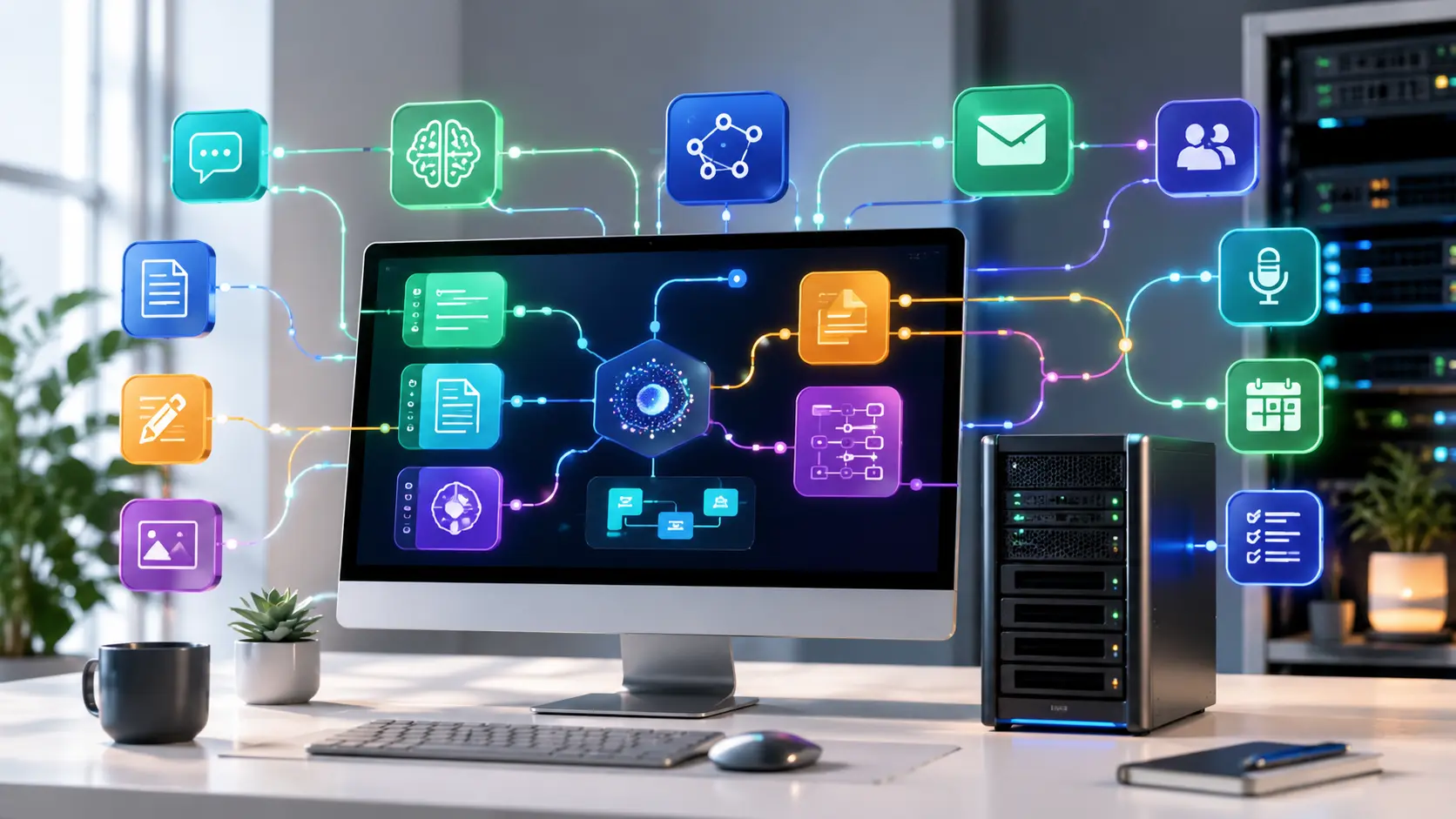
Odysseus AI is a free, open-source workspace that brings chatbots, AI agents, research tools, documents, email and local language models into one self-hosted interface.
The project attracted unusual attention because one of its creators is Felix Kjellberg, better known as PewDiePie. However, Odysseus is more than a celebrity-branded chatbot. It represents a growing movement among AI users who want powerful assistants without handing every document, email and conversation to a large technology company.
Instead of accessing Odysseus through a conventional cloud subscription, users install the software on their own computer or server. They can then connect local AI models, commercial APIs or a combination of both.
That distinction is also its biggest advantage—and its biggest complication.
What is Odysseus AI?
Odysseus is a self-hosted AI workspace released as open-source software under the AGPL-3.0 license. Its interface combines several functions that would normally require separate applications:
- AI chat and custom agents
- Persistent memory
- Multi-step web research
- Document creation and editing
- Email management
- Notes, tasks and calendars
- Model comparison
- Image tools
- Local speech-to-text and text-to-speech
- Scheduled AI tasks
- Connections to tools through MCP
According to the project’s official GitHub repository, users can connect both locally hosted and API-based AI models. Supported options include local inference tools such as Ollama, llama.cpp and vLLM, as well as services that provide OpenAI-compatible endpoints.
Odysseus therefore is not a new foundational model competing directly with GPT, Claude, Gemini or Meta’s Llama models. It is an interface and orchestration layer that lets users decide which models process their requests and where those models run.
A simple way to understand it is:
ChatGPT provides the interface, models and cloud infrastructure. Odysseus provides a workspace in which you choose and control the models and infrastructure.
Did PewDiePie create Odysseus?
Odysseus was launched by PewDiePie, whose real name is Felix Kjellberg, at the end of May 2026.
Kjellberg is best known for building one of YouTube’s largest channels, but he has increasingly discussed Linux, self-hosting and local AI. Odysseus turns those interests into a public software project developed alongside an open-source community.
The creator framed it as a challenge to recurring subscriptions and centralized AI platforms. Users can download, modify and host the software themselves instead of depending on a single provider.
That message helped Odysseus spread far beyond the usual open-source AI community. As of August 19, 2026, its GitHub repository displayed approximately 85,700 stars—an exceptionally large audience for such a young self-hosted project.
The popularity does not automatically mean that the software is mature. The repository still lacks conventional packaged releases, while its default development branch receives frequent changes. Users who value stability are advised to use the more curated main branch rather than the rapidly changing dev branch.
What can Odysseus do?
The central feature is a familiar AI chat interface, but Odysseus expands that interface into a broader productivity environment.
Chat with local and cloud models
Users can connect Odysseus to a model running on their own hardware. Someone with Ollama installed, for example, can use a compatible open or open-weight model without sending the conversation to an external model provider.
Alternatively, users can connect cloud APIs when they need a larger or more capable model. This makes it possible to use a local model for private everyday tasks while reserving frontier models for more demanding work.
This choice is more important than the Odysseus interface itself. The selected model determines most of the system’s writing quality, reasoning ability, coding performance, speed and hardware requirements. Odysseus can give a model memory and tools, but it cannot turn a modest local model into a frontier model simply by placing it inside a better-looking workspace.
Create AI agents
Odysseus agents can access tools, files, memory, web search and shell commands. Depending on the permissions supplied, an agent can locate files, edit documents, run code, convert formats or conduct online research.
This is more powerful than ordinary question-and-answer chat, but it also introduces additional security risks. An agent with access to a computer’s files or command line should not be treated like a harmless chatbot. Our guide to prompt injection and advanced AI security threats explains how malicious instructions inside a webpage, email or document can try to redirect an agent.
Conduct deep research
Its research system can break a subject into multiple steps, search the web, read sources and assemble a report.
This makes Odysseus comparable to deep-research features offered by commercial AI platforms. The difference is that the workspace and research history can remain on infrastructure controlled by the user. Search queries and webpages may still pass through external search services, however, and the quality of the finished research continues to depend on the model, sources and verification process.
Work with documents and email
Odysseus includes an editor for text, Markdown, HTML, CSV and code. AI can propose changes or help create and reorganize content inside the workspace.
It can also connect to email through IMAP and SMTP. Available functions include inbox summaries, tagging, reminders and draft replies.
Email integration is potentially useful, but users should configure it carefully. Self-hosting an interface does not eliminate the security implications of giving an AI agent access to an inbox.
Compare AI models
The Compare feature places model answers side by side and can conceal which model produced each response. It can then synthesize the competing answers. This allows users to judge output without being influenced by the model’s brand.
For people experimenting with local models, this can help determine whether a smaller model is sufficient—or whether a paid API still produces meaningfully better results.
Build persistent memory around your own work
A conventional chatbot usually knows what is inside the current conversation and whatever memory its provider chooses to make available. Odysseus can maintain its own persistent memory and retrieve relevant context across sessions.
That means a user can gradually build an assistant around recurring projects, preferences, notes and documents. The value is not that the underlying model permanently learns new weights from every interaction. Instead, Odysseus stores information and retrieves the relevant pieces when a new task needs them.
This distinction matters. Retrieval can make an assistant feel more consistent and personal, but retrieved memories can still be incomplete, outdated or irrelevant. Users should not assume that persistent memory gives a model perfect knowledge of their work.
Choose models based on your hardware
The Cookbook feature helps users browse compatible models and quantized variants and assess them against the available hardware. Quantization reduces the memory required to run a model, usually with some trade-off in output quality.
This makes local AI more approachable than manually searching model repositories and guessing which file will fit. A small quantized model may run on an ordinary computer, while a larger model can require substantial system memory or a capable GPU. Odysseus organizes that decision; it does not remove the underlying compute requirement.
Schedule recurring work
Notes, tasks, calendars and scheduled agents allow Odysseus to operate as more than a chat window. A user could configure recurring research, reminders or information-processing tasks, provided the server remains online and the necessary models and external services remain available.
This is close to the direction commercial platforms are taking with autonomous and always-on assistants. The major difference is operational responsibility: with Odysseus, the user runs the machine, maintains the integrations and decides which permissions the agent receives.
Connect tools through MCP
Odysseus supports the Model Context Protocol, commonly shortened to MCP. The protocol gives compatible AI applications a standardized way to discover tools and data sources.
In practical terms, MCP can let an Odysseus agent communicate with an external service without every integration being built directly into the core application. That expands what the workspace can do, but every connected server also creates a new trust boundary. Users should verify what an MCP server can read, change or execute before enabling it.
Odysseus is not a model: how it relates to Llama, Ollama and ChatGPT
The terminology around local AI is confusing because products from different layers are regularly compared as though they do the same thing. Odysseus, Llama, Ollama and ChatGPT occupy different positions in the stack.
| Name | What it is | What it provides |
| Odysseus | Self-hosted AI workspace | Interface, agents, memory, research, documents, integrations and model routing |
| Llama | Family of AI models from Meta | The underlying language and reasoning capabilities when a Llama model is selected |
| Ollama | Local model runtime and server | Downloads and runs compatible models, then exposes them to apps such as Odysseus |
| llama.cpp or vLLM | Model inference software | Runs and serves models with different hardware and performance priorities |
| ChatGPT | Hosted AI product from OpenAI | OpenAI models plus a managed interface, memory, tools, files, research and cloud infrastructure |
| Claude | Hosted assistant and model family from Anthropic | Anthropic models plus managed chat, projects, research, artifacts and coding tools |
| MCP | Open integration protocol | A common method for AI applications to connect with tools and data sources |
One possible local setup therefore looks like this:
Llama supplies the model → Ollama runs that model → Odysseus supplies the workspace, memory and tools.
If a user replaces Llama with a compatible DeepSeek, Mistral or Qwen model, Odysseus remains the workspace. Our practical guide to running DeepSeek locally explains the same fundamental separation between a model, a runtime and the application placed on top.
Odysseus can also connect to a commercial API. In that configuration, it becomes a self-hosted front end for a remote model. A user could gain Odysseus’s documents, memory and workflow while still relying on an external provider for the actual inference.
Is Odysseus open source in the same way as Llama?
Not quite.
The Odysseus application is published under the GNU Affero General Public License version 3. Its source code can be inspected, modified and redistributed under the conditions of that license.
Llama concerns the model itself, including its weights and accompanying software. Meta makes Llama weights broadly available, but the models are governed by Meta’s own community license and acceptable-use terms. That is why Llama is often described more precisely as “open weight” rather than fully open source. We examine the distinction in Is Llama Open Source? What Meta’s License Actually Allows.
Running Llama inside Odysseus does not change Llama’s license. The workspace remains AGPL-licensed, while the selected model retains its own license and restrictions. Every model should therefore be checked separately, particularly before commercial deployment.
What can Odysseus do that a normal chatbot cannot?
Odysseus does not possess a secret intelligence unavailable elsewhere. Its advantage is that it combines model choice, user-owned context and action-taking tools in one environment.
Here are several workflows that illustrate the difference.
A private document assistant
A user can run a local model, add private documents, retrieve relevant passages and draft summaries or revisions without intentionally sending the material to a model company’s API. This can be attractive for personal archives, unpublished writing, confidential notes or early-stage business documents.
Accuracy and confidentiality still require controls. The machine, backups, integrations and network must be secured, while model output should be verified.
A mixed local-and-frontier workflow
A user might process sensitive notes with a local model, compare the answer with a stronger cloud model after removing confidential details, and use Odysseus to synthesize the results.
This is harder to reproduce in a single-provider chatbot because the product normally decides which models and infrastructure are available. Odysseus lets the user make that routing decision.
An agent that works across files and tools
Rather than repeatedly copying information into a chat window, an Odysseus agent can be given permission to search a folder, read selected files, perform a conversion, update a document and record a task.
Commercial products increasingly offer similar agent functions. The difference is not that Odysseus invented agentic work, but that the user can inspect and modify the workspace and choose where it runs. That aligns with a wider principle we discussed in Want Control of AI Agents? Start with Your Infrastructure.
A personal model laboratory
The blind comparison interface makes Odysseus useful for testing. A developer or writer can send the same task to several local and cloud models, judge them without labels and see whether an expensive model genuinely adds value.
For many tasks, a smaller model may be sufficient. For complex research, coding or reasoning, a frontier API may still win decisively. Odysseus makes that trade-off visible instead of forcing one provider’s model hierarchy on the user.
A workspace that can survive a provider decision
If a commercial chatbot changes its price, removes a feature, restricts a model or closes an account, the customer has limited control. A self-hosted workspace reduces that dependency because the application and stored context remain under the user’s control.
The selected cloud API can still disappear, and an open-source project can also become abandoned. But model portability makes it easier to replace one backend without rebuilding the entire working environment.
Do not expect Odysseus to outplay everything you know about AI
Odysseus deserves attention, but it should not be treated as a magical ChatGPT killer.
A workspace does not automatically improve the intelligence of the model inside it. If the same Llama model is run through Odysseus and another well-configured interface, its fundamental knowledge and reasoning ability remain broadly the same. Memory, retrieval, prompts and tools can make the workflow much more useful, but they do not secretly create a larger or better-trained model.
In fact, many people who install Odysseus on ordinary hardware will initially use a local model that is less capable than the strongest versions of GPT, Claude or Gemini. Large AI companies spend enormous sums on model training, inference infrastructure, safety systems, product design and reliability. A young community project is unlikely to immediately outperform all of that in every category.
Users should expect trade-offs:
- A smaller local model may hallucinate more or follow complex instructions less reliably.
- Installation and updates can break in ways a managed web app generally does not.
- Local inference may be slow without suitable hardware.
- Mobile access, integrations and account recovery require more work.
- There is no guaranteed enterprise support desk or service-level agreement.
- Giving agents shell, email or file access creates serious security responsibilities.
- The newest development branch may change faster than documentation can keep up.
Someone seeking the simplest polished assistant should compare Odysseus with the products in our guide to the best ChatGPT alternatives. Odysseus is strongest when ownership, experimentation and control matter more than convenience.
You can criticize open-source software—but judge it in context
It is tempting to say that nobody can complain about a free open-source project. That is not completely right. Security weaknesses, confusing documentation and broken features still matter, especially when software can access private files, email and shell commands. Constructive criticism is how open-source projects improve.
But the context does matter.
Odysseus does not charge users for the application and then lock its implementation behind a private service. It publishes the code, gives people permission to run their own copy and provides a route for developers to inspect problems, file issues or propose improvements. It does not owe every user the polish and support of a multibillion-dollar subscription company on its first attempt.
That changes the most useful response to a flaw. Instead of only saying that a feature is bad, a user can document the failure, submit a reproducible bug report, improve the instructions, test a fix or contribute code. Not everyone has the skills or time to do that, but the possibility itself distinguishes an open project from a closed product.
Open source is not entitled to a free pass. It deserves a fair test—and criticism that recognizes what is being offered.
Is Odysseus AI really private?
Odysseus can be considerably more private than a conventional cloud chatbot, but only when it is configured accordingly.
If the application and model both run locally, prompts, files and generated answers can remain on the user’s own hardware. That is the strongest privacy configuration.
However, self-hosting the Odysseus interface while sending requests to an external API does not make those requests local. The API provider still receives whatever is included in the request and applies its own data-retention terms. Users considering cloud models should review our broader explanation of ChatGPT privacy and security alongside the terms of their chosen provider.
Privacy therefore depends on the complete data path:
| Configuration | Where the workspace runs | Where prompts are processed |
| Odysseus with a local model | Your hardware | Your hardware |
| Odysseus with a cloud API | Your hardware | External provider |
| Mixed configuration | Your hardware | Locally or externally, depending on the selected model |
Users should also consider backups, search providers, email connections and other integrations. A local-first application can still send information elsewhere when external services are enabled.
Is Odysseus free?
The Odysseus software itself is free and open source.
That does not guarantee that using it costs nothing. Local models require suitable hardware and electricity, while commercial model APIs charge according to their own pricing. Web-search providers and other connected services may also require paid accounts.
Running a smaller model through Ollama on hardware someone already owns can be inexpensive. Running large models locally may require a powerful GPU, substantial memory and technical maintenance.
Odysseus removes the mandatory platform subscription. It does not remove the underlying cost of AI computation.
How to install Odysseus AI
The project recommends Docker for the quickest installation. The official quick-start instructions are:
git clone https://github.com/odysseus-dev/odysseus.git
cd odysseus
cp .env.example .env
docker compose up -d --build
Once the containers are running, the interface is available at:
http://localhost:7000
The initial administrator password appears in the Odysseus container logs. More detailed Windows, macOS, GPU and native installation instructions are available in the project’s official setup guide.
The core native application requires Python 3.11 or newer. On Windows, the documentation describes Ollama as the easiest route for running a local model, while GPU serving through vLLM or SGLang generally requires Linux or WSL2.
Odysseus is therefore accessible to technically confident users, but it is not yet as simple as creating a ChatGPT account and opening a browser tab.
Odysseus AI versus ChatGPT
| Feature | Odysseus AI | ChatGPT |
| Hosting | Self-hosted | OpenAI cloud |
| Models | Local models and selected APIs | OpenAI models |
| Subscription required | No | Free and paid plans |
| Setup | Technical installation required | Immediate |
| Data control | Depends on user configuration | Depends on OpenAI plan and settings |
| Maintenance | User-managed | Managed by OpenAI |
| Customization | Extensive and open source | Limited to platform features |
| Support | Community-driven | Commercial product support |
ChatGPT is easier to start using and provides direct access to OpenAI’s frontier models. Odysseus offers considerably more control, but the user becomes responsible for installation, updates, model selection, authentication and security.
For most mainstream users, ChatGPT remains more convenient. For developers, privacy-conscious professionals, homelab enthusiasts and organizations experimenting with local AI, Odysseus offers something the major hosted platforms cannot: ownership of the workspace itself.
Read also

Is Odysseus AI safe?
Odysseus can be deployed safely, but self-hosting transfers responsibility from a commercial provider to the user.
The project explicitly advises users to keep authentication enabled, avoid placing private information in Git repositories and never expose unprotected model or service ports to the public internet. The settings AUTH_ENABLED=true and LOCALHOST_BYPASS=false are particularly important when the installation is accessible over a network.
Extra caution is necessary when agents receive access to shell commands, email or personal documents. AI models can misunderstand instructions and may be vulnerable to malicious content encountered in files, emails or webpages.
Self-hosted does not mean automatically secure. It means the user controls—and must protect—the system.
Who should use Odysseus?
Odysseus is particularly interesting for:
- People already running a home server or NAS
- Developers testing different open AI models
- Users who want their conversations and memory stored locally
- Organizations exploring private AI workspaces
- Researchers comparing local and commercial models
- People trying to reduce dependence on multiple AI subscriptions
It is less suitable for users who want a completely maintenance-free assistant or who are uncomfortable with Docker, API keys and server security.
Why Odysseus and open-source AI should be celebrated
The limitations do not diminish what Odysseus represents. They are precisely why the project is worth celebrating without pretending it has already beaten every commercial platform.
Open-source AI may offer the healthiest long-term direction for users, developers and societies because it distributes control. It lets people inspect the software that mediates their work, run it in different jurisdictions, adapt it to local needs and preserve access when commercial priorities change.
That can produce several public benefits:
- Competition: users are less dependent on a handful of companies deciding prices, models and acceptable use.
- Privacy and sovereignty: individuals and organizations can keep some workloads on infrastructure they control.
- Auditability: researchers and developers can inspect application code instead of relying entirely on marketing claims.
- Adaptability: communities can translate, modify and extend software for needs a large vendor may never prioritize.
- Resilience: an open project can be forked or maintained elsewhere if its original team stops development.
- Education: people can study how memory, agents, retrieval and model routing work in a real application.
- Interoperability: open standards and replaceable models reduce the risk of one provider owning the full AI stack.
Open source does not guarantee fairness, safety or permanence. Projects need maintainers, security reviews, documentation and sustainable funding. Public code can still contain vulnerabilities, and local deployment can be misconfigured. Even an open workspace may depend on model weights governed by more restrictive licenses.
But those are reasons to invest in the ecosystem, not to dismiss it.
Odysseus gives a huge nontechnical audience a tangible demonstration that an AI workspace does not have to belong entirely to OpenAI, Google, Anthropic or Microsoft. Even users who never install it benefit from the competitive pressure created when a credible alternative can be downloaded, studied and changed.
Frequently asked questions
Does Odysseus have its own AI model?
No. Odysseus is an AI workspace, not a foundational model. It connects to local models or external model APIs and adds an interface, agents, memory, research and productivity tools around them.
Can Odysseus run Llama?
Yes, a compatible Llama model can be served through a supported local runtime such as Ollama, llama.cpp or vLLM and then connected to Odysseus. Hardware requirements depend on the chosen model size and quantization.
Can Odysseus run completely offline?
Core chat and document workflows can operate locally when the model also runs locally. Features that depend on web search, cloud APIs, email synchronization or online calendars require network access. Installation and model downloads generally require an internet connection first.
Is Odysseus better than ChatGPT?
Odysseus offers more control, model choice and self-hosting freedom. ChatGPT is easier to use, fully managed and directly connected to OpenAI’s strongest models and product infrastructure. The better option depends on whether the user prioritizes ownership or convenience.
Does local AI always keep data private?
No. Data can still leave the machine through cloud-model APIs, search providers, email connections, telemetry in related tools, remote backups or insecure network exposure. Privacy depends on every component in the workflow.
Can a business use Odysseus?
Technically, yes, but a business should evaluate the AGPL license, the separate license of each model, authentication, patching, backups, access controls, logging, support requirements and regulatory obligations before deployment.
The bigger significance of Odysseus AI
Odysseus matters because it packages several open-source AI trends into a product that ordinary technology enthusiasts can understand.
Local models already existed. Self-hosted chat interfaces already existed. AI agents, memory systems and document tools already existed. Odysseus combines those pieces into a single workspace—and PewDiePie’s enormous reach introduced the idea to an audience that might never have encountered projects such as Ollama or Open WebUI.
Its real competitor may not be ChatGPT itself. It is the assumption that useful AI must always arrive as a subscription attached to somebody else’s cloud.
Odysseus is not as polished or effortless as the largest commercial platforms, and users should be careful not to confuse local installation with automatic privacy, security or superior intelligence. It may never outperform every closed platform on every task. That is not the only standard by which it should be judged.
It demonstrates that an increasingly capable AI workspace can belong to the person running it. Its code can be studied. Its models can be changed. Its weaknesses can be reported and improved in public.
For a young open-source project, that may be the most important part of the story—and more than enough reason to celebrate it.

Latest comments
Loading