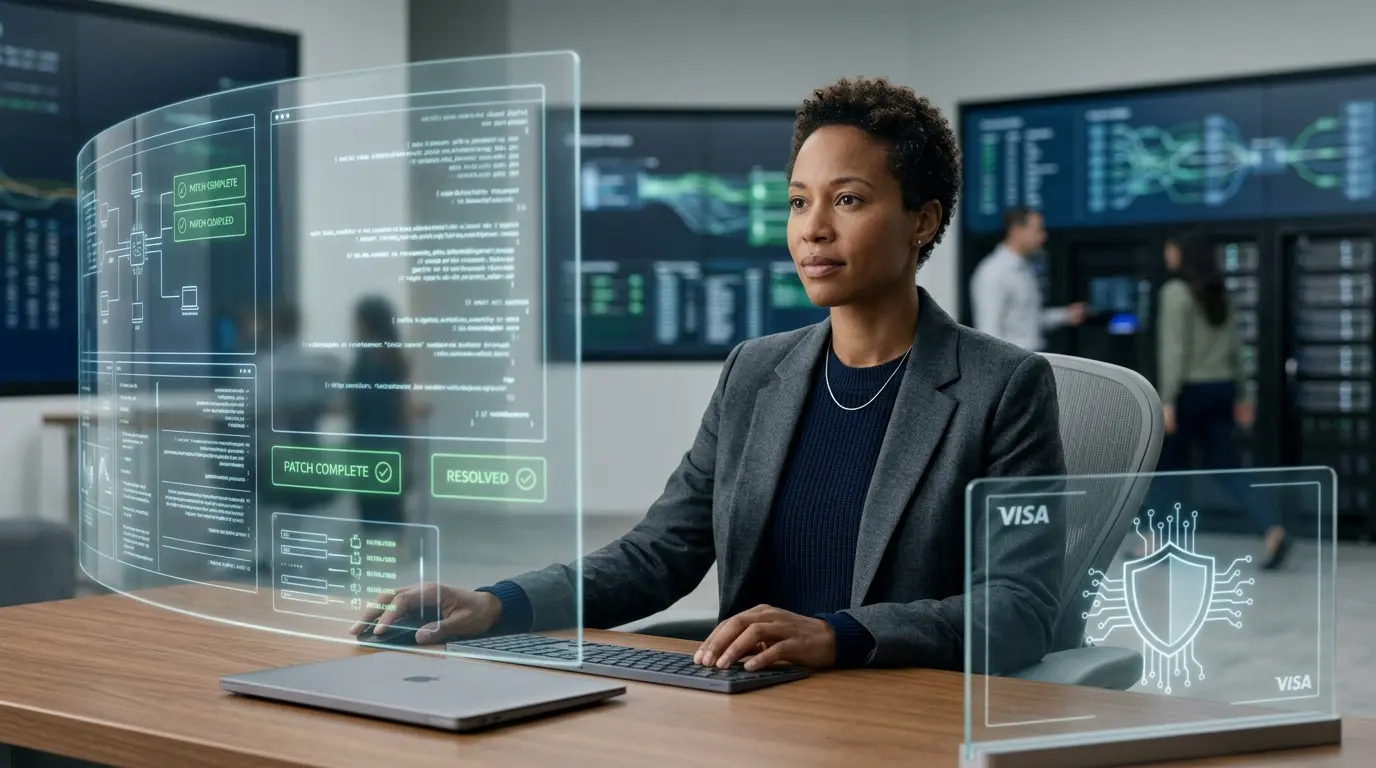
Visa now employs autonomous AI agents to repair software vulnerabilities instantly. This shift toward agentic security enables the payment giant to identify and fix coding flaws without human assistance. By deploying these systems, Visa strengthens security across global networks.
Managing thousands of applications creates a massive surface area for potential attacks. Traditional scanning tools produce a high volume of alerts which overwhelm human security analysts. Autonomous agents solve this problem by triaging and fixing the issues without requiring a ticket for every small bug.
Accelerating Software Defense With Agentic AI
Software vulnerabilities often remain open because manual patching takes too much time. By using agentic AI, Visa reduces the window of opportunity for cybercriminals. These autonomous systems analyze code during development and apply fixes before hackers find an opening.
- Autonomous agents write code patches in real time.
- Security teams avoid manual backlogs by automating routine repairs.
- Financial data remains safer through constant, automated monitoring.
The automation software provider supplies Visa with the tools needed to secure thousands of applications. Instead of waiting for a security engineer to review an alert, the system creates a pull request automatically. This speed is essential for a company processing billions of transactions.
Providing developers with ready-to-use fixes streamlines the entire pipeline. Engineers no longer view security as a roadblock which slows down innovation. Instead, security becomes an integrated part of the building process.
Data Protection Through Proactive Automation
Cyber threats evolve quickly, meaning static defense tools are no longer sufficient. Agentic security represents a shift toward active, self-healing software environments. Visa is among the first major financial institutions to adopt this level of automation for security.
The software functions by understanding the context of a vulnerability within the codebase. The system then proposes a fix which aligns with existing coding standards. This ensures the repairs do not break other parts of the application.
- AI agents understand complex code logic to provide accurate fixes.
- Automation lowers the cost of maintaining secure software.
- Continuous updates prevent old bugs from resurfacing in new releases.
The integration of these agents allows for a continuous feedback loop between security and development teams. As the AI identifies and fixes problems, the system learns more about the specific coding patterns of the organization. This learning process leads to higher accuracy in remediation attempts.
By adopting autonomous security remediation, Visa ensures every new feature undergoes rigorous, automated safety checks. Implementing these tools helps Visa maintain trust with millions of cardholders. By removing the delay inherent in human-led security, the company stays ahead of potential data breaches.
| Category | Performance Impact |
| Resolution Speed | Vulnerabilities fixed in minutes |
| Manual Workload | Reduced by automating routine patches |
| Defense Type | Continuous proactive defense |
| Code Quality | AI-generated patches meet security standards |
Financial institutions face massive pressure to secure digital assets against sophisticated threats. Moving toward autonomous remediation allows companies to maintain high safety standards while accelerating the pace of software production. Other financial leaders are likely to follow Visa's lead as the technology proves effective.
The move signals a major change in how large corporations handle digital safety. By using large language models trained on secure coding practices, these systems understand how to rewrite risky code without introducing new errors. This precision allows Visa to scale software development without increasing risk levels.
source:

byDavid Porter

Loading