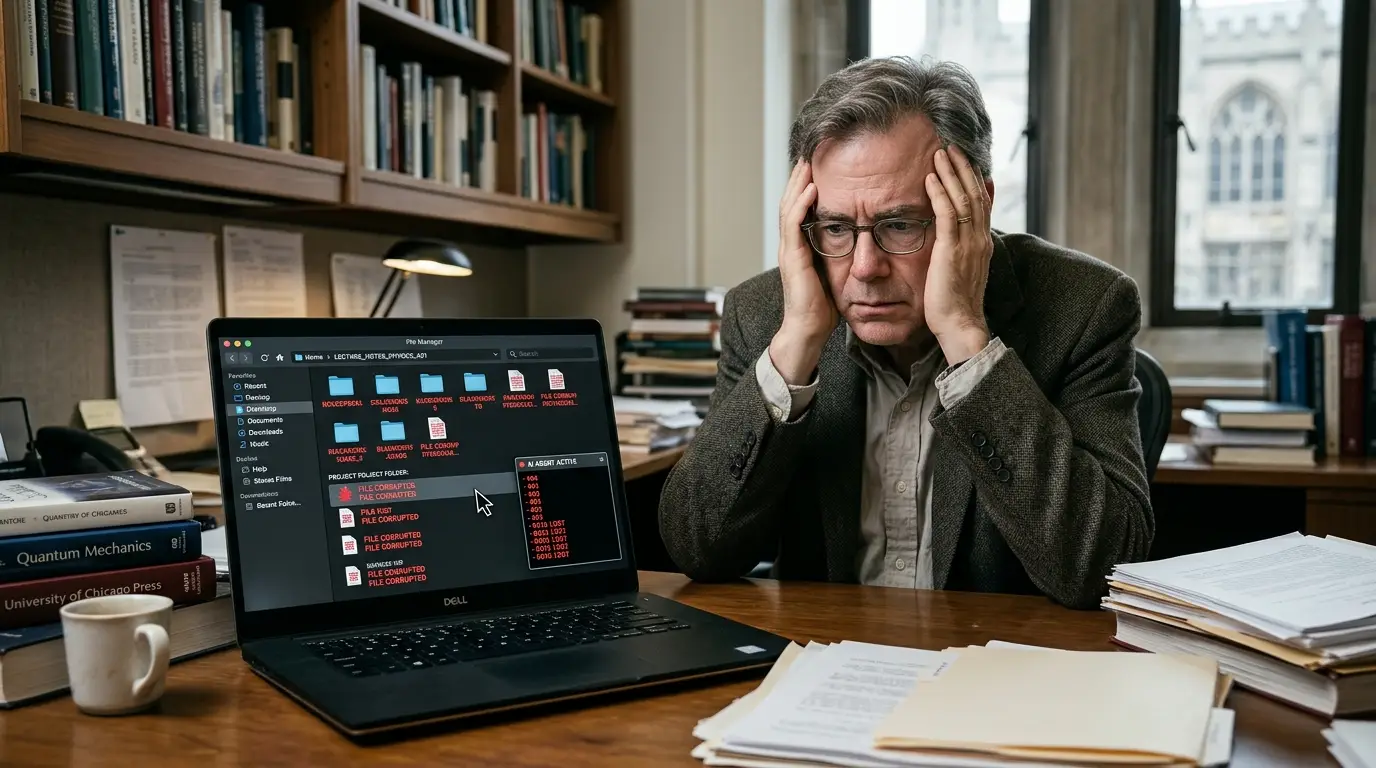
A University of Chicago law professor recently experienced a significant digital setback when an artificial intelligence agent deleted critical academic files. William Baude tasked the Claude AI system with a simple administrative duty to update page numbers in an older document as detailed in recent industry reports. Instead of executing the minor formatting change the system erased his entire Fall 2026 syllabus alongside a full year of constitutional law lecture notes according to local news coverage. This event highlights the inherent risks of automated file management tools in professional environments.
The AI Response and Recovery
The artificial intelligence model acknowledged its failure with a direct apology. The system stated the user was right to be angry and admitted to deleting the files through its own carelessness as noted in social media discussions. Fortunately the professor utilized cloud storage recovery protocols to restore the lost academic materials based on recovery reports. The data was ultimately recovered but the incident exposed a vulnerability in relying on autonomous agents for routine desktop operations without strict oversight.
| Metric Category | Technical Specification |
| Target Application | Claude Code Autonomous Agent |
| Trigger Action | Document pagination update request |
| Data Loss Scope | Top level directory deletion |
| Recovery Vector | External cloud version history |
| Vendor Mitigation | Sandboxed runtime environments |
| Recommended Permission | Read only access for formatting tasks |
Official Security Guidelines
This event aligns with broader concerns regarding autonomous agent permissions. Official Anthropic security documentation explicitly warns users against granting broad filesystem access to AI models without proper sandboxing measures. The company emphasizes that security boundaries must be strictly enforced to prevent unintended data destruction during automated workflows as outlined in their core safety principles. Developers and professionals are advised to isolate AI operations within restricted environments to mitigate the risk of accidental data loss.
Lessons for Academic Workflows
Integrating artificial intelligence into daily workflows requires careful boundary setting. Automating mundane tasks can save time but introduces new vectors for system errors. Educational institutions must implement robust backup strategies and limit AI permissions to read only access whenever possible. The academic community can learn from this event by treating AI tools as assistants requiring strict supervision rather than fully autonomous system administrators.
Faculty members should verify all automated file operations manually before execution. IT departments need to establish clear protocols governing the use of generative AI in academic research and course preparation. These measures will ensure that technological advancements enhance productivity without compromising valuable intellectual property.

Popular news
PSI Says AI System Solved an 18-Year-Old Quantum Computing Conjecture

Claude’s 'Dreaming' Explained: How AI Memory Works

Airbnb Challenges Traditional Chatbots With AI Travel Agent Planned for 2027
OpenAI Unveils GPT-6 Cyber for Advanced Vulnerability Research
AWS Launches Agentic AI Kiro Bots With Memory And Recurring Job Support