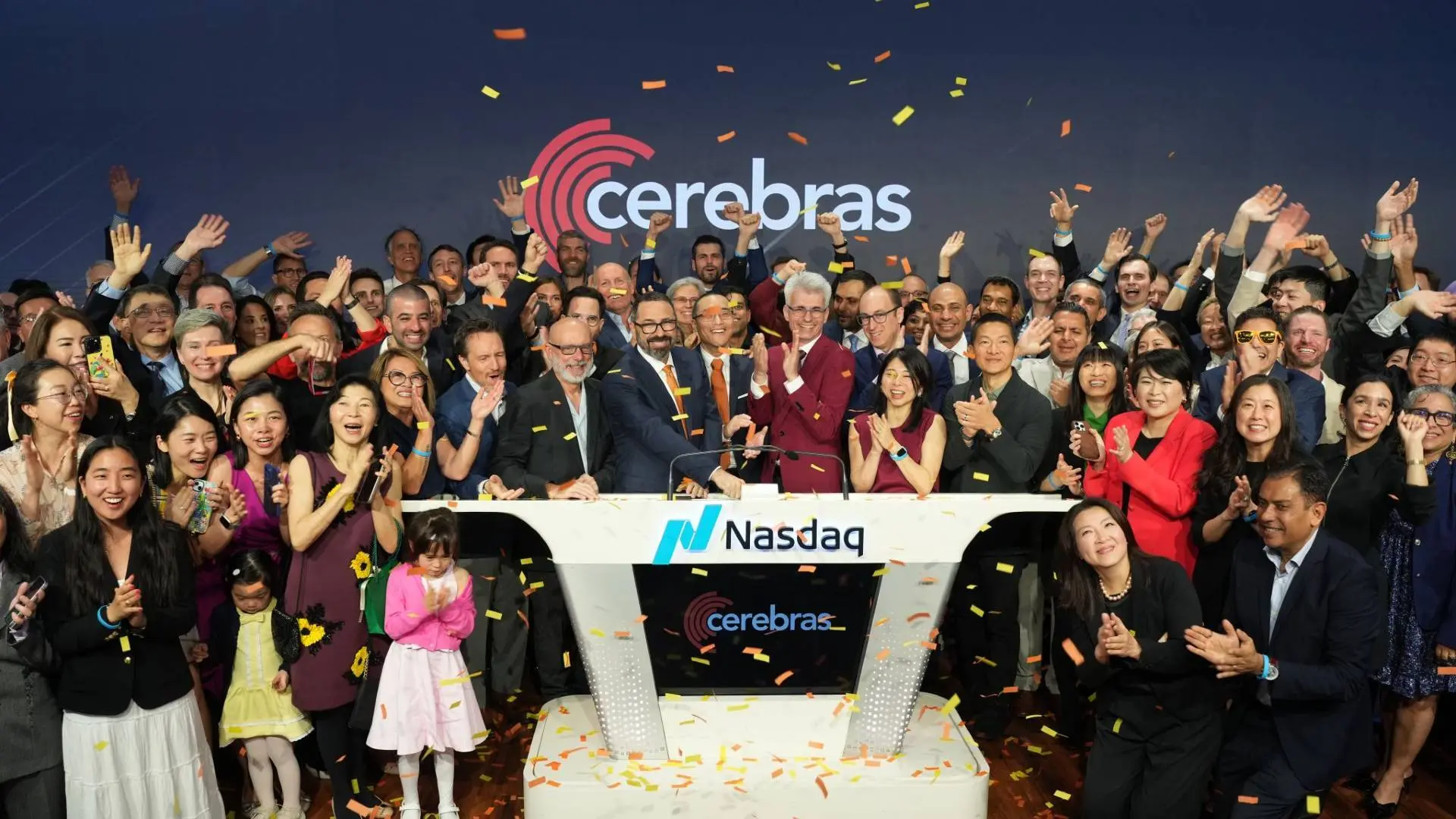
AI chipmaker Cerebras Systems surged 68% in its Nasdaq debut on Thursday, closing at $311.07, well above its IPO price of $185. The listing pushed its fully diluted market capitalisation to approximately $95 billion, according to CNBC. The listing arrives at a pivotal moment: as Big Tech pours record capital into AI infrastructure, investors are placing big bets on chipmakers capable of meeting that demand.
Cerebras, whose wafer-scale processors are designed to train and run AI models faster and more cheaply than conventional GPUs, has emerged as one of the few credible challengers to Nvidia in that race.
The Numbers Behind the Surge
The company sold 30 million shares in its initial public offering, raising $5.55 billion, making it the largest IPO for a US tech company since Uber's debut in 2019. Shares opened at $350, peaked at $386, and then drifted lower before closing at $311.07. If underwriters exercise their option to purchase an additional 4.5 million shares, total proceeds could climb to $6.38 billion, CNBC reported.
Cerebras narrowly missed joining Facebook-parent Meta and Alibaba as one of the few companies to end its first day on Wall Street with a market cap exceeding $100 billion.
Challenging Nvidia
Cerebras' most formidable competitor in hardware is Nvidia, the world's most valuable company. Cerebras claims speed and price advantages over Nvidia's graphics processing units due to architecture differences. In December, Nvidia paid $20 billion for assets from startup Groq, whose chips more closely resemble Cerebras', and months later announced plans for Groq-based products.
OpenAI struck a $20 billion multi-year deal with Cerebras in early 2026 for computing capacity and related services, a signal that hyperscalers are actively hedging their dependence on Nvidia by backing a broader field of chip alternatives.
Read also


But Cerebras is far from alone in taking aim at Nvidia. AI chip startups raised $8.3 billion in funding globally in 2026, as a growing crop of challengers bet that Nvidia's GPUs, originally designed for gaming and repurposed for AI, are not purpose-built enough for the demands of modern AI inference.
In the US, there have been $500 million funding rounds in 2026 for MatX, Ayar Labs, and Etched. In Europe, the challenge is gaining momentum too: Dutch startup Euclyd, U.K.-based Optalysys and Olix, British firm Fractile, and France's Arago are all fundraising or planning significant rounds, collectively targeting nine-figure sums, according to CNBC.
A Rocky Road to the Public Markets
The path to Thursday's listing was anything but smooth. In September 2024, Cerebras filed to go public, but withdrew its submission a little over a year later after its prospectus was heavily scrutinised, largely due to a heavy reliance on a single customer in the United Arab Emirates, Microsoft-backed G42. Cerebras refiled in April, and in its refreshed prospectus, the company said 24% of revenue last year came from G42, down from 85% in 2024. Revenue at Cerebras jumped 76% last year to $510 million.
Two New Billionaires
The tech billionaires club gained two new members after the IPO. Co-founder and CEO Andrew Feldman and technology chief Sean Lie now own stakes worth $3.2 billion and $1.7 billion, respectively. Feldman's stake of almost 10.3 million shares represents about 5.5% of the company, while Lie owns nearly 3%.
The IPO has also delivered handsome returns for early backers. Benchmark, which co-led Cerebras' Series A funding round in 2016, is sitting on shares worth $5.5 billion at Thursday's close, while Foundation Capital, another key early investor, holds a stake valued at $4.8 billion.
Opening the Floodgates for AI IPOs?
Cerebras is the biggest pure-play AI IPO to hit Wall Street and the first notable tech offering in months, as the market struggled to rebound from the downturn that began in 2022. But the listing could herald a wave of even larger offerings. SpaceX, OpenAI, and Anthropic, all at or near trillion-dollar valuations on the private market, are seen as potential candidates to go public later this year.
"We have tremendous opportunities for growth, and this was the right way to fund our growth," Feldman told CNBC after the listing.

Popular news

Latest comments
Loading