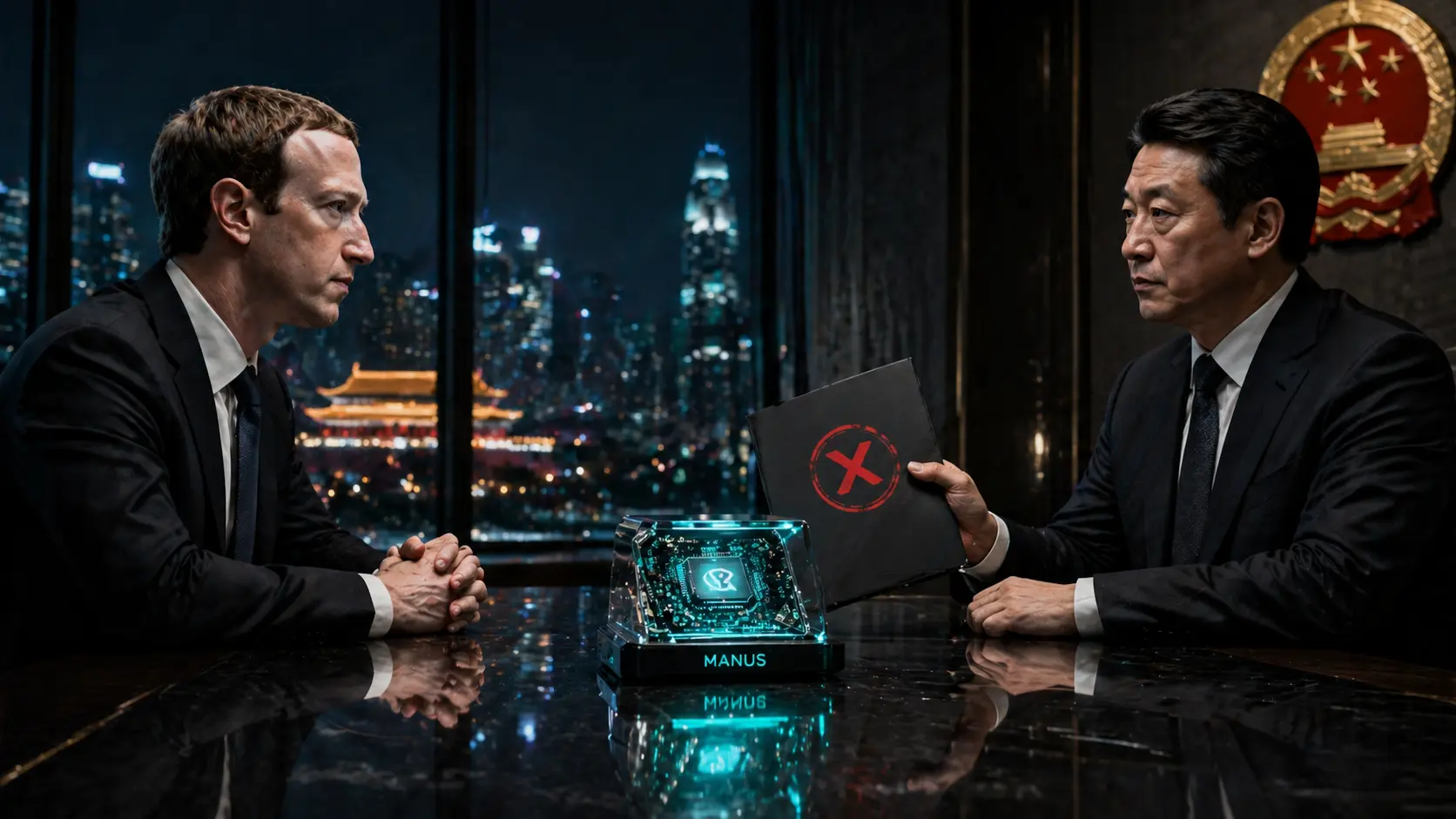
China’s regulator has blocked Meta’s multibillion-dollar acquisition of AI startup Manus, reports the Financial Times. The move comes months after the deal closed and puts pressure on one of Meta’s biggest AI bets to date. It highlights rising geopolitical tension around artificial intelligence and could ripple into European and Dutch AI strategies.
What exactly happened?
China has formally rejected the takeover. The National Development and Reform Commission has been probing the deal for months and sees potential national security risks. While there’s no detailed public reasoning, the concern clearly points to technology transfer to the United States.
Meta announced the Manus purchase in December, reportedly paying around $2 billion for the AI agent developer—one of Meta’s largest AI acquisitions so far.
The timing makes it messy: the deal is already closed and integrated:
- Manus employees now work at Meta
- The technology is embedded in Facebook, Instagram, and WhatsApp
- Products—like AI agents in chat apps—are partly live
Which raises a hard question: can China still unwind this deal?
Why is Manus strategically vital?
Manus builds AI agents that perform tasks via existing chatbots. These agents are programs that autonomously take actions based on user input, often powered by language models.
Manus’s tech works as a “layer” on top of existing AI systems, meaning:
- Users can automate complex tasks through chat
- Companies can speed up workflows without building their own AI
- Integrations with platforms like WhatsApp deliver instant value
That’s exactly why Meta cares: it supports the push to turn messaging platforms into productivity and AI hubs.
Why is China stepping in?
Beijing wants control over strategic tech. AI is seen as core to economic and military power. The key concerns:
- Technological sovereignty: stopping Chinese innovations from landing in U.S. hands
- Data security: preventing sensitive information from leaving China
- Competitive edge: protecting the domestic AI industry
It echoes past blocks on foreign takeovers in sensitive sectors, increasingly justified on national security grounds.
Can the deal still be reversed?
Legally, it’s uncertain. Manus is incorporated in Singapore, beyond China’s direct jurisdiction. Other factors still weigh in:
- The founders are Chinese
- Scrutiny focuses on the origin of the technology
- Political pressure can have indirect effects
Experts say a full rollback is unlikely. But China could impose constraints, such as:
- Export controls on technology
- Restrictions on Chinese staff
- Sanctions on collaboration
What does this mean for the Netherlands?
The Netherlands sits in the middle of the global AI contest. This case cuts directly into policy debates over technology, innovation, and dependency.
1. Europe’s strategic autonomy under strain
Europe aims to be less dependent on U.S. and Chinese AI. This episode shows how fragile that balance is. Dutch companies often rely on American platforms while also engaging with Chinese tech.
2. Impact on Dutch companies
Firms embedding AI into operations—often via Meta platforms—could be indirectly hit by geopolitical limits. Think about:
- Shifting access to AI features
- Compliance risks in cross-border work
- Uncertainty around data flows
3. A push to build AI at home
This could accelerate investment in European AI. The Netherlands is already focusing on:
- Public–private AI collaborations
- National AI strategies
- Innovation via universities and startups
What does this say about AI’s future?
AI is becoming a geopolitical lever. Mergers, investments, and tech exchange are increasingly under government scrutiny.
The headline trend: AI is no longer just tech or business—it’s a strategic power play.
For companies, that means:
- More regulation and oversight
- Tougher, more complex international deals
- A bigger role for politics in innovation
For users, that means:
- Less transparency about AI sources
- Possible feature limitations
- A more fragmented AI ecosystem
Read also

Conclusion
China’s block on Meta’s purchase of Manus marks a new phase in the global AI race. National interests increasingly trump market logic. Whether the deal is truly unwound remains unclear, but the signal is unmistakable: AI is strategic property.
For the Netherlands and Europe, the mandate is clear. To keep control over critical tech, invest in domestic AI capacity—and reduce reliance on foreign players.

Popular news

Anthropic Secures Thirty Two Billion Dollar Queensland Data Centre Deal for Claude

Zuckerberg Rejects AI Slowdown Calls Amid Industry Safety Debate

Crusoe Secures Nearly Four Billion Dollars to Scale Factory Built AI Data Centers

Amazon Secures Generac Stake in Massive Eight Billion Dollar Generator Pact

Spain Registers First End-to-End Autonomous AI Data Breach

MIT and Suffolk Unveil How AI is Reshaping Construction Productivity
Latest comments
Loading