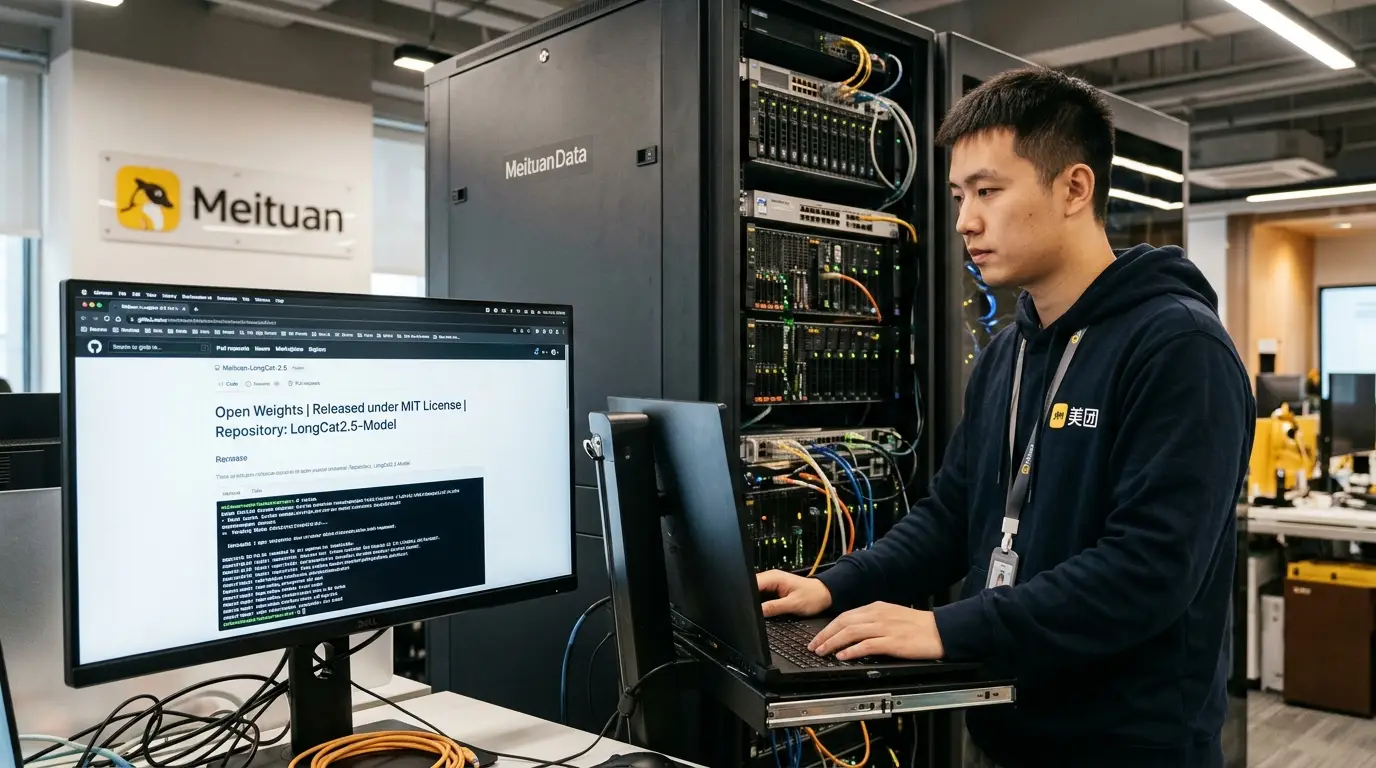
If you thought the open-source AI race was cooling down for the holidays, think again. As VentureBeat recently reported, Chinese tech giant Meituan just made its highly anticipated LongCat-2.5 model completely accessible to the public. Dropping the weights under a highly permissive MIT license just a week after its initial unveiling, this move instantly turns one of the most capable agentic coding models on the market into a playground for self-hosting enterprises and indie developers alike.
Rethinking Multimodal Architecture
Most large language models bolt on a vision encoder as an afterthought, but Meituan took a fundamentally different route. According to the official LongCat-2.5 technical blog, the system represents visual signals as multi-level discrete tokens. This allows the backbone to process images and text in a completely unified token-based format rather than relying on clunky diffusion adapters. The engineering team also heavily optimized the W4A4 inference pipeline specifically for domestic AI accelerators, achieving a massive 43% boost in prefill throughput compared to standard INT8 baselines. Under the hood, it is a Mixture of Experts (MoE) behemoth featuring 1.6 trillion total parameters, but it only activates about 48 billion per token to keep latency manageable during long context rollouts.
Sizing Up the Generational Leap
The real story here is how heavily the team leaned into long-horizon reinforcement learning. Instead of just feeding the model more pretraining data, they trained it on real-world agent failure trajectories and executable verification environments. During the RL scaling phase, the researchers actively filtered out zero-gradient groups and penalized repetitive reasoning to stop the model from overthinking simple prompts. They also completely disabled network access inside the training environments to prevent the agent from opportunistically cheating by searching the web for the answer. The resulting performance jump over its predecessor is staggering.
| Evaluation Metric | LongCat-2.0 Score | LongCat-2.5 Score | Generational Multiplier |
| DeepSWE v1.1 (Repo Engineering) | 9.7 | 64.6 | 6.6x |
| Terminal Bench v4.0 (CLI Automation) | 3.0 | 38.5 | 12.8x |
| 3DCodeBench (Text-to-3D Vision) | N/A | 55.4 | Native Vision Added |
| BrowseComp (Deep Web Research) | 79.9 | 91.9 | +12.0 pts |
| AutomationBench v1.0 (Office Work) | 15.8 | 65.1 | 4.1x |
Unleashing Agentic Workflows Locally
For teams building autonomous software engineers or GUI automation tools, having local access to this specific architecture is a massive deal. Developers can now pull the safetensors directly from the Meituan Hugging Face repository and run complex coding agents entirely behind their own corporate firewalls without paying exorbitant API fees. With a supported context window stretching up to one million tokens, the model can ingest an entire legacy codebase, map out the dependencies, and execute targeted refactoring jobs without losing track of the original architecture. This long-context retention is exactly what enterprise engineering teams need when deploying AI agents to maintain millions of lines of legacy code.
The model's native vision capabilities mean it can seamlessly take a screenshot of a broken UI, understand the underlying CSS, and write the patch in one continuous agentic loop. While it still slightly trails closed-source heavyweights like Claude Opus 5 when building entire greenfield repositories from a raw specification, it absolutely dominates in terminal automation, spreadsheet manipulation, and visual-to-code tasks. Dropping an MIT-licensed model of this scale forces every other lab to rethink how they gatekeep their best agentic tooling.

Popular news

Goldman Sachs Pulls the Plug on Vibe Coding for Traders
Australian STEM Game Competition Ends Over Generative AI Use

AI Stocks Rebound After Sharp Sell-Off as Nvidia, ASML and Chipmakers Recover

Anthropic Launches Claude Fable 5.2 and Cuts API Prices

AI firm Databricks invests half a billion dollars in the Netherlands and doubles its team