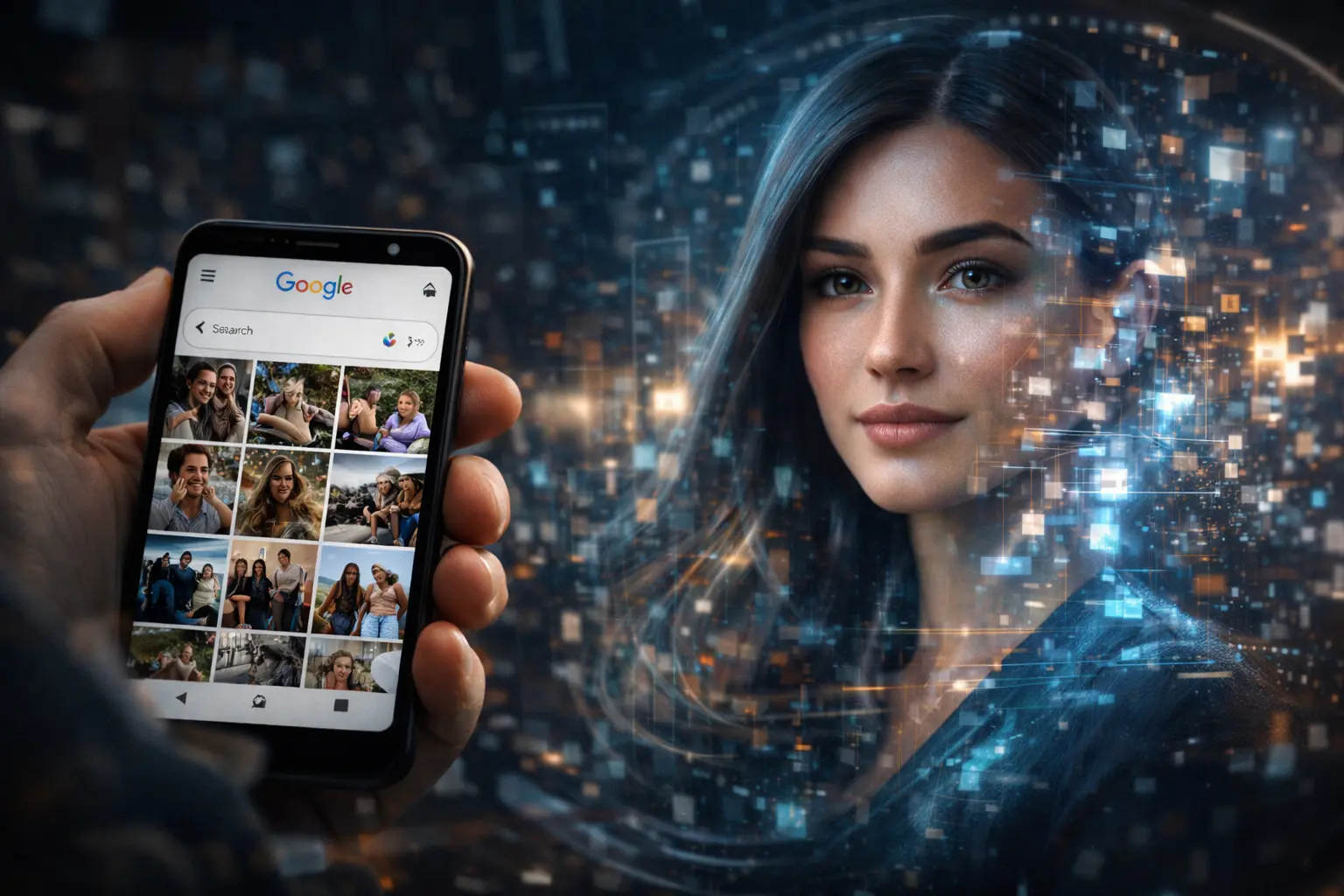
Google is rolling out a new Gemini feature that generates personalized images from your own photos. The update, currently U.S.-only, shows how fast personal AI is moving—and it immediately raises privacy stakes. The implications for Europe and the AI Act are significant.
The core of the announcement is simple: Google is tying its Gemini model directly to Google Photos. The AI can now create images that feature your face, your surroundings, and your memories. It’s a new phase in AI personalization.
What does Google Gemini do with your photos?
Google Gemini generates personal images by analyzing and reusing your existing photos. It recognizes faces, locations, and context, and weaves them into newly generated visuals.
Concretely, this means:
- Gemini uses your stored photos as input
- The AI creates new scenes featuring your face or environment
- Results feel more realistic and personal than standard AI images
This blurs the line between real memories and generated content—ushering in a new category: synthetic personal content.
Why is this a major privacy turning point?
AI is no longer limited to generic data—it’s tapping straight into personal archives. That makes the privacy impact far greater than with earlier AI tools.
The risks are tangible:
- Facial data can be reused without explicit context for each generation
- Personal situations may be reconstructed inaccurately or undesirably
- Abuse scenarios—like deepfakes from your own photos—become more plausible
For European users, this is sensitive territory. Tying AI to personal data sources triggers strict rules under the AI Act and GDPR.
Why isn’t this feature available in Europe (yet)?
Europe often pauses these kinds of AI features due to regulation. This type of AI may fall under “high-risk” applications within the AI Act.
European rules demand:
- Transparency about data use
- Consent per application
- Limits on biometric data
Because Gemini directly uses personal photos and facial recognition, legal uncertainty looms. Google is choosing to test in the U.S. first.
What does this mean for the Netherlands?
Hyper-personal AI is coming closer, but rollout will likely be slower due to regulation.
The impact across sectors:
Business Companies could create personalized marketing content using customer data—if regulations allow it.
Education AI could deliver visual, personalized learning—using realistic scenarios based on students.
Labor market New roles will emerge around AI ethics, data governance, and privacy management.
Society The line between real and fake will blur further, eroding trust in imagery.
Is this the future of AI?
Yes—this is a clear step toward fully personalized digital assistants. AI is shifting from generic to individual.
The trend is clear:
- From generic prompts to personal context
- From text to multimodal experiences
- From external datasets to your own data sources
Tech giants like OpenAI and Meta are exploring similar features. The race to own personal AI ecosystems is on.
Conclusion: innovation collides with regulation
With Gemini, Google is making a big play on personal AI—immediately hitting Europe’s guardrails. The tech is impressive, but it raises hard questions about privacy, control, and data ownership.
Europe faces a strategic choice: accelerate innovation or prioritize protection. That tension will shape how AI evolves in the Netherlands in the years ahead.

Popular news

AI breathes new life into an old game: ask for your own Fallout 2 mods

Anthropic’s $80.7 Billion Loss Explained in Today’s AI News Podcast

Microsoft wants to keep AI agents in the workplace on a tighter leash

AI Cleans Up Your TV with CleanYourTV

Australian Federal Police Warns of AI Accelerated Youth Radicalization Risks

Goldman Sachs Predicts AI IPOs Could Add 100 Billion Dollars to Indian Market Capitalization
Latest comments
Loading