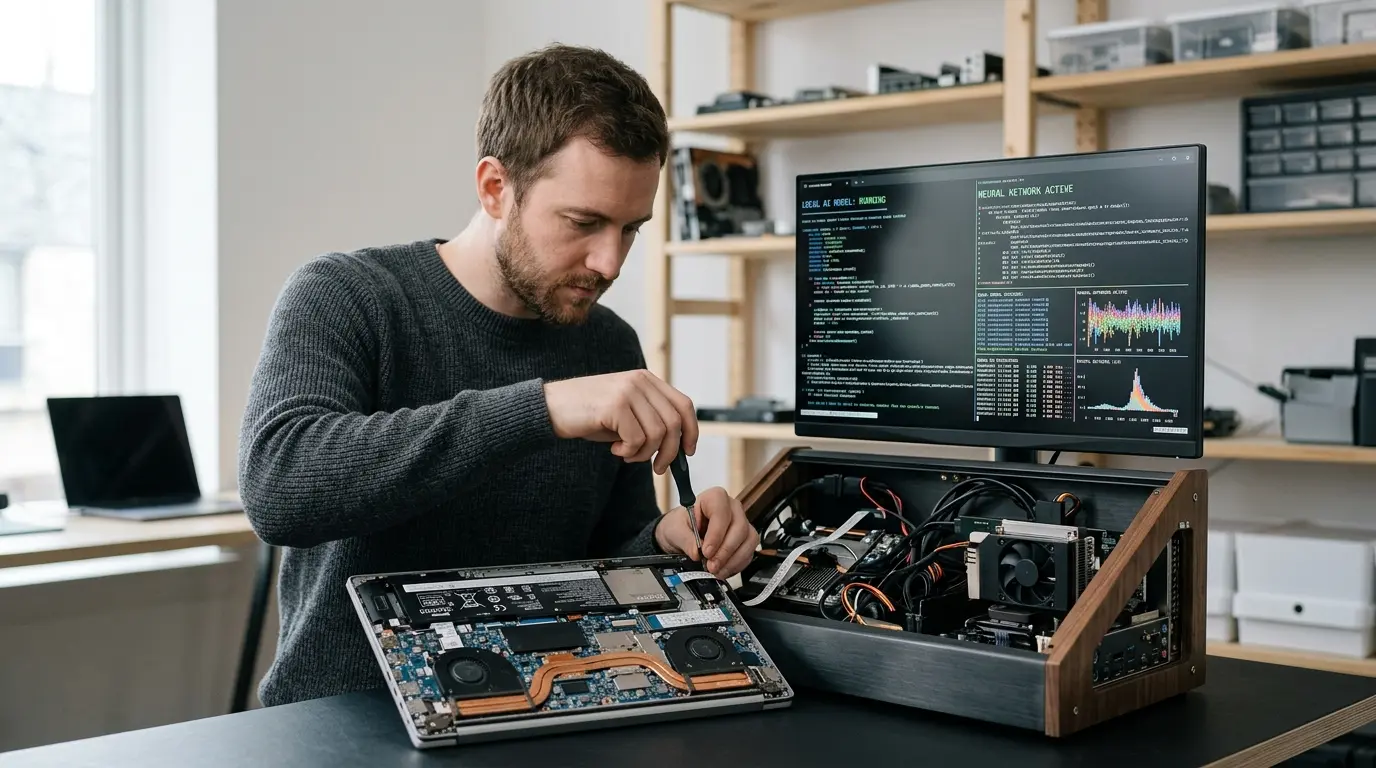
One tech enthusiast recently transformed a standard Lenovo Yoga laptop into a bizarre desktop hybrid specifically to run local AI chatbots. By wiring an AMD Radeon RX 7900 XT through a tiny M.2 slot, this experiment attempts to bypass traditional mobile hardware limitations.
The resulting machine features exposed circuit boards and a massive external power supply to keep the desktop GPU running. Although the setup looks like a professional workstation from a distance, the internal connections tell a different story of technical struggle.
The creator behind this project sought to maximize VRAM for Large Language Models without purchasing an entirely new workstation. According to technical details, this specific "Franken-rig" suffers from significant performance bottlenecks due to laptop DRAM limitations.
Hardware Hacks Meet Brutal Performance Realities
Connecting a high-end desktop graphics card to a thin-and-light laptop requires creative cabling and a specialized M.2 to PCIe adapter. This specific build uses the laptop’s internal storage slot to bridge the connection to the powerful Radeon card.
The physical transformation requires removing the bottom panel of the Lenovo Yoga and leaving the internals exposed to the air. While the AMD Radeon RX 7900 XT provides 20GB of VRAM, the data transfer speeds are limited by the small M.2 interface.
- Host Device: Lenovo Yoga 7i Laptop
- GPU: AMD Radeon RX 7900 XT (20GB VRAM)
- Connection Type: M.2 to PCIe riser cable
- Power Source: External 850W ATX Power Supply
- Primary Use: Running local LLMs like Llama 3
Running local AI models demands high memory bandwidth to process tokens quickly and efficiently. Even with a top-tier graphics card, the system must frequently swap data between the GPU and the laptop’s system memory.
Bottlenecks Killing Local AI Potential
The biggest hurdle for this project involves the soldered LPDDR5 memory found inside the Lenovo Yoga. This laptop RAM lacks the speed necessary to keep up with the demands of an external desktop-class AI processor.
Latency issues arise as the AI model attempts to move information through the narrow PCIe lanes of the M.2 slot. Performance benchmarks show the system produces text much slower than a dedicated desktop build with native motherboard support.
| Feature | Specification |
| GPU Memory | 20GB GDDR6 |
| System RAM | Soldered LPDDR5 |
| Connection Speed | PCIe 4.0 x4 (via M.2) |
| Cooling Solution | Open-air exposure |
Users interested in local AI often find that VRAM capacity is more important than raw clock speeds. However, the bottleneck here proves that the connection method is just as vital as the card itself for smooth chatbot interactions.
Despite the messy appearance and the technical flaws, the project demonstrates the lengths enthusiasts will go to for local processing power. The trade-offs in portability and speed make this a cautionary tale for those looking to avoid buying a proper desktop.

byDavid Porter
Latest comments
Loading