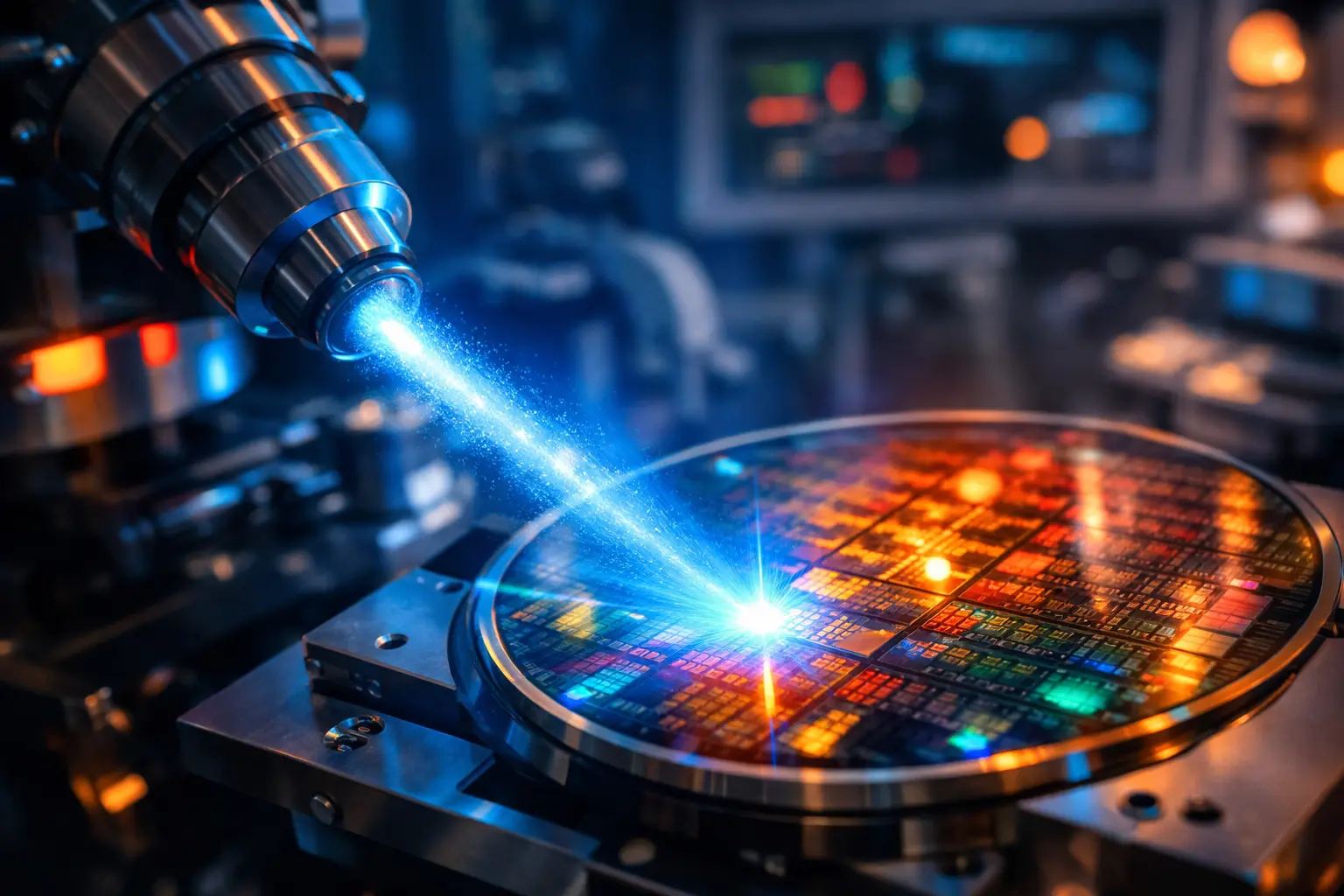
Norwegian startup Lace Lithography has raised $40 million to reinvent chip manufacturing with a helium-based lithography technique. The deal instantly puts the company on the map as a potential challenger to ASML in the global semiconductor arena. The round was led by Atomico, with participation from M12 and Nysnø, among others.
The innovation targets a core step in chipmaking: lithography. This process defines how transistors are etched onto chips and underpins today’s AI systems.
What makes this chip tech different?
Lace Lithography’s approach uses helium atoms instead of light to draw chip structures. Traditional lithography, pioneered by ASML, relies on extreme ultraviolet light to project patterns onto silicon—a method now running into physical limits.
The helium method works fundamentally differently:
- Helium atoms have an extremely short wavelength
- That enables even smaller, more precise structures
- Less scattering boosts accuracy
In theory, this could produce smaller, more powerful chips than today’s systems.
Who’s behind Lace Lithography?
The founders blend physics, engineering, and AI expertise to push this breakthrough. Bodil Holst and Adrià Salvador Palau have spent years advancing atomic beam physics and instrument development.
Their background matters because:
- Atomic beam tech is extremely complex
- Precision instruments are essential for chipmaking
- AI is used to optimize processes
That rare mix is a meaningful competitive edge.
Why does this matter for the chip industry?
The development could loosen dependence on today’s lithography stack. ASML currently dominates the market for advanced chip tools, especially with EUV systems.
Lace Lithography’s impact could be significant:
- New competition in a near-monopoly market
- Potential long-term cost reductions
- Faster AI chip development
It’s a notable storyline for the Netherlands, where ASML plays a central role in Europe’s tech economy and geopolitics.
When will this tech hit the market?
Lace Lithography aims to have a working pilot installation by 2029, signaling the technology is still early.
The roadmap looks like this:
- Current phase: prototype development
- Next step: industrial validation
- Goal: pilot production by 2029
Ambitious, yes—but typical for deep tech and semiconductor timelines.
What does this investment mean for Europe?
The raise underscores Europe’s growing role in deep tech and chip innovation. Investors like Atomico are increasingly backing fundamental technologies.
It aligns with broader trends:
- European strategic autonomy in chips
- Rising investment in AI infrastructure
- Growth of deep tech startups beyond Silicon Valley
M12’s involvement also signals that U.S. players are taking the tech seriously.
Bottom line: serious contender or long-shot bet?
Lace Lithography is positioning as a potential disruptor, but success isn’t guaranteed. The tech is promising, yet must prove itself at industrial scale.
Still, the move matters because:
- Today’s lithography is nearing its limits
- Alternatives are becoming necessary
- Demand for AI chips is exploding
If the helium approach delivers, it could reset the balance of power in the chip industry.

Popular news

AI breathes new life into an old game: ask for your own Fallout 2 mods

Anthropic’s $80.7 Billion Loss Explained in Today’s AI News Podcast

Microsoft wants to keep AI agents in the workplace on a tighter leash

AI Cleans Up Your TV with CleanYourTV

Goldman Sachs Predicts AI IPOs Could Add 100 Billion Dollars to Indian Market Capitalization

Global Memory Shortage Threatens Corporate AI Adoption
Latest comments
Loading