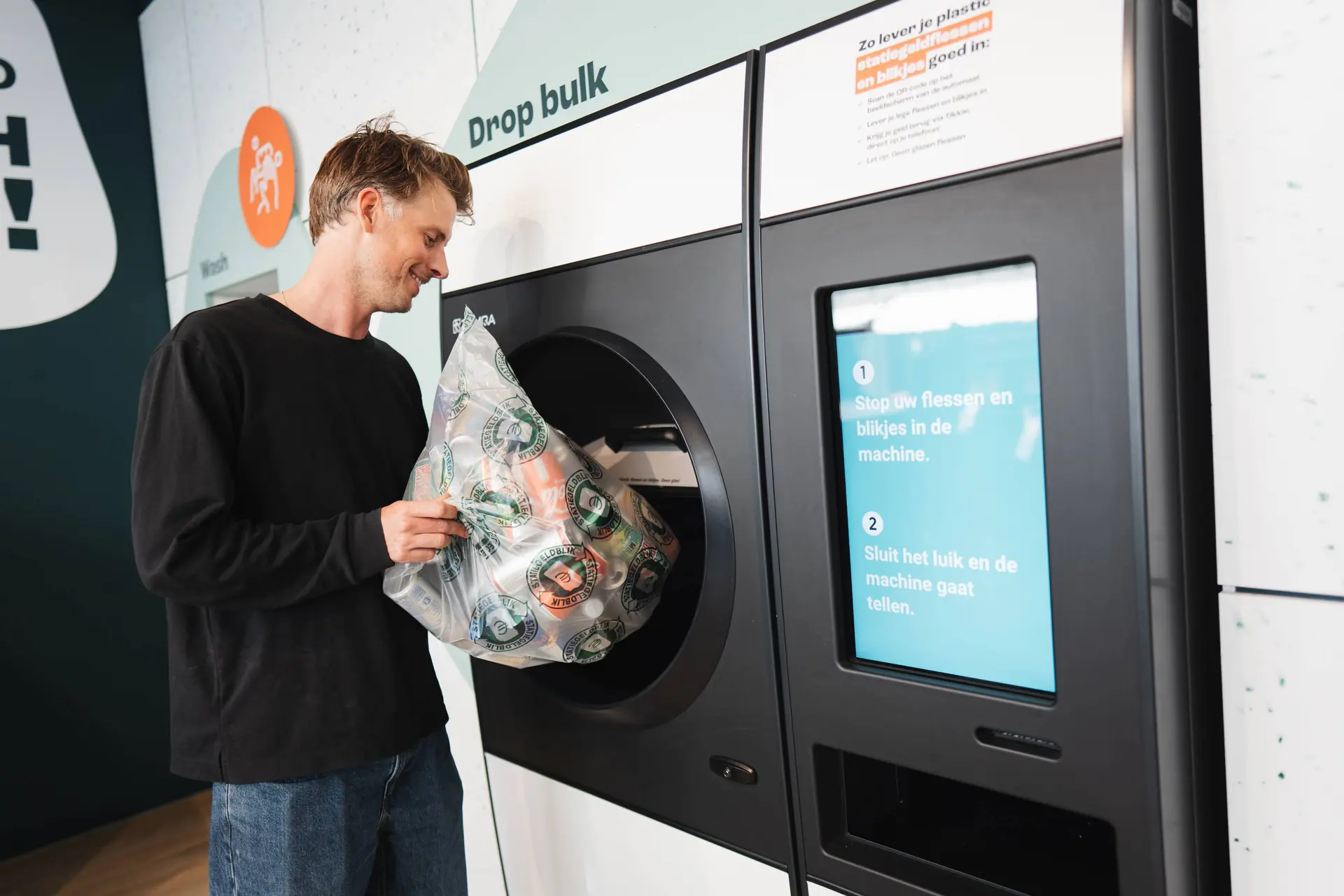
Dutch recycling startup Droppie has raised €4.2 million in growth capital to scale its network of recycling stores from 13 to 70 locations. The company aims to use AI to recover high-grade materials while paying consumers for dropping off waste correctly, it announced in a press release.
Backers include the Amsterdam Climate and Energy Fund (AKEF), ROM InWest, the Social Impact Funds of Rotterdam and Amsterdam (SIF), Start Foundation, Dutch Dragons crowdfunders, and existing shareholders.
With the new funding, Droppie plans a rapid rollout in major Dutch cities, where, according to the company, separate collection still fails to deliver enough high-quality recyclable material.
AI to lift recycling quality
At the heart of the concept is the Dropbot, an AI-powered collection machine that uses image recognition to automatically identify materials. The system detects items like plastic packaging, small electronics, and textiles, weighs each submission, and links it to a user via the Droppie app.
Users then receive an automatic cash reward.
Droppie says this creates a fully traceable materials stream. Because items are delivered clean and pre-sorted, they can be reused or recycled at much higher quality than waste collected through traditional containers.
For plastics, that could mean certain packages can be turned back into food-safe packaging—something typically not possible with heavily contaminated household waste.
EU rules are driving demand for recycled inputs
The expansion comes as European regulation increasingly requires producers to use recycled content. Under the new Packaging and Packaging Waste Regulation (PPWR), packaging will need to contain more recycled materials over the coming years.
Meanwhile, the supply of high-quality recyclate remains tight. Cheap virgin materials, including imports from Asia, also make it hard for recyclers to compete on price.
Droppie sees an opening. Co-founder Natascha Hermsen argues that the Netherlands must reduce its reliance on imported primary resources and that a domestic circular materials chain is becoming essential amid rising geopolitical risk and resource scarcity.
Data is becoming the backbone of circular systems
Beyond physical collection, data is central to the business model.
Every drop-off is digitally recorded, enabling producers to prove which recycled materials they use and where they come from. That traceability is increasingly critical as EU rules tighten on the provenance of recycled inputs.
According to Droppie, this will create one of the most detailed data sources on waste streams in the Netherlands.
Social impact is part of the pitch
Investors also emphasize the company’s social value alongside its circular goals.
With support from Start Foundation and the Social Impact Fund, Droppie creates jobs for people distanced from the labor market. Investor AKEF says the company proves sustainability and social inclusion can go hand in hand.
ROM InWest cites Droppie’s ability to shift consumer behavior as a key investment reason. By directly rewarding proper sorting, the investor expects cleaner material streams that are better suited for high-grade recycling.
From 13 to 70 locations
Droppie currently operates thirteen recycling stores. With the new capital, it plans to expand to seventy sites across major Dutch cities.
The focus is on dense urban areas with lots of high-rises, where waste pileups around containers are a persistent issue. By paying residents to sort their waste, Droppie hopes to boost both material quality and neighborhood livability.
Why it matters
The investment signals AI’s growing move into physical infrastructure and the circular economy—beyond chatbots and generative tools. Image recognition and data analytics are being used to process waste more efficiently, while the resulting data helps producers meet tougher EU sustainability rules.
As Europe pushes for strategic autonomy in critical materials, digital systems that enable high-quality recycling could become a cornerstone of future circular supply chains.

Latest comments
Loading