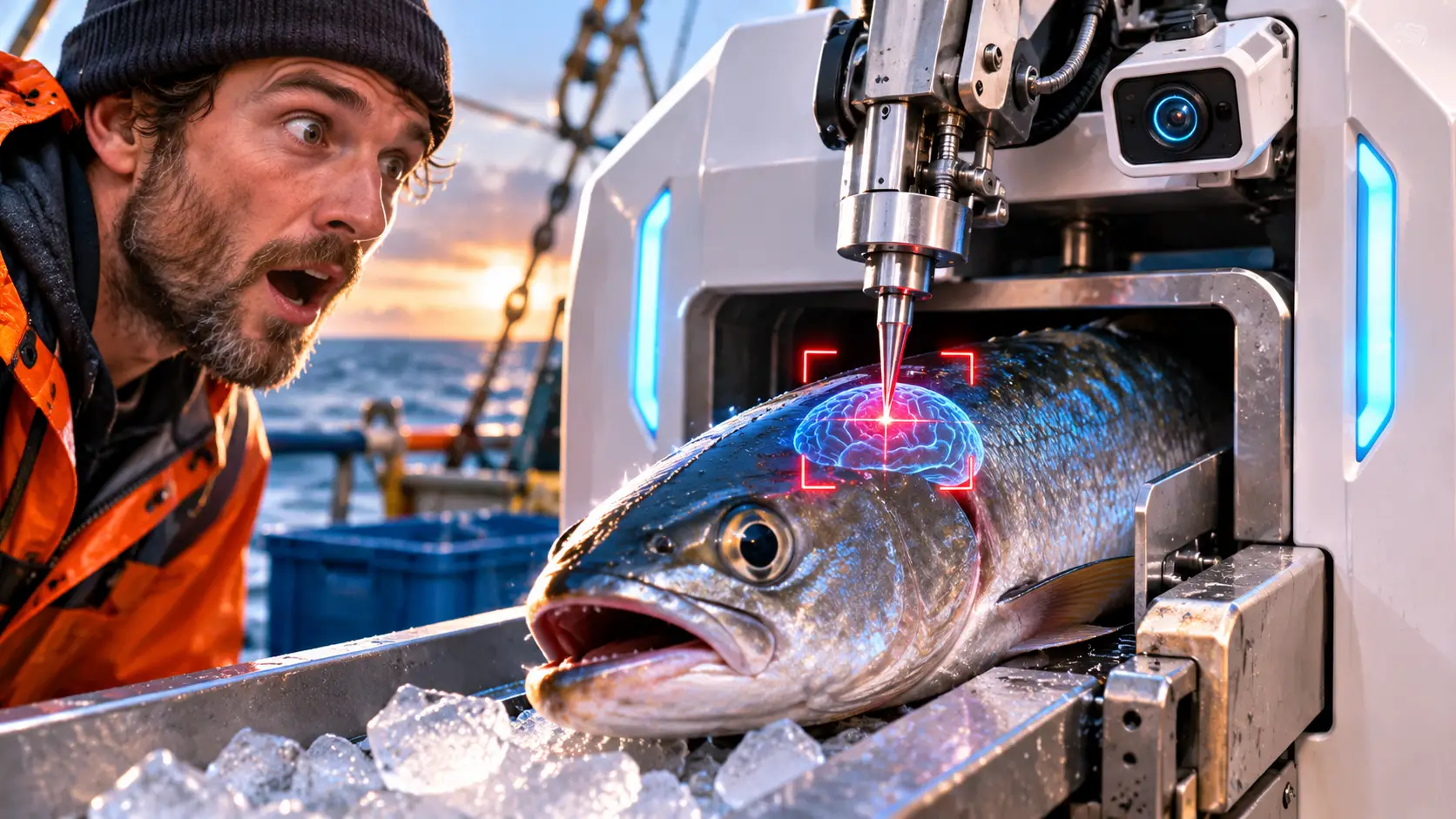
A US startup is using artificial intelligence to drive a metal pin through fish brains moments after they are caught. Shinkei Systems is automating an ancient Japanese fish-killing technique. The company says the method keeps fish fresh up to three times longer and improves their flavor. Silicon Valley investors now see a multimillion-dollar opportunity.
The technique sounds gruesome, but it serves a serious purpose. Many commercially caught fish die slowly from oxygen deprivation, causing stress that can affect the quality of the meat. Shinkei aims to replace that process with a fast, controlled treatment using robotics and AI.
An AI robot processes fish in seven seconds
The robot, called Poseidon, is about the size of a refrigerator. Fishers install it on board and feed their catch into the machine as soon as it comes aboard.
Artificial intelligence then takes over. Using cameras and image recognition, Poseidon analyzes each fish and identifies its species. The software then locates the brain and gills.
A mechanism drives a metal pin through the brain, then makes an incision near the gills. The fish is placed in a mixture of ice and water, allowing it to bleed out while its body cools rapidly.
An earlier model completed the process in about seven seconds, Semafor reported. Shinkei has since developed faster versions. A new model designed for Alaska’s salmon fishery takes about six seconds, according to Fast Company.
The robot has to handle a wide range of conditions. Fish don’t always lie in the same position, different species have different anatomy, and boats are constantly moving at sea. AI helps the system work precisely despite these variations.
An ancient Japanese technique gets a high-tech upgrade
The technique behind Poseidon is called ikejime. Japanese fishers and specialist processors have used it for centuries to kill fish quickly and preserve the quality of the meat.
When a caught fish thrashes for a long time or slowly suffocates, its muscles use up their energy reserves faster. This can lead to lactic acid buildup, affecting the processes that occur after death. The speed at which rigor mortis sets in, for example, influences the fish’s final texture.
Ikejime aims to minimize this stress and muscle activity. Traditional methods may also involve destroying the spinal cord. According to the Los Angeles Times, the Poseidon robot primarily automates piercing the brain and cutting near the gills.
Shinkei says carefully handled fish retain their quality two to three times longer. The company says conventionally processed fish often begin to lose quality after five to seven days, while its own products can remain in good condition for two to three weeks under suitable conditions.
That doesn’t mean every fish is automatically safe to store three times longer. Results depend on factors including species, hygiene, and the temperature during storage and transport. The exact shelf-life gains from Poseidon have not yet been widely verified by independent research.
Peter Thiel’s investment fund sees an opportunity
Shinkei was founded in 2021 by entrepreneurs Saif Khawaja and Reed Ginsberg, a former engineer at SpaceX.
The startup caught the attention of Founders Fund, the US investment firm co-founded by tech billionaire Peter Thiel. In June 2025, Shinkei raised $22 million in a funding round led by Founders Fund and Interlagos.
According to an October 2026 report by the Association for Advancing Automation, Shinkei has now raised more than $40 million in venture capital.
The company also has an unusual business model. Fishers get the robots at no cost. Shinkei then buys their catch at a higher-than-usual price and handles the processing and distribution itself.
The fish is sold under the Seremoni brand.
Demand isn’t limited to everyday consumers. Fast Company reports that the fish has been served at dozens of Michelin-starred restaurants, including well-known US fine-dining establishments.
In September 2026, Shinkei took a major step toward mainstream grocery stores. SeafoodSource reported that Seremoni products became available at select Whole Foods stores in Los Angeles, San Francisco, Chicago, Austin, and Denver.
With this technology, the startup is bringing a technique from Japan’s exclusive fish cuisine to a much wider market.
Is AI really better for fish?
Shinkei presents its technology not just as a way to sell better-quality fish, but also as a more humane alternative to letting caught fish slowly suffocate.
That claim needs some qualification.
A 2026 study published in the journal Aquaculture examined how effectively manual and automated ikejime methods render fish unconscious.
Among other methods, the researchers monitored brain activity in rainbow trout and hybrid sea bass. In trout, both methods eventually caused sustained unconsciousness, but not always immediately. Among the sea bass studied, around 25 to 43 percent remained conscious after treatment.
The researchers therefore recommend stunning fish beforehand using a method that guarantees immediate unconsciousness. They also stress that the technique needs further refinement for each species.
The study does not prove that every automated ikejime treatment is immediate and painless. But it does confirm that slow suffocation can cause prolonged suffering.
That presents a major technical challenge for Shinkei. Its robot must learn to recognize an increasing number of fish species and reliably target the right anatomical spot in each one.
The company is also developing additional sensors to assess the quality of individual fish. That data could help determine how long each fish will keep and guide the distribution of the catch.
Shinkei is evolving from a maker of an unusual fish-processing robot into a company seeking to transform the entire supply chain—from fishing boat to supermarket—with AI and automation.
Similar applications are emerging beyond the fishing industry. For example, AI Wereld previously reported on AI-powered robots that remove weeds autonomously. In both cases, the technology is not about generating text or images, but recognizing physical objects and carrying out precise tasks.

Popular news

PSI Says AI System Solved an 18-Year-Old Quantum Computing Conjecture

Claude’s 'Dreaming' Explained: How AI Memory Works

Airbnb Challenges Traditional Chatbots With AI Travel Agent Planned for 2027

OpenAI Unveils GPT-6 Cyber for Advanced Vulnerability Research
AWS Launches Agentic AI Kiro Bots With Memory And Recurring Job Support