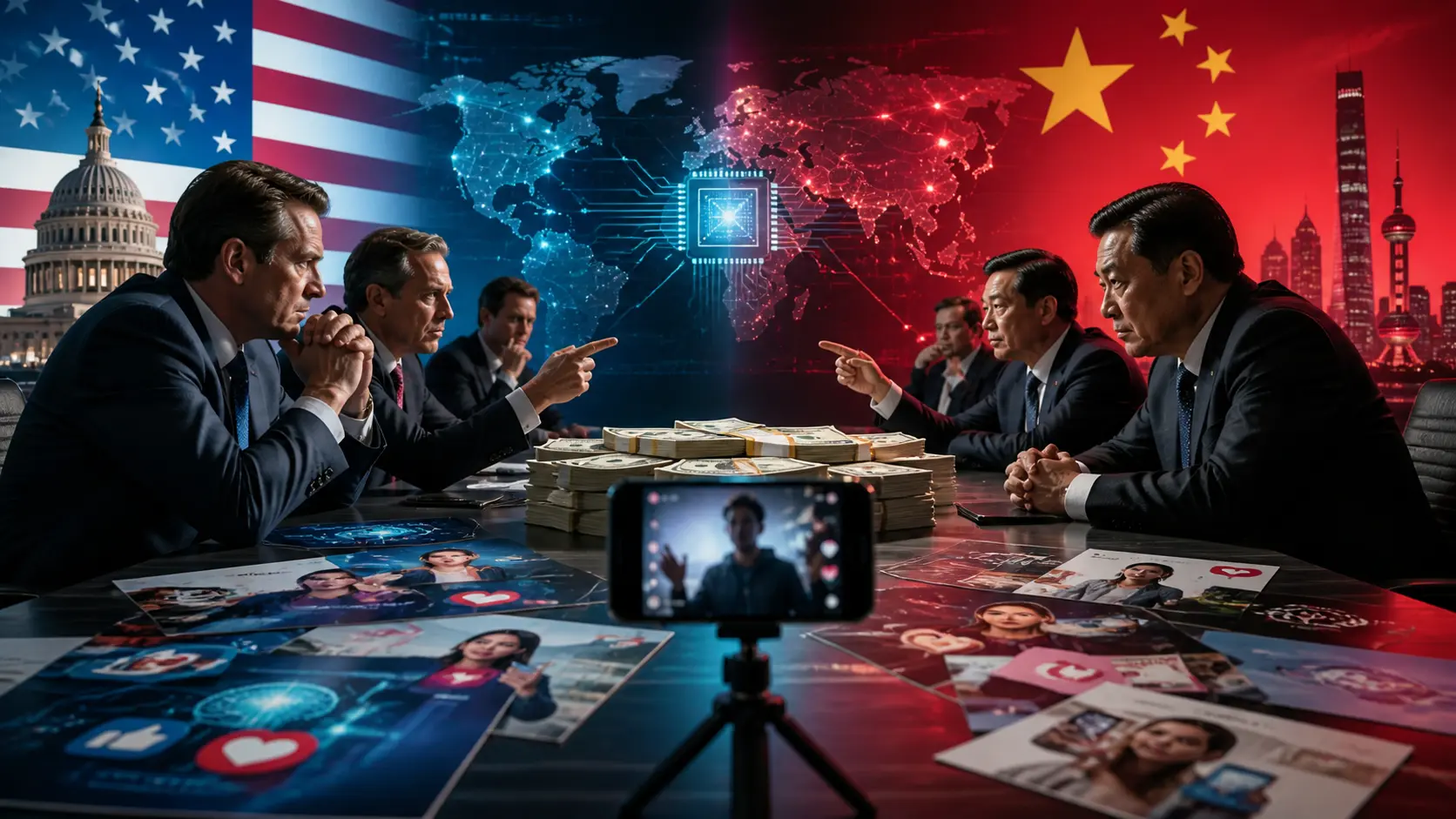
The AI industry isn’t just battling over chips, models, and data centers anymore. It’s fighting for the narrative. WIRED’s report on Build American AI shows how quickly that fight is escalating. A nonprofit linked to a pro-AI super PAC is paying influencers to promote “American AI” and stoke fear about China.
That shifts AI from a tech policy debate into full-blown narrative campaigning—much like crypto did in Washington—only now on a far more geopolitically charged front.
What happened
According to WIRED, Build American AI is paying social media creators to push pro-AI messaging and anti-China framing. The organization is tied to a broader political machine around Leading the Future, a super PAC backed by prominent tech figures and investors aiming to boost AI-friendly candidates and policies. Earlier reporting by Axios and the Los Angeles Times already showed this pro-AI political infrastructure has deep pockets and is explicitly pushing for lighter regulation and geopolitical competitiveness.
The influencer shift is strategically savvy because it breaks out of the Washington bubble. A lobby memo or PAC ad mostly reaches policy circles. A lifestyle or political creator on TikTok or Instagram can package the same message as cultural sentiment: AI saves jobs, China is the big risk, and stricter rules would weaken America. That makes the campaign not just political, but cultural. The aim isn’t only policy change—it’s to reset public instinct.
Why this is happening
Because the AI sector increasingly understands that regulation isn’t decided only in committees and courts—it’s won in public opinion. If voters primarily see AI as an economic opportunity and national security imperative, aggressive oversight becomes harder to sell politically. Layer in the U.S. election cycle, and it’s obvious why interest groups are seeking channels beyond traditional tech media. Influencers are cheaper, more diffuse, and often more credible with niche audiences than overt campaign messaging.
The China framing also reflects a broader shift inside the AI industry. The sector doesn’t just want to talk innovation; it wants to talk strategic necessity. You see it in U.S. defense contracts, super PAC funding, and the race with Chinese model makers. The effect is clear: regulation is increasingly reframed as a geopolitical handicap. That’s politically effective—but risky—because it crowds out serious debate on labor, privacy, and safety risks.
Why it matters
This shows AI isn’t just a product market—it’s an influence system. Whoever shapes the public frame ultimately sets the bounds for regulators, lawmakers, and journalists. For AIwereld, it helps explain why some debates suddenly feel so polarized: criticism of AI is more quickly cast as a drag on national strength, while industry interests get wrapped in “common sense” cultural packaging. That’s not neutral drift. It’s political engineering.
There’s a media lesson too. Once lobby money flows through influencer channels, the line blurs between news, branded persuasion, and ideological mobilization. The AI sector—already advantaged by capital and distribution—gains another edge: direct access to audiences beyond the traditional media filter. Anyone serious about covering AI should track not just model releases, but the messaging machines around them.
What it means for companies, Europe, and the AI ecosystem
For companies, AI politics is getting more mature—and more aggressive. Leaders can’t pretend AI rules are set purely by technocrats. Narratives about China, innovation, security, and jobs will be deliberately deployed to shape policy. Communications, public affairs, and compliance will intertwine more tightly. That also applies to European firms working with U.S. AI vendors: you’re part of a geopolitical story you didn’t write.
For Europe, this is a warning. If you can’t convincingly articulate your AI strategy, the debate will be captured by American or Chinese power frames. That’s why AIwereld’s pieces on European sovereignty and the role of DeepSeek or other non-Western players are more than isolated news items. They tie back to the same big question: who defines the language that makes the AI economy politically legitimate?
Read also

Bottom line
The Build American AI campaign signals AI’s evolution into a full power economy: infrastructure, lobbying, defense, culture, and elections are bleeding together. See that, and the rising heat in the debate makes sense. The fight isn’t just about what AI can do. It’s about who gets to write the story of what AI should be.

Popular news

Anthropic Secures Thirty Two Billion Dollar Queensland Data Centre Deal for Claude
Zuckerberg Rejects AI Slowdown Calls Amid Industry Safety Debate

Crusoe Secures Nearly Four Billion Dollars to Scale Factory Built AI Data Centers

Amazon Secures Generac Stake in Massive Eight Billion Dollar Generator Pact

Spain Registers First End-to-End Autonomous AI Data Breach

MIT and Suffolk Unveil How AI is Reshaping Construction Productivity
Latest comments
Loading