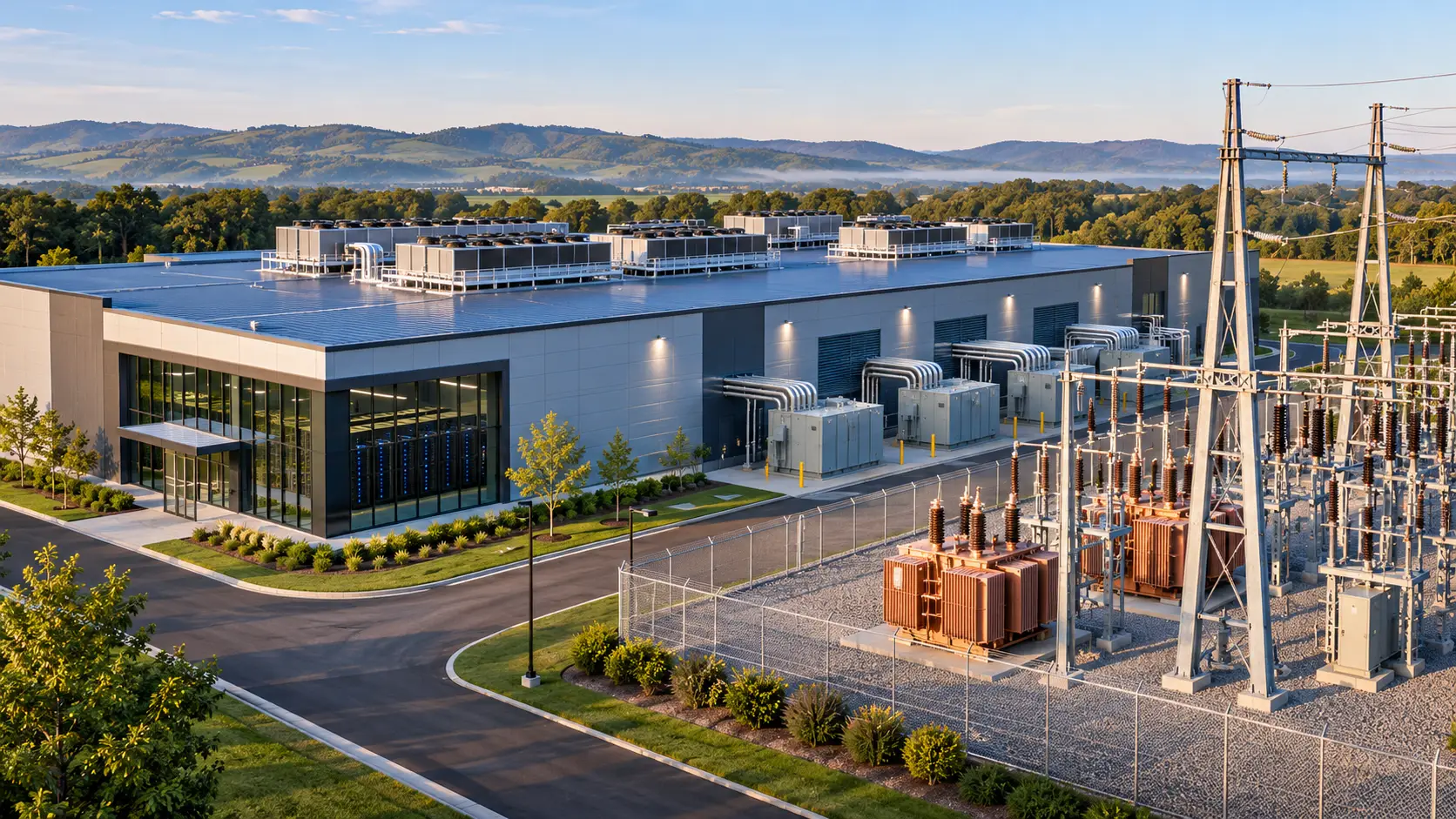
Editorial illustration of a data center and its connection to a nearby electrical substation.
A data center deal can put hundreds of megawatts in a headline without saying when a local grid will supply them. To read the deal, start with three questions. Who promised what? Where did the figure come from? What proves the first part is ready?
Three deals that can carry the same headline
A compute contract buys access to chips or servers. A cloud provider may agree to reserve a block of gear for one customer and run it for years. The customer can use that gear once the site is ready. The cloud provider still has to arrange power, cooling and a grid link.
A utility service agreement sets the terms for power at a site. Look for the utility, the address or delivery point, the load it can serve and any dates or work the parties must meet. A plan for a new line or substation can help explain why service will start in stages.
A power purchase agreement buys electricity or sets financial terms tied to what a plant sells. The U.S. Environmental Protection Agency’s guide to physical power purchase agreements gives examples of delivery and payment terms. A deal with a wind farm can sit alongside the contract that sets up service to the building.
Check what the megawatts count
Megawatts, or MW, tell you the scale of power at a given time. Ask if the number covers the IT gear, the whole site, a power plant or a share of capacity set aside in a contract. Servers and their links draw power. So do the pumps, fans and other gear that keep the site running.
Check the verb that goes with the figure. A firm may have asked for a certain load, signed a contract for it, built enough space for it or put it to work. Write down the date for each step if the firms give one. The first phase can cover only part of a project that spans several buildings or sites.
What TensorWave’s 457 MW deal spells out
Who signed and what they bought. In its November 16 announcement, TensorWave said it signed a six-year deal to give OpenAI dedicated AI compute across several U.S. sites. It plans to use AMD Instinct MI455X chips in Helios racks. The deal supports a wider chip partnership OpenAI and AMD announced in 2025.
What the figure covers. TensorWave’s statement released through Business Wire calls the 457 MW IT capacity. That puts the figure on the chip and server side of the deal. The companies did not give a total for utility service, a price or a list of sites in the announcement.
What comes first. TensorWave expects the first part to come online in the first half of 2027 and the full build to finish by early 2028. It gave no site-by-site dates or size for the first phase. Our coverage of the TensorWave agreement tracks how the deal fits OpenAI’s buildout.
Where to check the next milestone
Once a site is named, check who serves its address. Look for a utility filing that lists a substation, the amount of load for the first phase and any work the grid needs before service can start. An approval to build tells you what the utility may build. For proof of a live site, look for an in-service notice, a statement that service has begun or meter data that shows power draw.

Popular news

Good Morning AI | Anthropic slips, Claude reviews code and Tidal sets a cutoff

AI stocks slide again as Nvidia falls and Ambarella sinks 20.6%

GTA 6 on PC at 10 FPS? Inside the AI-Assisted Race to Port It

Tencent opens the AI models behind WeChat’s product search

Google’s Humanity’s First Exam Tests AI Reliability