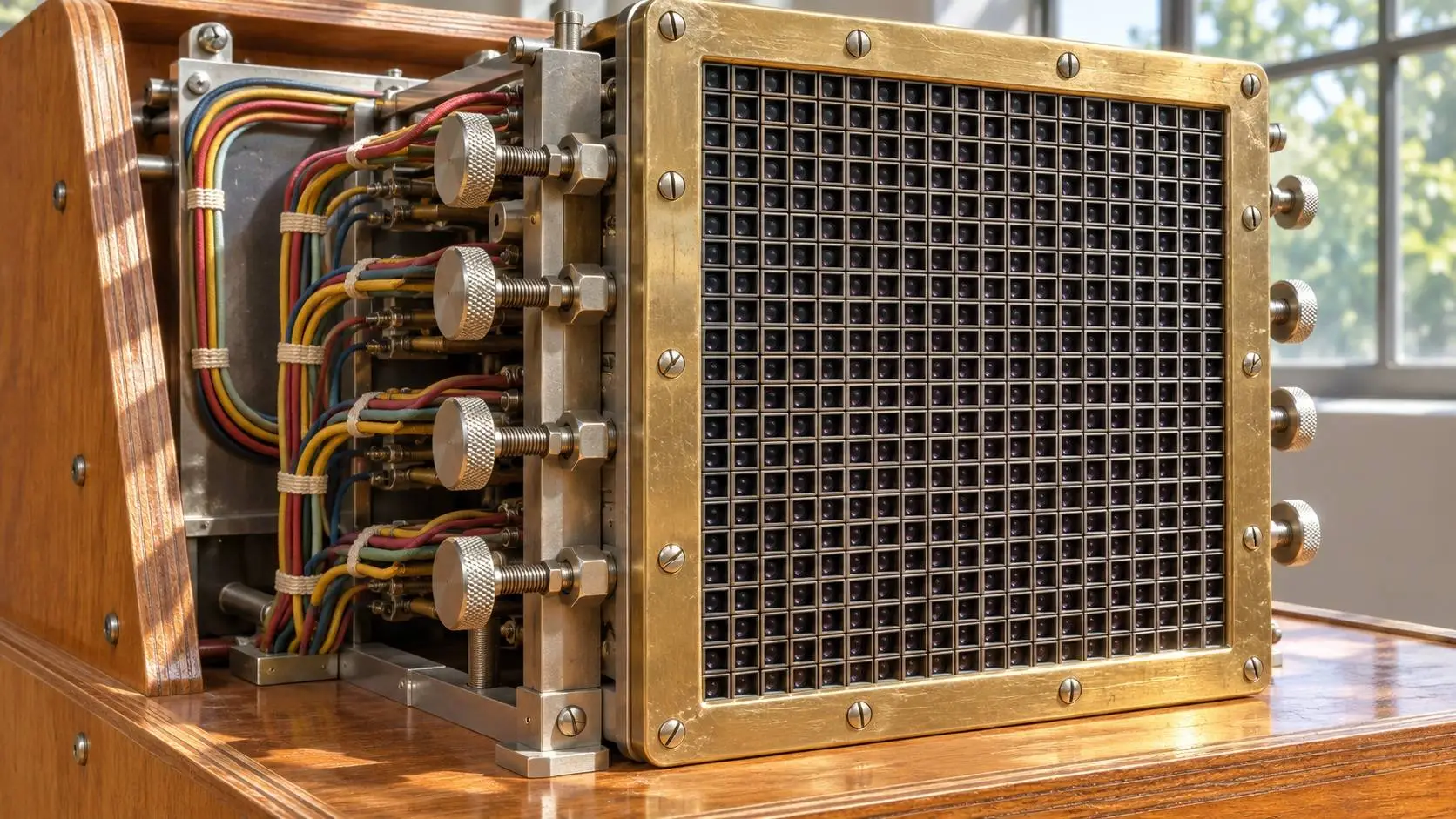
A square optical sensor grid is mounted in a brass-edged panel with bundled wires behind it. AI-generated editorial illustration by AI World Today.
Frank Rosenblatt’s perceptron made a guess, checked its answer, and changed the weights behind the guess when it got one wrong. In the 1950s, that gave people a new way to study how a machine could learn from examples.
Cornell’s history of the project describes a July 1958 demo on an IBM 704. Later, a machine called the Mark I put parts of the design into hardware. Both belong to the same line of work. Each gives us a different way to see what the perceptron could do.
A question about how we learn to see
Rosenblatt was trying to make sense of how past sights can shape what a person sees next. In a 1958 paper in Psychological Review, he looked at how links between parts of a simple system might hold traces of what it had learned. The strength of those links could change with experience.
Think of a child who can pick out a chair at a house they have never been to. They may have seen chairs with those sorts of shapes before. A machine could be tested on a smaller task, such as sorting new pictures into two groups. A useful test would give it pictures it had yet to see.
Many projects from the first years of AI research took a broad question and made it small enough to test. A perceptron gives us one case where you can point to the thing that changes after a mistake.
What a weight does in a simple perceptron
In the form used in many lessons, a perceptron takes in a few numbers. It multiplies each by a weight. It adds the results and checks whether the sum clears a cutoff. In that way, the weights and cutoff give it a rule for choosing between two labels.
Say one number tells it how dark the left side of a picture is. A second number tells it the same thing for the right side. Start with one weight for each number. The two weights show how much each side counts in the final guess.
Give the system an example with a known answer. If it gets the answer wrong, the learning rule shifts the weights. Next time, the same inputs can lead to a new guess. Training uses those small changes across many examples.
The inputs also set a limit. If two images give the system the same pair of numbers, the classifier sees them as the same. More work on the weights can help it use the clues it has. To tell that pair apart, it needs another clue.
Here is a small way to see the effect. Give both sides a weight of one and add their values. A dark patch on the right will count as much as one on the left. Change the left weight to two and it will count for twice as much. The cutoff then decides how large the total has to be to pass. This is an example of the rule used in lessons. It gives you a feel for the two things a change can do: put more value on a clue or raise the bar a guess has to clear.
The Mark I put the ideas in a cabinet
The Smithsonian’s record of the Mark I Perceptron shows the controls, switches, and other parts of a physical learning machine. It had units that sensed a signal, units that helped bring the signals together, and units that produced a response.
The museum dates the object to 1958 and notes that it came to the collection from Cornell and the Office of Naval Research in 1967. Those details help when you see the term perceptron in two places. A photo of the Mark I shows a particular device. A sketch of a few numbers and a cutoff shows a rule people can use in software.
In software a weight can be a number stored in memory. In a piece of lab hardware a change can show up as an electrical setting. In both cases, you can ask how to test the effect. Check how well the system does on fresh examples after the change.
Four points that a simple perceptron can’t sort
Draw a square and mark its four corners. Put a plus at two corners across from each other. Put a minus at the other two. Now try to draw a straight line with both plus signs on one side and both minus signs on the other. Any line that does one job fails at the other.
This is the familiar example called exclusive-or, or XOR. Two input numbers form the two axes. The simple rule assigns a label based on which side of a line a point falls on. Changing a weight can tip the line. Changing the cutoff can shift it. The rule still gives us one straight line.
That makes the problem easy to see. Each extra lesson can move the line somewhere new. To solve this case, we need features that describe a useful new clue or a design that can use more than one boundary.
Try adding a clue that says whether the two input values match. On the square, it can tell the two pairs of corners apart. That clue changes the task for the model. It can now work from a signal it could never get by shifting the old pair of weights alone.
What the debate proved about the model
Marvin Minsky and Seymour Papert’s 1969 book Perceptrons studied limits of particular types of machines. The same word could refer to a much wider set of designs. In Principles of Neurodynamics, Rosenblatt discussed models with more than one layer and other links between parts.
The lesson holds up when you look at a newer system. First find the exact version the authors studied. Then look at the inputs, the job, and what happens when the rule fails. Knowing which parts place a limit can tell you what to change next.
Rosenblatt’s work made one idea easy to study: a connection can change in a way that helps the next guess. Later work brought different networks, data, and methods to new tasks. For that wider story, see AI’s surge and stall in the 1970s and 1980s and our AI history collection.


Popular news
Soitec jumps 6.9% as European chip stocks rebound and Eutelsat falls
Ant Group releases a design image model that tops the open-weight ranking

Kioxia jumps 12.6% as Asian AI stocks trade through Thanksgiving

Perplexity lets developers search the web as it looked on an earlier date

AI sends more shoppers to retail sites ahead of Black Friday