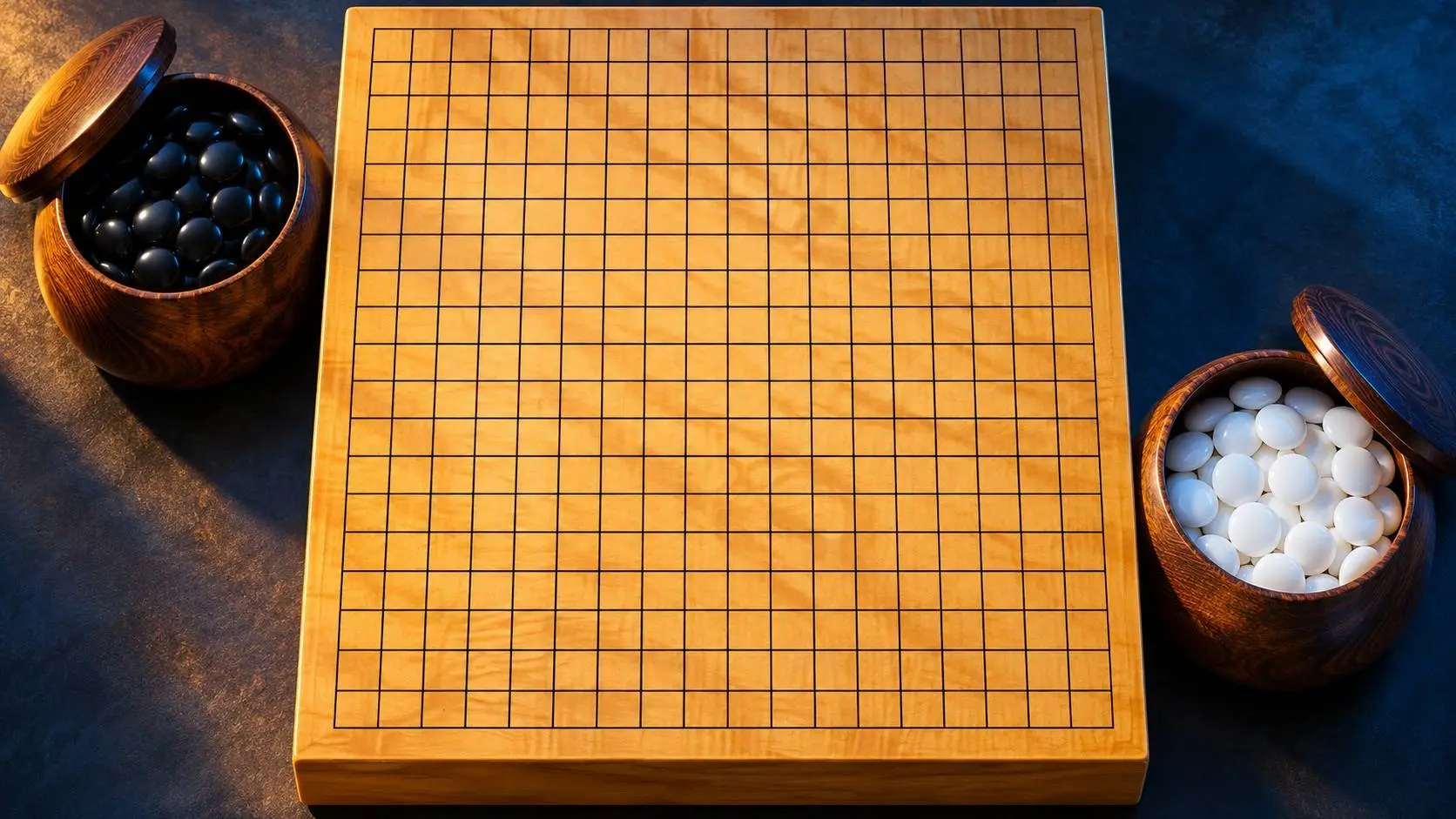
Two wooden bowls hold black and white stones beside an empty wooden Go board. AI-generated editorial illustration by AI World Today.
In game two of the 2016 match with Lee Sedol, AlphaGo set a black stone on the fifth line of the Go board. The move seemed odd to top players. As the game went on, it helped shape play across the center. Move 37 gave the public a clear view of what AlphaGo could do with trained networks and search.
Why players took a second look at Move 37
In Go, the players take turns placing stones. Stones can claim space or help other stones do so later. Near the edge, they can help wall off an area with fewer pieces. Farther out, a stone can give a player a say in what happens across more of the board.
The official game record with notes by Fan Hui, Gu Li, and Zhou Ruiyang shows the trade-off. White got ground on the right. Black gained ways to shape play in the center. The strength of the stone made more sense when the experts looked at the rest of the board and how play might go on.
A move like this can be hard to weigh by looking at one corner. Try thinking of a move that gives up room on one side of a board while letting you reach more of it later. Whether it works depends on what both players can do next. That is why the board record adds so much to the story.
If you open the game record, find the stones marked before and after 37. Read the notes with the full board in view. It is easier to see why center play could matter once you can see where the other stones already were. You can do that even if you have never played a full game of Go.
How AlphaGo judged the board
In the original AlphaGo paper, the team described two kinds of trained network. The policy network gave the search a list of moves that looked worth a try. The value network gave it an estimate of who might win from a given board. With those clues, the search could spend time on promising lines of play.
The team used games by strong human players in training. It also used reinforcement learning through games the system played against itself. The paper came out in January 2016. It shows the version that beat European champion Fan Hui in 2015. The team used a stronger version against Lee Sedol.
Imagine a map with more routes than you could check in a day. One tool can suggest a few roads worth a look. A second can help you judge where each road might leave you. A search uses those hints to work out what may happen further along the route. Each part does a job that helps the other parts.
In a game there is also a time limit. AlphaGo had to decide how to use the time it had to make a move. If it searched deep on every line, it would run out of time. The learned guesses gave it a way to put more of that time into the lines that looked good.
What the one-in-ten-thousand figure measures
In an account of the match, DeepMind cofounder Demis Hassabis said its data put the chance of a human playing Move 37 at about one in ten thousand. That was the team’s estimate of how often a person would pick the move. The game and the notes on it give us evidence of how well the move worked.
Think of a rare opening in a card game. Its rarity tells you how often people try it. To see whether it works, you have to look at the hand, the rules, and the replies. The same goes for a rare choice on a Go board.
An unusual move can be poor. A familiar move can be strong. In this game, an unusual move turned out to fit the rest of the position. The experts’ notes help us see what the number alone could never show.
Move 37 and Move 78 were in different games
Lee Sedol played a famous move of his own. It was Move 78 in game four. Lee won that game. AlphaGo played Move 37 in game two and won that game. The project’s record of the match gives the full score as four games to one for AlphaGo.
AlphaGo Zero came later. The team’s 2017 paper describes a version that learned through self-play without training on human games. It had rules, software, and a way to learn from wins and losses. The research moved from a mix of expert games and self-play toward an approach that could learn this task from its own games.
Those steps give the timeline its shape. A win over Fan Hui came before the Seoul match. AlphaGo Zero came after that. For a snapshot from before those events, see what AI could do when GTA 5 launched.
What makes Go a good test
With Go, the two players can agree on the board and on what counts as a win. We can see what choices were open to each player and how the game played out. That gives a test of whether the search and the trained networks can find good moves in real matches.
One striking move tells us where to look. The full match helps us check how the system held up over several games. Lee’s win gives us another game to study, with the same rules and a different set of moves.
Many tasks away from the board can be hard to score. Take a support desk. A fast reply may be good. A fair and correct reply can matter more. It may also be better to pass one case to a person who has more time to check. These goals are much harder to express with one win or loss.
Move 37 helped show how far the team had come on one clear task. If you want to see how, start with the record of the game. Look at the position, the move, and the replies. Then look at the paper to see what each part of the system brought to the choice. The details help make sense of what looked on the surface like a flash of insight.
For the research group’s wider setting, read our guide to Google and its AI work. Other tests and turning points are in our AI history collection.

Popular news
Marlowe raises $277 million to run AI on more kinds of chips
Replit brings in Resonate to help AI agents resume interrupted work
OpenAI adds spending limits to individual AI agent sessions

Amazon signs deal for Decart software to speed up Trainium
Amazon Connect AI now fills forms during live support calls