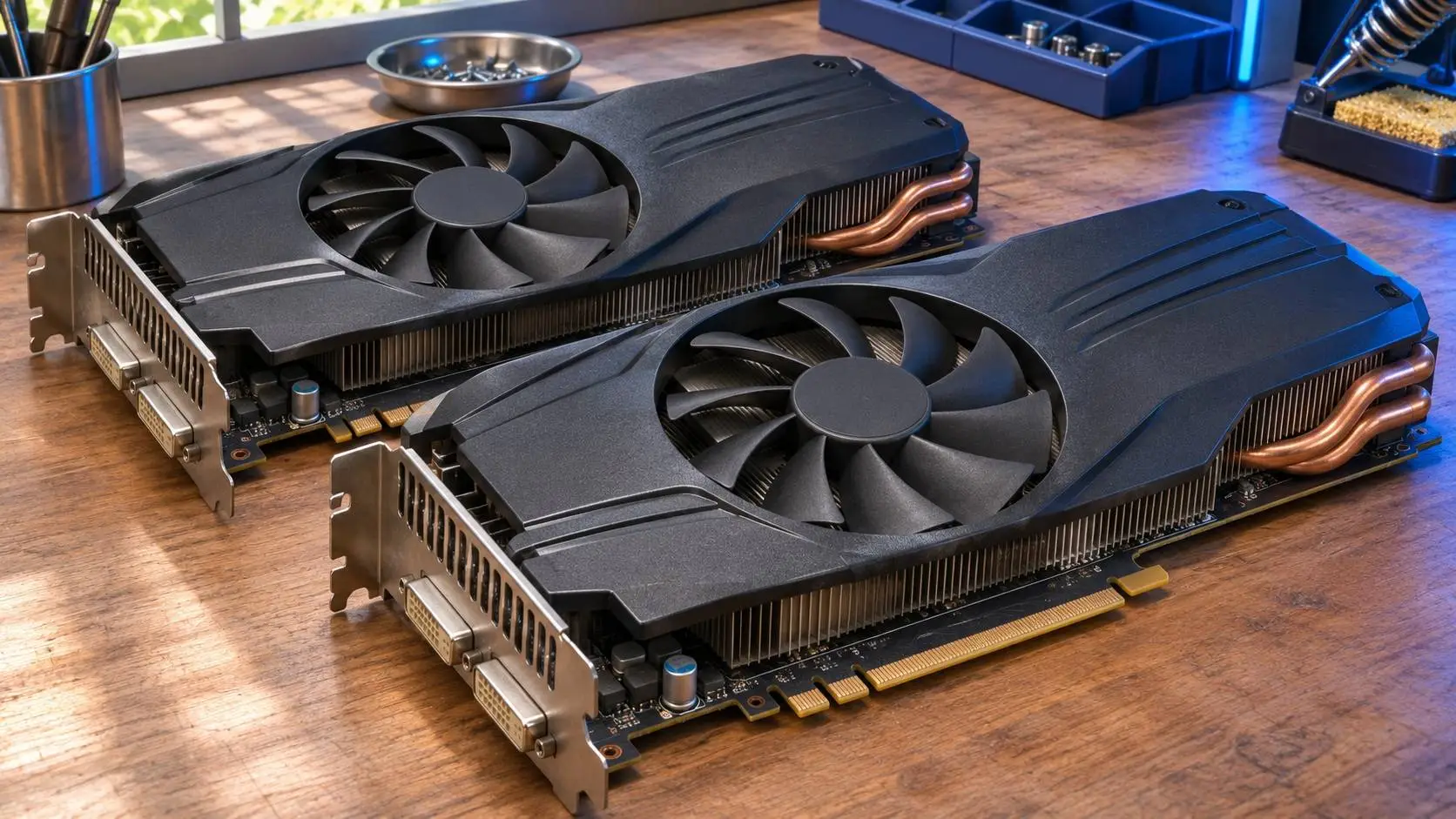
Two early-2010s graphics cards with dark cooling fans and copper heatpipes lie on a workbench. AI-generated editorial illustration by AI World Today.
In 2012, Alex Krizhevsky, Ilya Sutskever, and Geoffrey Hinton trained a model on two Nvidia GTX 580 graphics cards. AlexNet, as the model became known, helped cut the error rate in a major image contest. The cards made the work possible within days. The data, the way the team trained the model, and the contest all helped turn that work into a result people could check.
The original paper tells us how long one training run took. The two cards had 3 GB of memory each. One model took five to six days to train.
What the 15.3 percent error rate means
In the 2012 ImageNet contest, the strongest result from the SuperVision team had an error rate of 15.3 percent. The leading entry from the ISI team came in at 26.2 percent. These were top-five errors. A model could make five guesses for each photo. It got credit if its list held the right label.
Take a photo of a fox. A model ranks dog, wolf, coyote, fox, and cat. The first guess is wrong. The fourth makes it a hit in the top-five test. That is the score to keep in mind when you compare the two teams.
The strongest entry pooled guesses from several networks. The table in the paper also shows which entries had extra training data. To compare it with another system, check which numbers are for one network, which are for a group, and what each was allowed to see before the test.
It also helps to ask what counts as a correct answer. A photo may show both a dog and the car it sits in. A classifier can give a label from the list it knows. The contest tests whether the label scored as right is among its picks. To test whether it saw every object, you would need a test with more detail about what is in each shot.
The model built on an older way to read images
A 1998 paper by Yann LeCun and colleagues showed how convolutional networks could help read things such as handwritten digits. The networks could learn to look for small shapes in different parts of an image.
Think about a curl at the bottom of a handwritten number. It can be useful even if a person wrote the number just to the left of the center of the page. By looking for the same shape in many places, the network has a way to use the clue where it shows up.
Photos add their own problems. A bird can face the camera or turn away from it. Light can change. Leaves can hide half the bird. The challenge asks a model to make a useful guess even when a photo looks quite unlike the ones it saw in training.
Why the team split the work across two cards
A graphics processor can do many similar calculations at once. Training a network makes use of a lot of that kind of work. A 2009 paper by Rajat Raina, Anand Madhavan, and Andrew Ng had already tested GPUs on large learning tasks.
With AlexNet, one card had too little room for the design the team wanted. It split the network between two cards. Some parts worked on their own side. The authors chose where data needed to go from one side to the other, so the cards could share work without sending everything back and forth.
Speed also shapes how many ideas a lab can test. In the time it takes to run one very slow trial, a faster setup may let a team run the same trial, find a problem, and try a change. That matters when a result comes from a long set of choices about the design.
How AlexNet tried to learn patterns that would last
A model can get good at naming photos it has seen and still fail to name new ones. That is overfitting. One way the team tried to reduce it was dropout. During training it turned off some of the units at random. The rest had to learn useful clues that held up without the same group of units each time.
The 2012 dropout paper gives more detail. An example from school can help make the idea clear. A person who learns the order of a set of answers may score well on the same sheet. Change the order or give them a new example and you can see how much of the subject they learned.
The team also changed some of the images it gave the network in training. Different crops and flipped views could show more than one version of the same subject. The contest’s reserved set gave the team a way to see what carried over to new photos.
Think of an image where a dog sits just to the right of center. A crop can change where it sits in the new frame. A flip can place it on the other side. The label can stay the same. This gives the model examples that differ in ways that often do little to change what the image shows.
More GPUs raised another problem
Once a team can split the work between two cards, more cards can seem like the next step. Each card needs work that it can do, and some data has to travel from one to another. If a card has to wait for the rest, it may do little to help the whole job finish faster.
Krizhevsky’s 2014 paper on spreading work across GPUs looked at ways to divide that work. Two teams with the same number of cards can get quite different results based on how they share the load. For more on the hardware, see our guide to Nvidia GPUs and AI infrastructure.
What to look for in an image test
AlexNet helped show what a large set of labeled photos, a trained network, and fast hardware could do together. The drop in error told other teams where to look. The paper gave them enough detail to see what the team had tried and which part of the work they might improve.
Each piece helps explain the next step. The score points to a result. The rules tell us what the result means. The list of parts in the paper shows what another team would need to test the idea for itself.
For a sense of when that result reached the wider tech world, read what AI could do when GTA 5 launched. Explore more turning points in our AI history collection.

Popular news

Good Morning AI | Canada expands AI funding and Perplexity turns back the web
OpenAI starts testing Private Inference with a small group of customers
Anthropic says moving its Claude API to Rust cut CPU use by 70%
Claude beats humans on Linux and trails them on iOS in agent test
Bank of England asks who’s accountable when AI agents move money