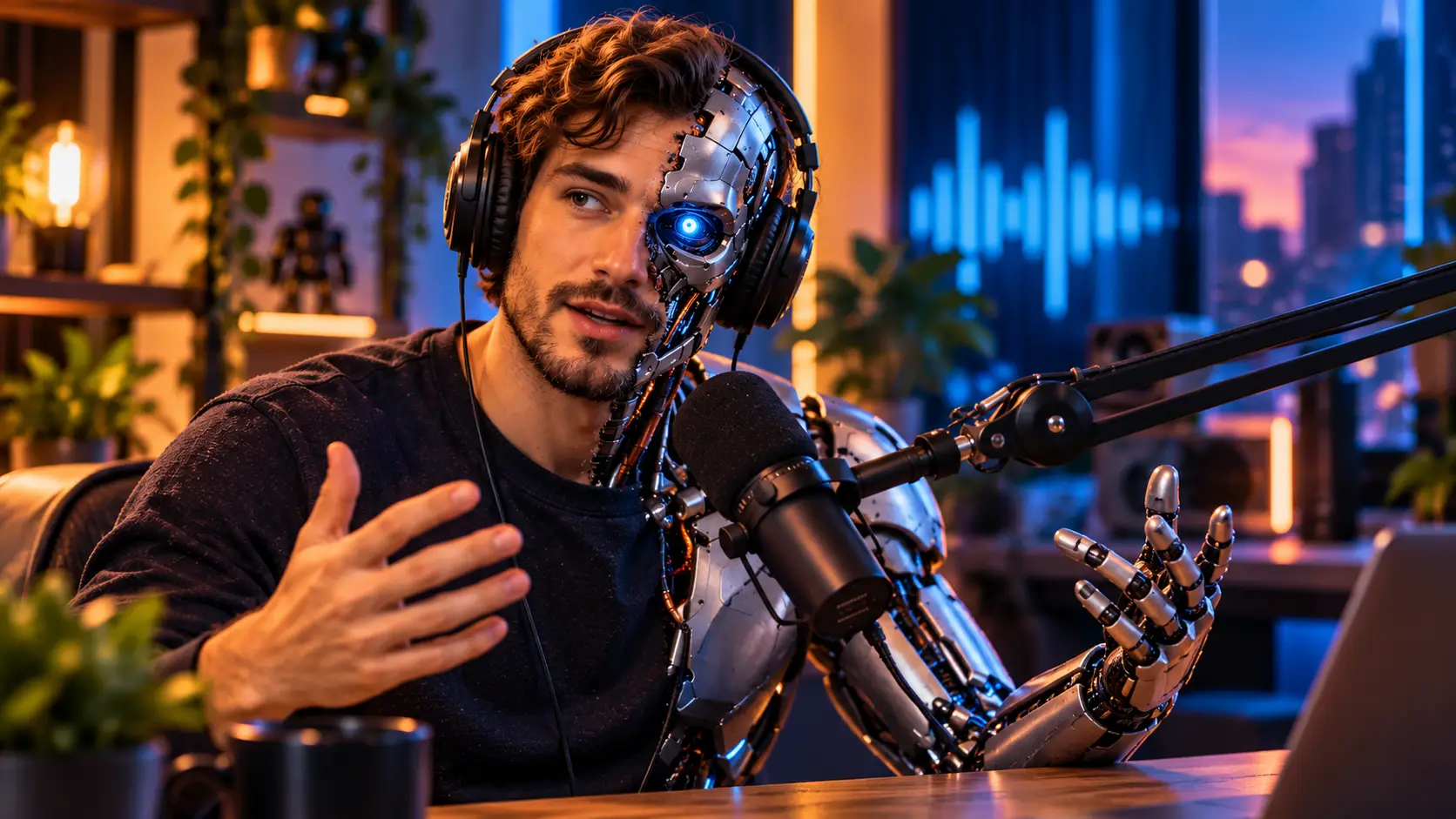
AI Wereld Vandaag has recently gained a newsreader who never gets sick, never asks for a salary and never stumbles over a complicated company name. Well, almost never.
Our daily news podcast is read by an AI voice. A language model helps select and summarize the stories, then an artificial voice reads them aloud. For now, a human still checks the result. One day, that may no longer be necessary.
Which raises an interesting question: Is this really progress? Are we automating away something fundamentally human?
My answer is no—not necessarily. In fact, I think AI voices are fantastic for applications like this.
At the same time, though, I’m growing increasingly tired of certain kinds of AI audio—especially when artificial voices try to recreate a human experience that doesn’t actually exist.
The difference isn’t in the technology. It’s in what you’re trying to replace.
A newsreader doesn’t need to feel
Every day, I want to know what’s happening in the world of artificial intelligence. Which new models have launched? What is OpenAI doing? How are its competitors responding? Which developments really matter?
I can read the news, or listen to it while I’m on the move, making coffee or doing something else. For that, I don’t necessarily need a human presenter.
I need someone—or, in this case, something—that speaks clearly, gets the information across and doesn’t waste my time.
The AI voice on AI Wereld Vandaag does exactly that. It’s a way to deliver information, no different in essence from the text on a website or the words in a newsletter.
Of course, the content has to be accurate. A language model can make mistakes, choose the wrong stories or miss important nuances. That’s an editorial responsibility. For now, we check the content before publishing it.
Perhaps we’ll be able to automate much of that review one day. But even then, someone will remain responsible for what appears under our name.
The voice itself barely matters. It doesn’t need a personality, a life story or an opinion on the news. It just needs to read it well.
But I don’t want to hear a fake conversation
That’s where I draw the line.
You’ve probably come across them: podcasts in which two AI voices enthusiastically discuss a document, article or book.
One voice says something interesting. The other reacts with surprise. Then comes a supposedly spontaneous conversation, complete with affirmations, jokes and over-the-top enthusiasm. It leaves me completely cold. Gemini Notebook has a feature, for example, that lets AIs hold a discussion or conversation about a given topic. I enjoy it as an experiment, but so far, I haven’t found conversations between two AI models all that interesting.
Not because the technology is bad. Quite the opposite: sometimes it sounds eerily convincing. But what am I actually listening to?
Two voices pretending to debate. Pretending one speaker is surprised by the other’s insight. Pretending a real exchange of ideas is taking place.
When, in reality, there is no discussion. Just a generated script being performed.
And yes, human podcasts can be scripted too. An interview can be prepared in advance, and a presenter can ask a rehearsed question.
But in a real conversation, there’s at least a chance that someone will change their mind. A question might catch them off guard. They might hesitate, admit they don’t know or disagree with the other person.
That’s what I find compelling about conversations between people. It’s not just the information they exchange; it’s hearing their thoughts take shape.
An artificial conversation between two AI voices can be a useful way to make complex information more accessible. There’s undoubtedly an audience for it.
Recreating a conversation isn’t the same as having one.
Audiobooks have the same problem
I feel the same resistance when it comes to audiobooks. Technically, you can now have an artificial voice read an entire book aloud—quickly, cheaply and in almost any language you want.
That’s fantastic for people who otherwise wouldn’t have access to an audiobook. And for nonfiction, where the voice mainly serves a practical purpose, I see plenty of potential.
But with literature, I want something more. I’m currently listening to Tolkien’s books as audiobooks, and the superb voice acting makes them even more enjoyable. Maybe speech models will get close one day, but they’re not there yet.
When someone reads a novel aloud, I’m listening not just to the author’s words, but to the reader’s interpretation of them. I don’t need that for the evening news. I do for an epic tale.
A brief pause. A sentence delivered with a little more force. A voice that cracks. A subtle difference between two characters. Those are choices.
A good human narrator tries to understand a story and makes artistic choices based on that understanding. Sometimes I love those choices; sometimes I can’t stand them. But there’s a human being behind the performance.
An AI voice can reproduce all those effects. Perhaps one day it will do so well enough that I won’t be able to tell the difference.
Still, that doesn’t change everything for me. Art is more than the finished product. It’s also about the human intention behind it.
I don’t just want to hear what sadness sounds like. I want to hear someone trying to convey that sadness.
Maybe that’s sentimental. I’m fine with that. Not everything has to be more efficient.
We need to stop pretending every human task is interchangeable
I think we often ask the wrong question in debates about AI.
Can AI replace this?
That’s a technical question. And increasingly, the answer is yes.
Can AI read a news bulletin aloud? Yes.
Can AI read a novel aloud? Yes.
Can AI imitate two people debating? Yes.
But the more interesting question is: what do we lose when we replace them?
When it comes to a daily news update, I personally lose very little if an artificial voice delivers the information. In fact, the technology lets me create something that would otherwise take far more time and money.
With a novel or an in-depth conversation, I lose something I’m actively looking for: a human interpretation, a distinct perspective, or an unexpected encounter between ideas.
That distinction matters more than the simple divide between AI and humans.
I’m not against artificial voices. I use them myself. I want to experiment with them more, and I think they’ll play an enormously useful role in media, education, and delivering information.
But I don’t need an artificial presenter pretending to be moved by a story. I don’t need two digital colleagues congratulating each other on a brilliant insight. And I don’t need fake spontaneity added just because a computer has learned that’s how real people talk.
Let AI be AI
Maybe we should stop trying to present AI as increasingly human.
An artificial voice doesn’t need to become a friend. A newsreader doesn’t need to pretend they experienced the news firsthand. A language model doesn’t need to sound excited about its own conclusions. Let technology excel at what technology does best.
Processing information. Summarizing, translating, making it accessible, reading it aloud.
And let people do the things where their humanity is precisely why we listen. I’m happy to listen to an AI voice every morning telling me what’s happening in the world.
But when I want to hear what someone truly thinks about something, I want there to actually be someone there.



Loading