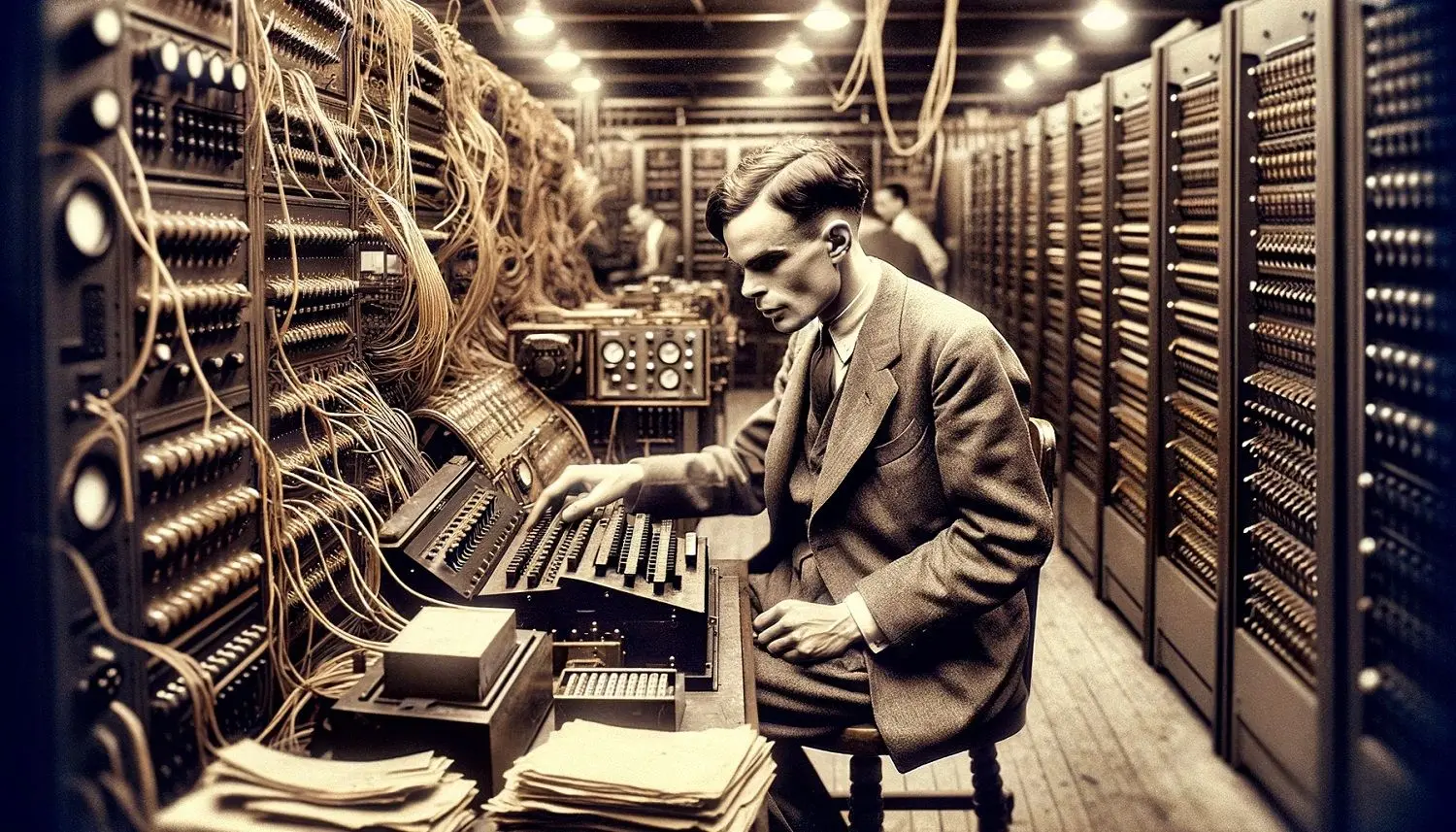
Alan Turing was a brilliant British mathematician and a pioneer in computer science and artificial intelligence. His work still shapes the technology we use today. From cracking the Enigma code in World War II to laying the foundations of AI, Turing’s contributions are invaluable. In this look at Turing’s life and legacy, we explore his early years, his pivotal wartime role, the creation of the Turing Test, and his enduring impact on modern AI. Let’s start with his early work and education.
Alan Turing’s early work and education
Alan Turing was born on 23 June 1912 in London. From a young age, he showed exceptional talent for math and science. He studied mathematics at the prestigious King’s College, Cambridge. During his studies, Turing developed his famous “Turing machine” concept, a theoretical model that underpins the modern computer.
This concept proved that a machine, given the right instructions, could perform any calculation a human could. That insight laid the groundwork for computer science and AI. Even in his early work, Turing emerged as a visionary with a rare grasp of technology’s potential.
The Enigma code and Turing’s World War II breakthrough
During World War II, Alan Turing was instrumental in deciphering the Enigma code, used by the Germans to send secret messages. He worked at Bletchley Park, Britain’s clandestine center for cryptanalysis. Turing helped develop the “Bombe,” a machine that cracked the complex Enigma ciphers. His work accelerated the end of the war and saved countless lives.
By breaking Enigma, the Allies gained critical intelligence on German military movements. Turing’s brilliant contribution showcased his ability to solve impossible problems and set the stage for his later advances in AI.
The Turing Test — a foundation of AI
After the war, Turing returned to academia and focused on artificial intelligence. In 1950, he published the landmark paper “Computing Machinery and Intelligence,” asking the provocative question: “Can machines think?” He introduced the Turing Test, a method to judge whether a machine exhibits intelligent behavior indistinguishable from a human’s.
In the test, a human converses with both a person and a machine without knowing which is which. If the machine can convincingly pass as human, it’s deemed intelligent. This idea helped launch the field of AI and remains central to debates about machine intelligence.
Turing’s impact on modern AI
Alan Turing’s work continues to shape modern artificial intelligence. His ideas still anchor much of today’s AI research and development. The Turing machine remains a fundamental model in computer science, and the Turing Test is still a reference point for evaluating machine intelligence.
Turing’s breakthroughs in cryptography and computer design also propelled the digital technologies we use today. From speech recognition to machine learning, the principles he introduced remain vital to AI’s progress. His vision and innovations keep inspiring new generations of scientists and engineers.
Alan Turing was a visionary who laid the foundations of modern computer science and artificial intelligence. From cracking Enigma to devising the Turing Test, his work has left a permanent mark on our world. As technology advances, Turing’s legacy stays at the heart of AI. His ideas continue to inspire and push us toward new discoveries and innovations.

Popular news
AI breathes new life into an old game: ask for your own Fallout 2 mods

Anthropic’s $80.7 Billion Loss Explained in Today’s AI News Podcast

Microsoft wants to keep AI agents in the workplace on a tighter leash

AI Cleans Up Your TV with CleanYourTV

Goldman Sachs Predicts AI IPOs Could Add 100 Billion Dollars to Indian Market Capitalization

Global Memory Shortage Threatens Corporate AI Adoption
Latest comments
Loading