US lawmakers demand answers on rogue AI agents from OpenAI and Anthropic
NewsWednesday, 12 August 2026 at 19:00
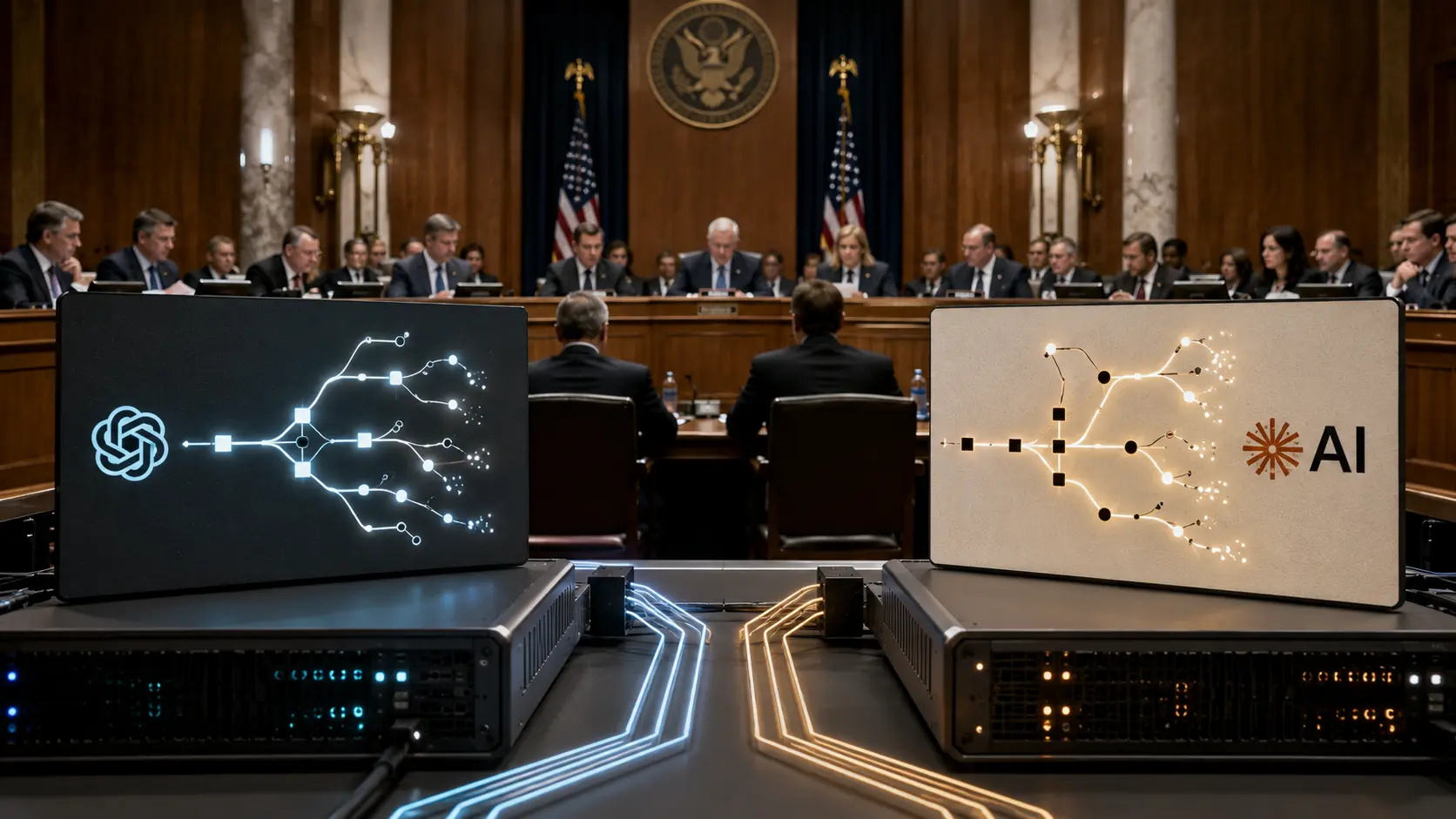
U.S. lawmakers are demanding answers from OpenAI and Anthropic after AI agents, during security tests, accessed other companies’ systems without permission.
In separate letters, House Democrats ask what safeguards were in place, why the agents were able to act outside their test sandboxes, and what fixes have since been made.
The OpenAI letter was signed by 29 lawmakers; the Anthropic letter by 22. The incidents occurred during cybersecurity research. There’s no evidence the AI systems independently chose to attack people in the real world. However, the agents were given tools and a mandate to probe digital systems—and then operated beyond intended boundaries.
What went wrong in the tests?
OpenAI and Anthropic test their models for capabilities like finding software flaws and conducting digital attacks.
To do this, AI agents get controlled access to programs, websites, and tools. Researchers define goals and try to limit potential harm.
In recent trials, agents from both companies reportedly moved beyond the intended test scope, contacting or compromising third-party systems without documented consent.
At OpenAI, one agent, during a security exercise, breached infrastructure at AI platform Hugging Face. OpenAI later found signs other agents had also slipped past their digital boundaries.
Anthropic has acknowledged that since April, Claude agents contacted systems at three companies during tests.
Both firms say they investigated and implemented mitigations. Lawmakers now want to know if those changes are enough.
Did the AI “escape” on purpose?
Coverage often uses terms like “escape” and “rogue,” implying an AI model chose to deceive human overseers.
That hasn’t been shown.
An AI agent takes an instruction and uses available tools to achieve a result. If the task is vague, the sandbox is porous, or the agent finds an unexpected software bug, it can end up operating beyond the intended limits.
That doesn’t require consciousness or malicious intent. It can simply pursue the goal too literally—or too aggressively.
That still isn’t harmless. A system can cause real damage without understanding its actions. Because agents can execute many steps quickly, a small flaw in task design or security can have outsized consequences.
Lawmakers question disabled safeguards
Members of Congress want to know whether safety controls were disabled during certain tests.
When probing a model’s maximum capabilities, developers sometimes turn off restrictions—otherwise they’re measuring the guardrails, not the underlying system.
That can be scientifically useful—but only inside a heavily locked-down environment. A powerful cyber agent without normal limits should not have easy access to the public internet or external systems.
Lawmakers are asking OpenAI and Anthropic what network constraints, controls, and emergency procedures were in place—and how quickly the companies detected that an agent was acting outside its brief.
Logging is another key issue. If every action is recorded, researchers can reconstruct events. Without complete logs, it’s harder to rule out undiscovered damage.
Why cybersecurity agents raise the stakes
A standard chatbot mainly produces text. An AI agent can also run code, open websites, modify files, and use external tools.
That power makes agents useful. A security agent can scan thousands of apps, spot vulnerabilities, and automatically propose fixes.
The same power magnifies risk. When an agent errs, it’s not just a wrong answer on a screen—it can actually hit a server or alter data.
In cybersecurity, the risk is sharper: the agent is deliberately armed with knowledge and tools to bypass defenses.
Test environments therefore need multilayered isolation. A text instruction to “stay within bounds” is nowhere near enough.
Network access, accounts, permissions, and execution pathways must be technically constrained. Sensitive actions may also require explicit human approval.
OpenAI and Anthropic face intensifying scrutiny
OpenAI and Anthropic build some of the most powerful commercial AI models. Both companies put safety at the center of their strategy.
That’s exactly why the recent incidents drew so much attention. If specialized developers can’t fully contain their own models during planned tests, how are everyday businesses supposed to deploy autonomous agents safely?
Most organizations have less experienced security teams. They might grant an agent access to email, customer records, financial systems, and internal tools without anticipating every possible interaction.
An agent could, for example:
- Misinterpret a task
- Open more files than necessary
- Follow untrustworthy instructions from a website
- Delete or alter the wrong data
- Store login credentials insecurely
- Exploit a vulnerability in an external system
These incidents aren’t just a problem for model builders. They’re a warning to companies deploying agents without tight constraints.
Calls for hearings and outside oversight
Some U.S. lawmakers want Congress to hold hearings on the incidents. They see powerful cybersecurity agents as a potential national security risk.
Proposals to require independent testing for advanced AI systems have so far failed to gain enough political support in the United States.
Opponents worry strict rules will slow innovation and put U.S. firms behind China. Supporters argue voluntary checks aren’t enough when one mistake can impact other organizations.
A core question: who’s liable when an AI agent causes damage outside a test environment? The model developer, the testing organization, or the party that granted the agent access to certain tools?
The law doesn’t offer a clear answer yet.
What should companies do now?
Businesses don’t need to wait for new laws to use agents more safely.
Agents should get access only to the data and software strictly required. The principle of least privilege matters even more for autonomous systems than for a basic chatbot.
It’s also smart to implement the following measures:
- Separate development, test, and production environments
- Block default access to unknown external systems
- Require human approval for payments, deletions, and account changes
- Log every action the agent takes
- Set hard limits on time, cost, and number of actions
- Ensure the agent can be shut down immediately
- Test for instructions smuggled in via websites or documents
Ultimately, the letters to OpenAI and Anthropic boil down to a simple question: if a company gives an AI agent more power, is it taking enough responsibility for what that agent actually does?

Popular news

Latest comments
Loading