5 AI stocks to watch now as chip spending accelerates
NewsWednesday, 12 August 2026 at 20:34
Updated at Wednesday, 12 August 2026 at 20:36
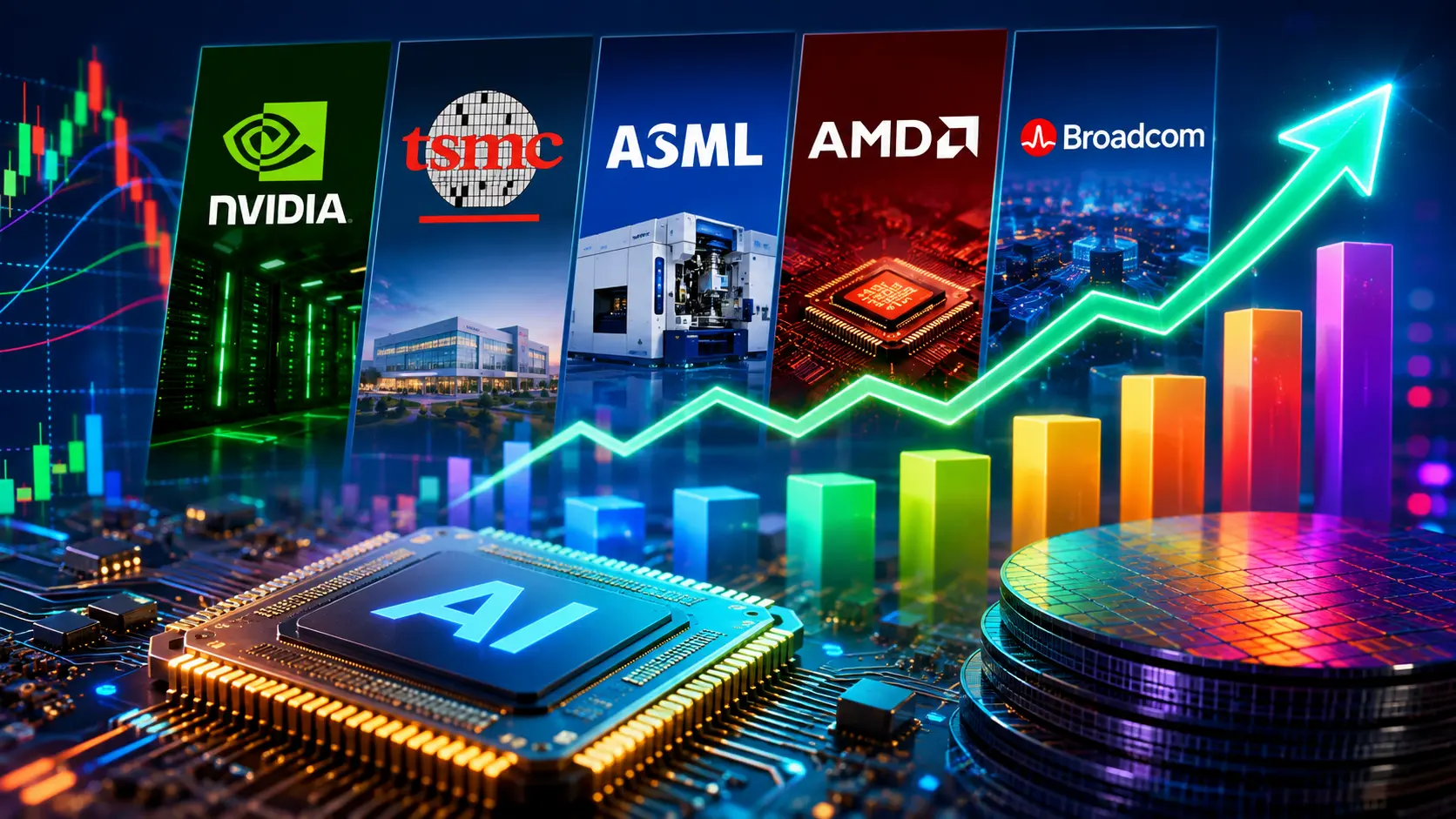
Artificial intelligence stocks are climbing again—but the latest rally is no longer just about chatbots.
The biggest financial commitments are increasingly flowing toward the physical and commercial infrastructure behind AI: processors, custom accelerators, semiconductor factories, networking equipment, data centers and enterprise software.
Five companies currently offer particularly revealing views of that market: Nvidia, AMD, Broadcom, Taiwan Semiconductor Manufacturing Company and Palantir.
| Company | Ticker | Price | Daily move | Immediate catalyst |
| Nvidia | NVDA | $223.89 | +2.94% | $500 billion AI-infrastructure financing initiative |
| AMD | AMD | $487.60 | +2.80% | Record quarterly revenue and Taalas acquisition |
| Broadcom | AVGO | $418.05 | +0.47% | Rapid custom AI-chip and networking growth |
| TSMC | TSM | $429.99 | +1.88% | July revenue increased 44.7% year over year |
| Palantir | PLTR | $172.67 | -1.30% | Revenue growth reached 93%, but valuation remains demanding |
These are not necessarily the five cheapest AI stocks—or automatic buying opportunities. They are five of the most interesting companies to follow because each controls a different bottleneck in the AI economy.
Price snapshot: August 12, 2026, at approximately 2:12 p.m. Eastern Time. U.S. markets were still open, so prices and daily changes may move before the closing bell.
1. Nvidia: the AI infrastructure financing machine
Price: $223.89
Daily change: +2.94%
Intraday range: $218.16–$224.98
Nvidia remains the clearest public-market proxy for global spending on artificial intelligence infrastructure.
Its latest move shows that the company is no longer content to wait for customers to finance new data centers. Nvidia has partnered with Apollo, BlackRock, Blackstone, Brookfield, Goldman Sachs and KKR to establish financing platforms intended to mobilize more than $500 billion in third-party capital for AI infrastructure.
That matters because electricity, land, financing and construction capacity are becoming nearly as important as the chips themselves. Nvidia benefits when more data centers can be funded and connected to the grid because those facilities create additional space for its processors, networking equipment and complete AI systems.
The company’s most recent reported quarter already demonstrated the scale of the boom. Fiscal first-quarter revenue reached $81.6 billion, up 85% from the previous year. Data-center revenue climbed 92% to $75.2 billion. Nvidia also authorized another $80 billion in share repurchases.
The next major event is Nvidia’s fiscal second-quarter report on August 26, 2026.
Why Nvidia is interesting
Nvidia is becoming more than a semiconductor designer. It now acts as a chip supplier, systems company, software platform, investor and increasingly a facilitator of infrastructure financing.
That gives the company exposure to almost every new AI data center—but it also creates a tightly connected ecosystem in which Nvidia and its customers sometimes fund one another.
The risk
At roughly 34 times reported earnings, Nvidia’s valuation is no longer as extreme as several other fast-growing AI names. Nevertheless, the share price assumes that global infrastructure spending will remain extraordinarily high.
Export restrictions, power shortages, circular financing or a slowdown in hyperscaler spending could challenge that assumption.
2. AMD: the challenger gaining scale
Price: $487.60
Daily change: +2.80%
Intraday range: $477.11–$491.48
AMD is trying to turn the AI accelerator market into a genuine two-horse race.
The company reported second-quarter revenue of $11.5 billion, with net income of $2.3 billion and diluted earnings per share of $1.38. Revenue rose from $10.3 billion in the preceding quarter, showing that AMD is gaining scale across data-center, client and embedded markets.
Two days after releasing those results, AMD announced the acquisition of Taalas, a company working on specialized compute technology for AI inference.
Inference—the process of running a trained model—is becoming one of the industry’s largest opportunities. Training creates the model, but every subsequent answer, generated image or agent action consumes inference capacity. As AI reaches more users, the cumulative cost of running models can eventually exceed the cost of training them.
AMD wants to compete with Nvidia using more than individual GPUs. Its broader strategy covers accelerators, EPYC processors, networking, software and purpose-built inference technology.
Why AMD is interesting
Customers increasingly want a credible alternative to Nvidia. Even companies that remain large Nvidia buyers have strategic reasons to qualify AMD hardware, improve their negotiating position and avoid dependence on a single supplier.
AMD does not need to overtake Nvidia to build a much larger AI business. Capturing even a modest portion of a rapidly expanding accelerator market could materially change its revenue base.
The risk
The market is already pricing in enormous growth. AMD trades at roughly 125 times reported earnings based on the current market data.
Its hardware must also compete with Nvidia’s mature CUDA ecosystem and with custom chips being developed by Google, Amazon, Microsoft, Meta and other large customers.
3. Broadcom: the custom-chip winner hiding in plain sight
Price: $418.05
Daily change: +0.47%
Intraday range: $417.15–$426.65
Broadcom is emerging as one of the biggest beneficiaries of the shift toward custom AI processors.
Not every AI company wants to buy a general-purpose Nvidia GPU for every workload. At sufficient scale, a chip optimized around a company’s own models and infrastructure can offer better performance, lower energy use and reduced operating costs.
Broadcom helps major customers design these custom accelerators. It also supplies the networking technology needed to connect enormous clusters of chips.
In its fiscal second quarter, Broadcom reported $10.8 billion in AI semiconductor revenue, an increase of 143% from a year earlier. Management forecast that the figure could reach approximately $16 billion in the third quarter, representing growth of more than 200%.
The company has also unveiled an LLM-optimized processor with OpenAI, further underlining its position in purpose-built AI infrastructure.
Why Broadcom is interesting
Broadcom can benefit even when large technology companies try to reduce their dependence on Nvidia.
More custom accelerators do not remove the need for advanced networking. In fact, larger and more diverse AI clusters can increase demand for Broadcom’s switching, connectivity and packaging technologies.
This makes Broadcom a particularly interesting “second-order” AI stock: it benefits from the arms race without needing every customer to choose the same processor architecture.
The risk
Broadcom trades at a high earnings multiple and its AI business depends heavily on a relatively small number of exceptionally large customers.
Custom chips are expensive to design and can take years to reach production. Any delay, cancellation or spending reduction by a hyperscale customer could therefore have an outsized effect.
Broadcom reports its next quarterly results on September 2, 2026.
4. TSMC: the factory behind the AI boom
Price: $429.99
Daily change: +1.88%
Intraday range: $424.20–$432.98
Nvidia, AMD and many custom-chip developers design advanced processors. TSMC manufactures them.
That distinction makes the Taiwanese company one of the most important—and difficult to replace—businesses in the global technology supply chain.
TSMC reported July revenue of NT$467.58 billion, up 44.7% from the same month a year earlier. Revenue over the first seven months of 2026 reached NT$2.87 trillion, an increase of 37%.
The numbers indicate that demand for advanced semiconductor capacity remains extremely strong. AI accelerators require not only leading-edge fabrication but also sophisticated packaging techniques that combine processors and high-bandwidth memory into complete computing systems.
Capacity at these advanced nodes and packaging facilities has become a strategic bottleneck.
Why TSMC is interesting
TSMC does not need to predict which individual chip designer will ultimately win.
It manufactures products for multiple competing companies and benefits from the growing complexity of advanced processors. Nvidia’s growth, AMD’s expansion and the custom-silicon movement can all translate into more demand for TSMC.
This “picks and shovels” position makes the company one of the broadest ways to follow AI-chip demand.
The risk
Its manufacturing concentration in Taiwan creates a geopolitical risk that cannot be ignored. TSMC is expanding in the United States, Japan and Europe, but recreating its Taiwanese ecosystem abroad is costly and time-consuming.
Samsung and Intel are also attempting to win more advanced foundry business. Meanwhile, enormous capital requirements mean TSMC must invest before it knows precisely how much future demand will materialize.
5. Palantir: explosive growth meets an extreme valuation
Price: $172.67
Daily change: -1.30%
Intraday range: $168.36–$174.57
Palantir represents the application layer of this list.
While the four semiconductor companies supply the infrastructure, Palantir sells software designed to help governments and businesses connect data, deploy AI systems and use them in operational decisions.
Its second-quarter results were extraordinary. Revenue increased 93% year over year, while U.S. revenue climbed 115% to $1.57 billion. U.S. commercial revenue surged 149%.
Palantir consequently raised its full-year guidance and now expects 2026 revenue growth of approximately 82%.
Those figures help explain why Palantir has become one of the market’s most closely followed AI software companies. Its Artificial Intelligence Platform, or AIP, is designed to connect models with company data and real-world workflows rather than merely provide a standalone chatbot.
Why Palantir is interesting
Palantir is producing the type of growth investors have been waiting to see from enterprise AI.
The key question for the entire industry is whether massive infrastructure spending will eventually generate valuable applications. Palantir’s results suggest that at least some organizations are moving from experimentation to paid, operational deployments.
The risk
Palantir is also the most obvious valuation warning in this group. The shares trade at roughly 148 times reported earnings even after their decline during the current session.
At that level, merely reporting strong growth may not be enough. Palantir must continue producing exceptional results for years to justify what investors are already paying.
Its large exposure to government and defense contracts also introduces political, procurement and reputational risks.
What these five stocks reveal about the AI market
Together, the companies map the emerging AI supply chain:
- Nvidia designs dominant general-purpose AI systems.
- AMD provides an increasingly credible alternative.
- Broadcom builds custom accelerators and networking technology.
- TSMC manufactures the most advanced processors.
- Palantir attempts to turn all that computing power into useful enterprise applications.
The strongest financial evidence still sits near the infrastructure layer. Nvidia, Broadcom and TSMC are reporting enormous demand because companies must build compute capacity before they can offer AI products at scale.
Palantir’s growth provides evidence that monetization is beginning farther up the stack. The tension is that valuations have often risen even faster than revenue and profit.
The bottom line
These five stocks are interesting for different reasons, but they share the same central question: can real AI revenue grow quickly enough to justify the amount of capital now being committed?
Nvidia’s new financing partnerships suggest the infrastructure boom could become even larger. AMD is gaining scale, Broadcom is capturing the custom-chip transition, TSMC is running the factories and Palantir is showing what enterprise monetization might look like.
The opportunity is real. So is the risk embedded in current prices.
Investors should therefore look beyond daily percentage moves. The numbers that matter most are data-center demand, AI revenue, manufacturing capacity, customer concentration, margins and the amount of actual cash generated from AI deployments.
This article is for informational purposes only and does not constitute investment advice. Share prices are volatile, and investors should conduct their own research before making financial decisions.
Suggested social caption:
The AI trade is no longer one stock.
Nvidia finances the infrastructure.
AMD challenges the leader.
Broadcom builds custom chips.
TSMC manufactures them.
Palantir tries to turn compute into revenue.
Here are five AI stocks moving now—and the risk behind each rally.

Popular news

Latest comments
Loading