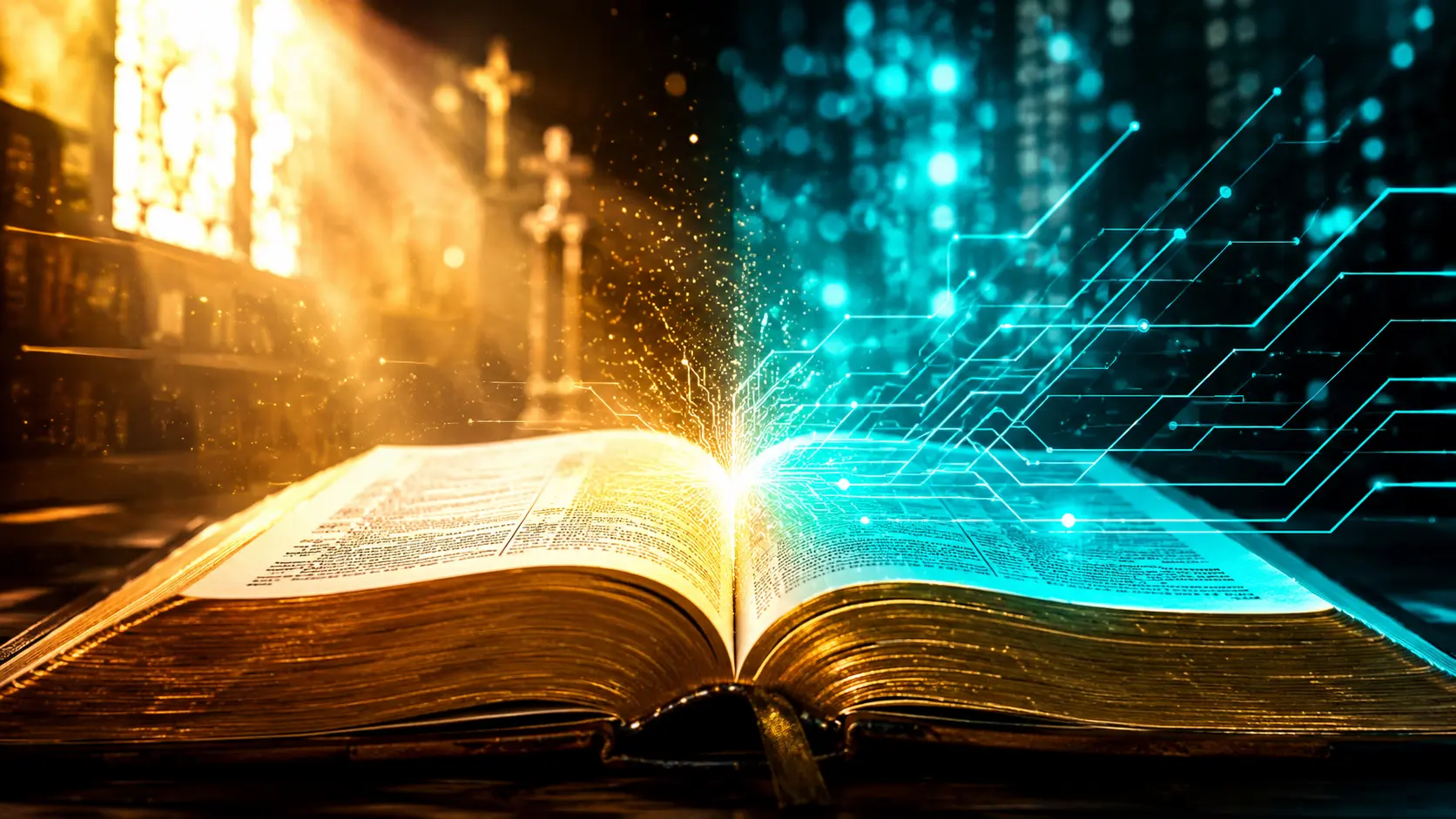
Pope Leo XIV has delivered his first major remarks on artificial intelligence. Speaking at a Vatican gathering, the new pontiff said AI offers enormous promise for science, healthcare, and communications, but also poses a serious threat to human dignity, work, and truth. According to Vatican News, he called AI “one of the defining challenges of this century.”
The comments are notable: it’s the first time Leo XIV has publicly laid out his vision for AI as pope. With that, the Vatican steps squarely into a fast-intensifying global debate, as companies like OpenAI, Google, Microsoft, and Meta pour billions into advanced AI systems.
The pope stressed that technological progress can never be separated from ethics. He warned that economic interests and efficiency risk being placed above human values. “Technology must serve humanity, not replace it,” he said in Rome.
Leo XIV’s stance echoes earlier Catholic warnings about automation and digital power. Under former Pope Francis, the Vatican repeatedly pushed for “ethical AI,” but Leo XIV appears to sharpen the tone as generative AI rolls out at breakneck speed worldwide.
The pope singled out AI’s impact on young people, jobs, and the information ecosystem. Algorithms, he said, can fuel disinformation, social manipulation, and a society with less human interaction. He also cautioned against systems that make decisions without human accountability or transparency.
Those concerns extend far beyond religious circles. Governments and regulators worldwide are racing to keep pace with AI’s rapid development. The European Union recently enacted the AI Act, the first sweeping law to rein in powerful AI systems. The European Commission says AI developers must be more transparent about risks, training data, and potential social harms.
Meanwhile, the geopolitics of AI is hardening. The United States and China are investing heavily in AI infrastructure, chips, and military applications. AI is shifting from a purely technological innovation to a strategic power lever. Analysts at outlets including Reuters and Bloomberg note that governments now view AI as critical to economic dominance, national security, and digital influence.
Leo XIV’s remarks land as Silicon Valley increasingly grapples with AI’s social fallout. OpenAI CEO Sam Altman has said AI “has the potential to change nearly every part of society.” At the same time, researchers warn about job losses, power concentration, and systems that may become difficult to control.
Within the Catholic Church, a deeper question looms: what does artificial intelligence mean for our very concept of the human person? The pope argued that human identity must never be reduced to data, algorithms, or economic output. He urged scientists, policymakers, and tech companies to “keep the human soul at the center” when designing new systems.
That moral lens is only growing more urgent as AI takes on creative and cognitive work. Generative AI can now write, code, perform medical analyses, and produce realistic video. The line between human and machine creativity is blurring faster than many policymakers expected.
In recent years, the Vatican has moved more assertively into tech debates. It has partnered with companies like IBM and Microsoft on discussions about AI ethics, focusing on transparency, inclusion, and human oversight. Leo XIV now goes further, explicitly warning about the social and spiritual fallout of unchecked AI development.
Experts say the Vatican’s influence in this conversation may be larger than many assume. The Catholic Church represents more than a billion believers and has often shaped global debates on ethics, science, and human rights. As AI raises fundamental questions about autonomy, truth, and labor, philosophical and religious voices are becoming harder to ignore.
The pope concluded with a call for international cooperation. AI, he argued, cannot be guided solely by commercial incentives or geopolitical rivalry. Nations should work together on limits, responsibilities, and the protection of human rights.
That touches a core question growing more urgent worldwide: who ultimately decides how AI shapes society? Tech companies command vast data, compute, and capital, while governments often struggle to keep up. Religious and civic groups, meanwhile, are pushing to ensure human values are not subordinated to automation and profit.
Pope Leo XIV’s first major AI message makes one thing clear: artificial intelligence is no longer just about technology. The debate has shifted to power, ethics, and what role humans want to retain in an increasingly autonomous digital world.



Loading