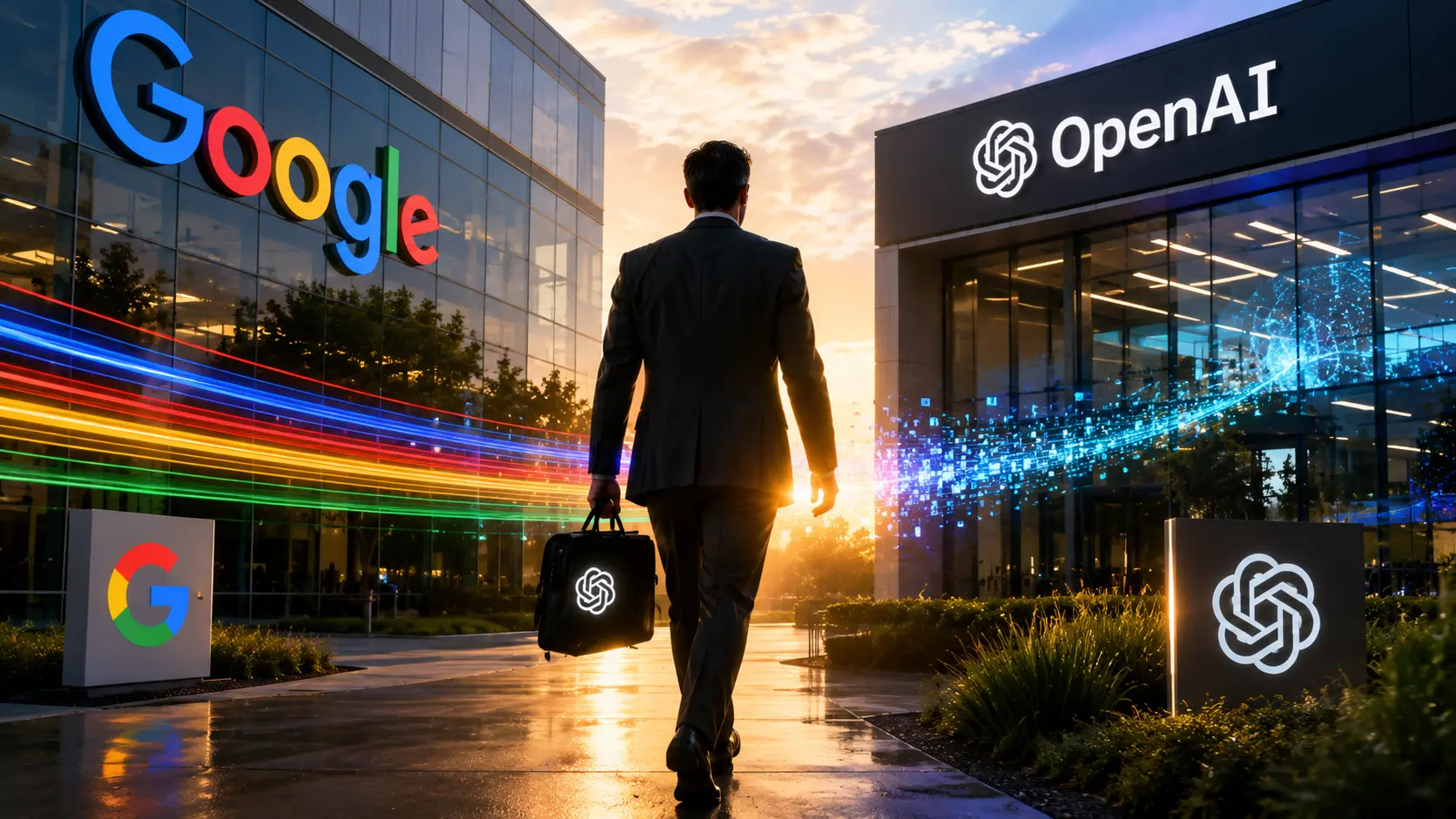
OpenAI has poached another of the world’s most influential AI researchers. Noam Shazeer, Google’s VP of Engineering and a key force behind Gemini, is moving to OpenAI. The jump comes less than two years after Google reportedly spent about $2.7 billion to bring Shazeer back via a deal around Character.AI.
This is more than a staffing move. Shazeer is widely seen as an architect of the modern AI boom. He co-authored the landmark paper Attention Is All You Need, which introduced the transformer architecture that powers today’s largest AI models, including ChatGPT, Gemini, and Claude.
His exit underscores how fierce the battle for AI talent has become—and how strong OpenAI’s pull remains, even as Google, Anthropic, Meta, and others intensify competition.
Who is Noam Shazeer?
Noam Shazeer is part of a small group of researchers who laid the foundation for the current generation of AI systems.
He spent years at Google and played a major role at Google Brain, a precursor to today’s Google DeepMind. In 2021 he left to co-found the chatbot startup Character.AI. In 2024, Google reportedly structured a roughly $2.7 billion deal that brought Shazeer and part of his team back into the company.
After returning, he became a technical leader behind Gemini—Google’s flagship AI model and a direct rival to ChatGPT. Inside Google, he was viewed as pivotal to closing the gap with OpenAI.
That’s what makes his move to OpenAI stand out.
Why this move matters
This shift is about expertise, not org charts.
In AI, veteran researchers are scarce. Only a limited number of people can design and train new frontier-scale model architectures. Many analysts liken today’s moment to the early semiconductor era, when a few dozen engineers separated leaders from laggards.
Shazeer is in that league.
Reuters reports he’ll work at OpenAI on next-generation AI architectures and research. OpenAI CEO Sam Altman has also said he’s wanted to collaborate with Shazeer for years.
Bringing in a researcher with this track record doesn’t just bolster OpenAI’s technical edge—it signals to the market that OpenAI remains a magnet for elite talent.
Is Google losing ground?
One departure doesn’t erase Google’s AI lead.
The company still has thousands of AI researchers within Google DeepMind under Demis Hassabis. Gemini is also scaling fast. According to Google, the Gemini app surpassed 750 million monthly users by the end of 2025.
Still, the timing stings.
Google has poured billions into strengthening its AI push. Gemini now underpins Search, Android, Workspace, and the company’s broader cloud strategy.
When one of the system’s key architects leaves for its biggest rival, it inevitably raises questions about talent retention and internal competition.
The AI talent war escalates
The AI race is less about products—and more about people.
Meta, OpenAI, Anthropic, Google, and xAI now offer compensation packages reaching tens of millions of dollars a year for top researchers. In many cases, equity eclipses base salary.
The logic is simple.
A single breakthrough in model architecture can create billions in market value. That’s turned elite scientists into some of the most valuable scarce assets in tech.
Shazeer’s move shows that even multibillion-dollar investments can’t guarantee loyalty.
What it means for OpenAI
For OpenAI, Shazeer’s arrival is a strategic play.
The company is preparing for an IPO while facing tougher rivals. Google has advanced quickly with Gemini, and Anthropic’s Claude is gaining ground. Recent benchmarks even showed Gemini outpacing ChatGPT on certain tasks.
By hiring one of Google’s top AI architects, OpenAI not only strengthens its research bench but also indirectly weakens a core competitor.
It’s a sign of the AI race’s next phase: not just models, chips, and data centers—but the people who design the technology.
What it means for the AI market
The headline: AI expertise is concentrating in a handful of companies.
OpenAI, Google DeepMind, Anthropic, Meta, and a few Chinese labs hold most of the world’s top-tier AI researchers. That widens their technological lead and makes it harder for newcomers to catch up.
For European AI startups, that’s a critical challenge. The gap isn’t just funding or infrastructure—it’s access to the most experienced researchers.
Shazeer’s move highlights a broader trend: the global AI race is increasingly decided by talent, not just technology.
Conclusion
The shift of Gemini heavyweight Noam Shazeer to OpenAI is one of the year’s most striking AI personnel moves.
For Google, it’s the loss of a key Gemini architect. For OpenAI, it’s a major boost to its research arm. And for the rest of the market, it’s fresh proof that the fight for AI talent now rivals the battles over users, models, and capital.
In AI, the winners are increasingly the companies that attract the sharpest minds. This week, OpenAI just landed another one.

Popular news

Anthropic Secures Thirty Two Billion Dollar Queensland Data Centre Deal for Claude

Zuckerberg Rejects AI Slowdown Calls Amid Industry Safety Debate

Crusoe Secures Nearly Four Billion Dollars to Scale Factory Built AI Data Centers

Amazon Secures Generac Stake in Massive Eight Billion Dollar Generator Pact

Spain Registers First End-to-End Autonomous AI Data Breach

MIT and Suffolk Unveil How AI is Reshaping Construction Productivity
Latest comments
Loading