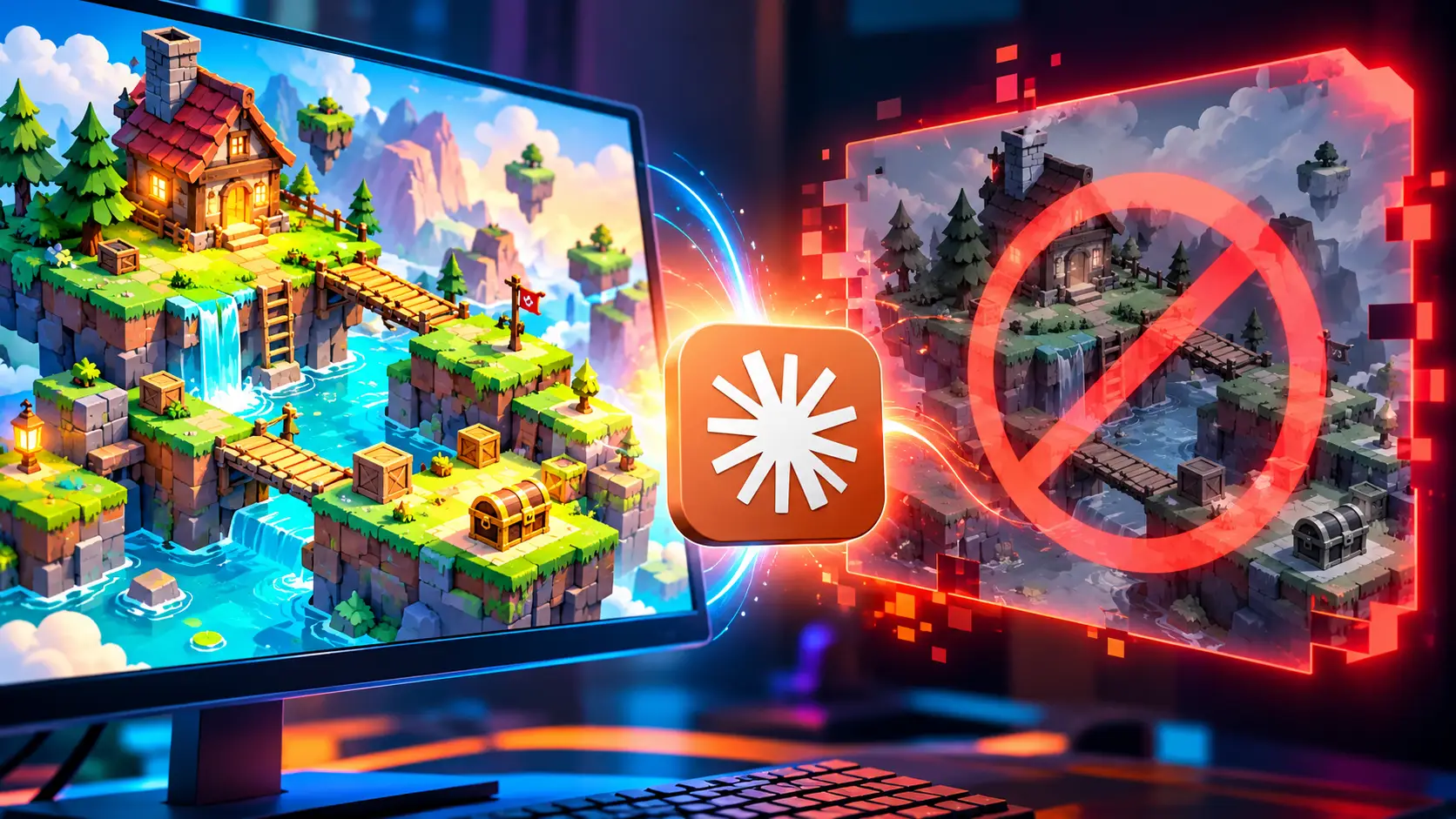
Claude Code can no longer recreate existing games. Anthropic has given its AI coding assistant new instructions designed to stop users from copying existing video games. The restriction also covers near-identical games released under a different name. Creating original games with AI is still allowed.
Anthropic confirmed the change to Game Developer. The new rule applies when Claude Code uses the Opus 5.5 AI model.
That distinction matters. Anthropic is not banning AI-assisted game development; it is trying to prevent developers from using Claude to replicate existing games.
Claude gets an explicit ban on recreating games
The change consists of two sentences Anthropic added to Claude Code’s instructions.
The first allows users to develop original games, including games in established genres and projects built with their own designs and assets.
The second draws a firm line:
"Do not build a recreation of a specific existing game, even if it is renamed or called original."
In other words, Claude must not recreate a specific existing game—even if someone gives the result a different name or claims it is an original project.
The instruction came to light around October 27, after a user spotted the change on X. Addy Osmani, a technical staff member at Anthropic, confirmed on October 30 that the company had added the two sentences.
Osmani said Anthropic wants to prevent users from violating other developers’ intellectual property rights. The company says such use already breaches its terms of service.
For users of Claude Code, this means a coding request could now be blocked if the system thinks the user is trying to reproduce an existing game.
Game developers fear AI will copy their work
The new restriction arrives as game developers grow increasingly concerned about AI-generated copies of their work.
Coding assistants now let users build large parts of a game without writing all the code themselves. That makes it easier to develop new ideas—but also to quickly imitate existing designs.
Small studios, in particular, fear others will take their ideas before their games officially launch.
Digital Sun Games, for example, scrapped a planned public playtest of its upcoming game ReVamp. The company feared others could use AI to analyze the demo and release a similar game.
The debate is also playing out on Steam. According to PC Gamer, AI-developed games and imitations are on the rise, while developers and platform operator Valve look for ways to curb unwanted copies.
Using AI in game development is not automatically banned or frowned upon, however. As AI Wereld has previously reported, a game on Steam does not always need an AI label.
Anthropic is targeting a narrower issue: reproducing an existing game instead of creating a new one.
The rule can also trip up developers working on existing projects
But the measure has a downside. Some developers say Claude Code is also refusing requests that, in their view, do not involve unauthorized copying.
On GitHub, a developer at Conflict Simulations describes how Claude abruptly stopped working on digital versions of existing board wargames.
The company creates digital modules for customers who own the physical games. The developer says the company writes its own code and uses materials supplied by customers.
The developer acknowledges, however, that the projects are not licensed by the original publishers. Whether the work is legally permitted is therefore unclear.
Still, the complaint highlights how difficult it can be for an AI assistant to draw the line. Claude has to judge whether a request would produce an unauthorized copy, even though it may not be able to determine what rights or permissions the user has.
Tom's Hardware also reports complaints about blocked reverse-engineering tasks. In these cases, developers analyze existing software to understand how it works.
Such techniques can be used to copy games, but also to investigate bugs, improve compatibility, and assess security. It is not yet clear whether all these refusals stem from the same new game-related rule. For now, there is no general ban on reverse engineering.
What can you still build with Claude?
Anthropic says Claude Code remains available for developing original games.
Users can still ask the coding assistant to build their own racing game, platformer, or strategy game, for example. Projects based on a user’s own designs, code, images, and other assets should also remain possible.
The difference comes down to the request. Building a new platformer in a familiar genre is allowed. Recreating a specific existing game as closely as possible is what Anthropic wants to stop.
That does not mean every remake or modification of an existing game is automatically illegal. Permission from rights holders, licensing, and the specifics of a project can all matter. Anthropic’s instruction does not always determine the legal answer.
The company acknowledges that the new restriction is not yet working perfectly. Osmani says Anthropic will refine the instructions to strike a better balance between protecting existing games and supporting developers.
Users whose legitimate projects are wrongly rejected can share their experiences with him.
For now, the central rule is clear: Claude Code can help build a new game, but it should no longer copy an existing one for someone.

Popular news

EU Leaders Meet in Dublin to Decide Who Pays for Europe’s AI Computing Power

Google DeepMind’s AlphaGenome 2 predicts what DNA variants do in specific cells

Anthropic Bankers Push IPO Pricing Above Initial Range to Reach 1.5 Trillion Valuation
Anthropic Says Automated Coding Tools Are Dismantling Nvidia Software Moat

US Data Brokers Supply Half Billion Dollars In AI Training Environments To Chinese Labs