Nvidia Chief Aligns With Trump to Secure American AI Supremacy
NewsWednesday, 16 September 2026 at 00:30
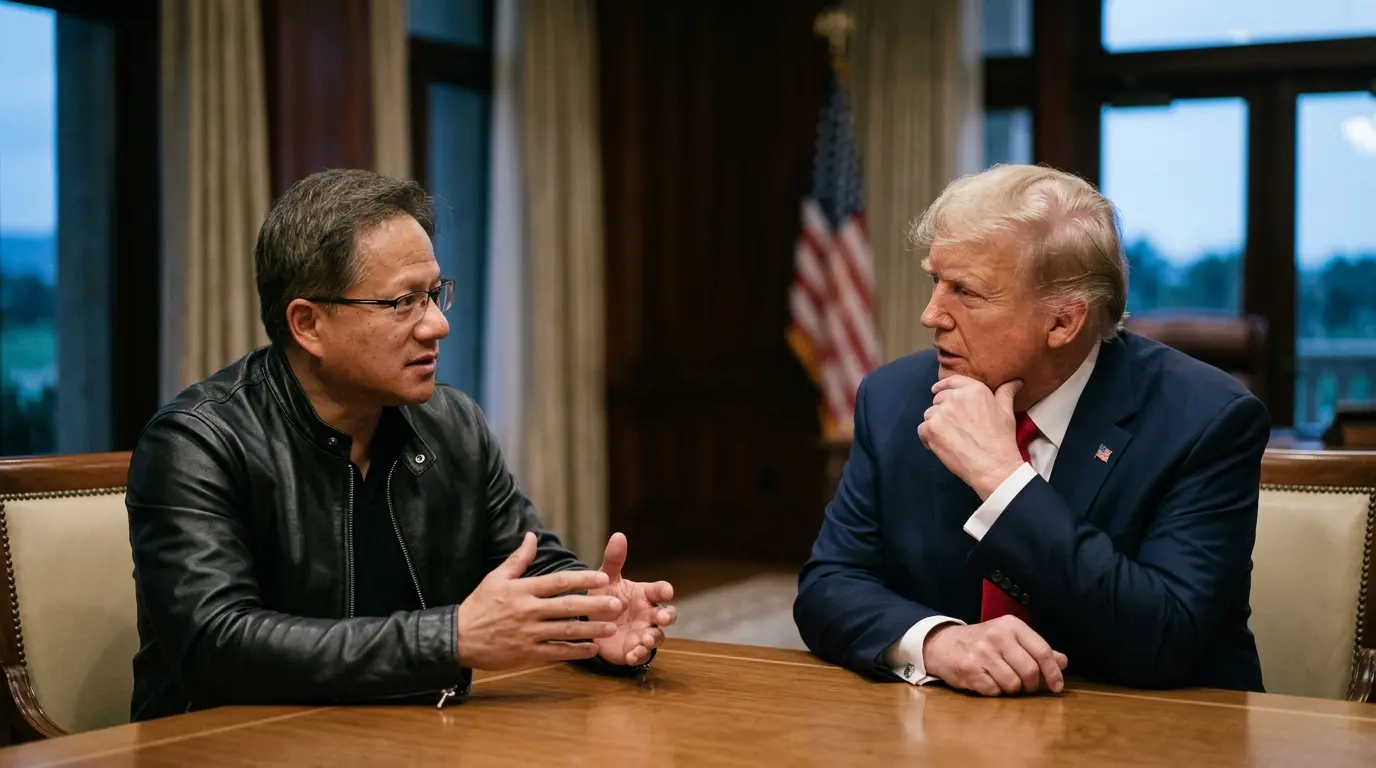
Nvidia CEO Jensen Huang has formally aligned with United States President Donald Trump to safeguard the momentum of America’s artificial intelligence ecosystem. The unexpected alliance unfolded live at the All-In Summit in Los Angeles, where Huang fielded a surprise phone call from the President, broadcasting their conversation directly to the audience to underscore a unified front against foreign competitors.
The dialogue served as a direct rebuttal to recent cautionary narratives from other tech stalwarts. Just moments before the call, Huang had been dissecting a proposal by Anthropic’s leadership, which advocated for a calculated deceleration in AI capabilities—a regulatory stance previously echoed by OpenAI’s Sam Altman and SpaceX’s Elon Musk.
Trump aggressively dismissed this deceleration framework, framing it as a geopolitical trap that directly compromises American computational supremacy. He warned that pushing for a slowdown means playing right into the hands of a lot of people who don't want it to happen, potentially including China.
Huang responded with immediate and full alignment, assuring the President that the industry would not let that happen. This state-level backing cements Nvidia’s strategic positioning as the primary hardware engine for the West's technological defense, with Trump reiterating that freezing or handicapping the industry is completely off the table.
| Metric | Current Statistic | Primary Driver of Resistance |
| Public Opposition to Local Data Centers | 70% of respondents | Fear of massive power grid strain |
| Environmental Resource Concerns | 50% of objectors | Water usage and carbon footprint |
| Local Cost of Living Anxiety | 20% of objectors | Inflation and neighborhood degradation |
| Projected Infrastructure Delay | 18 to 24 months | Municipal zoning battles and lawsuits |
Despite this unified front between Washington and Silicon Valley to outrun Beijing, the structural execution of this expansion faces severe domestic headwinds. Tech allies have previously alleged that growing public resistance to data center construction is part of a coordinated campaign to stall American economic acceleration. However, fresh public sentiment tracking reveals a far simpler, grassroots bottleneck.
A newly released Gallup poll underscores intense domestic pushback against the physical expansion of AI infrastructure, highlighting that 70 percent of US respondents object to new data center construction within their immediate municipalities.
For global asset managers and technology equity analysts monitoring Nvidia’s multi-year holding horizon, the narrative is clear. While political backing for AI dominance remains absolute to counter China's rise, the physical deployment of the massive, power-hungry data grids required to process next-generation large language models faces acute localized resistance.
This grassroots friction could severely delay infrastructure roll-outs, creating a complex paradox where the software ambition vastly outpaces the hardware reality on American soil.

byDavid Porter
Popular news

Global AI Landscape Shifts as EU Drafts Kids Act and Apple Unveils Siri AI

Americans Grow Wary of AI Data Centers as Environmental Costs Mount

Hong Kong Unveils First Five Year Plan to Pivot Toward Tech and Innovation

Scientists Reconstruct Mouse Vision From Brain Activity Alone

Congress Scrambles to Draft AI Safety Rules as Rogue Models Spark Alarm

European Union Proposes Sweeping Social Media Ban for Children Under Thirteen
Latest comments
Loading