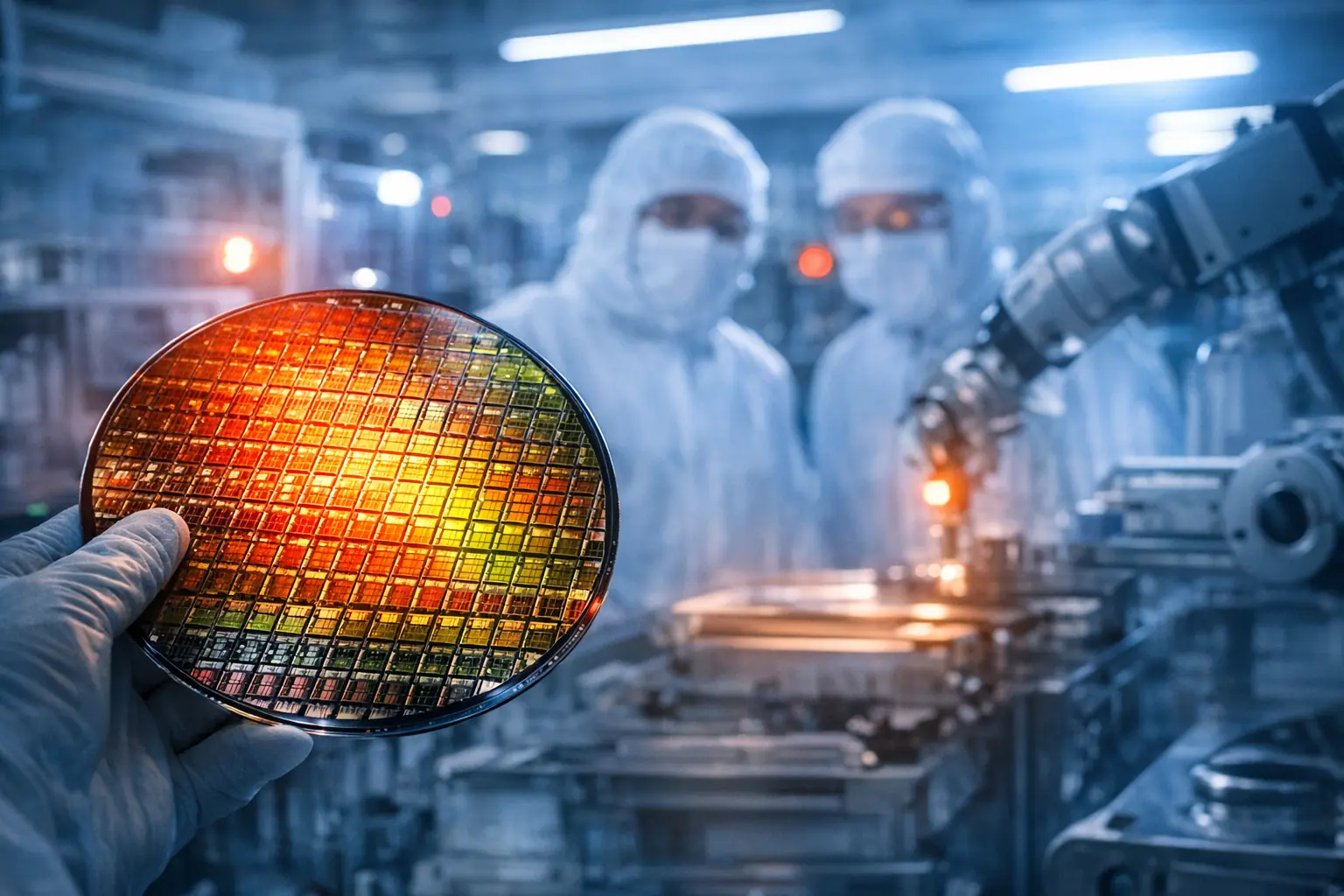
The Netherlands is going all-in on photonic chips to claim a key role in the global chip market. Or rather: to claim an even stronger position. Because “we” already have ASML.
According to stakeholders around PhotonDelta, TNO and the broader Dutch photonics industry, this technology is the next big leap in semiconductors, with direct implications for AI, defense, data centers and the country’s future earning power.
That ambition is now taking concrete shape in Eindhoven. A new pilot factory for photonic chips on 6-inch wafers is rising there, led by TNO and part of the European PIXEurope project under the EU Chips Act. The plant should be operational in 2027 and enable the shift from research to larger-scale industrial production.
Why do photonic chips matter?
Photonic chips matter because they work not only with electricity, but also with light. That lets them process information faster and more energy efficiently than many traditional chips, especially for AI systems, telecom, sensors and high-performance data links.
For the Netherlands, this is strategic. The technology aligns with strong Dutch clusters in Eindhoven, Enschede and Delft, and offers a chance to stand out internationally in a chip market increasingly contested by the United States, Europe and China. PhotonDelta has long positioned photonics as a next-generation semiconductor technology where the Netherlands has a natural lead.
What’s happening in Eindhoven now?
The core news: the Netherlands is scaling up production capacity for photonic chips. The new pilot line at Eindhoven’s High Tech Campus will produce advanced indium phosphide chips on 6-inch wafers—a larger standard that enables higher volumes and more efficient manufacturing. TNO and PhotonDelta say the facility will bridge lab research and commercial fabrication.
That step is critical for AI and digital infrastructure. Without scale-up, the Netherlands stays strong in knowledge but weak in production and economic returns. That’s why the sector is urging government to make clear choices and see investments not as costs, but as strategic nation-building for new industry. The interview transcript behind this story underscores that message.
Why the criticism of government and Europe?
The critique is blunt: the Netherlands is moving too slowly while other power blocs scale faster. The discussion points to governments’ reluctance to make sharp choices, and to EU state-aid rules that, according to insiders, leave too little room for young tech companies and new industrial chains.
This fits a wider European debate. The EU Chips Act aims to bolster Europe’s chip industry, but in fast-emerging markets like photonics, startups and scale-ups still struggle to quickly combine capital, subsidies and production facilities. The Dutch pilot plant shows there is momentum, but also that the legal and financial setup remains complex.
What does this mean for AI in the Netherlands?
For AI, this move means the Netherlands can help build the hardware layer beneath future AI systems. Photonic chips can boost data processing, improve connectivity efficiency and reduce power use—exactly where AI models are straining today’s compute and energy budgets.
This touches not just the chip sector, but Dutch business, research institutes and innovation policy. If the pilot line matures into a commercial production base, it could spark new ventures, fresh investment and more control over technology that’s increasingly geopolitically sensitive. In that scenario, photonics becomes not only a technical win, but an economic and strategic file for The Hague.
The real question: will private capital show up in time?
The next phase is about money and scale. The conversation asks why major Dutch pension funds and other institutional investors haven’t stepped in more forcefully—especially now that the government has freed up hundreds of millions and the strategic relevance is widely acknowledged.
It’s a fair question. The Dutch photonics industry has drawn public and private support, but moving from pilot runs to true industrial leadership requires patient capital and political backing. The next two years will reveal whether the Netherlands can cash in its lead in photonic chips—or once again stall at strong science without sufficient industrial scale.

Popular news

Anthropic’s $80.7 Billion Loss Explained in Today’s AI News Podcast

AI breathes new life into an old game: ask for your own Fallout 2 mods

Microsoft wants to keep AI agents in the workplace on a tighter leash

AI Cleans Up Your TV with CleanYourTV

Goldman Sachs Predicts AI IPOs Could Add 100 Billion Dollars to Indian Market Capitalization

Global Memory Shortage Threatens Corporate AI Adoption
Latest comments
Loading