Huawei Unveils OceanStor M900 to Crush AI Inference Memory Bottlenecks
NewsFriday, 18 September 2026 at 11:30
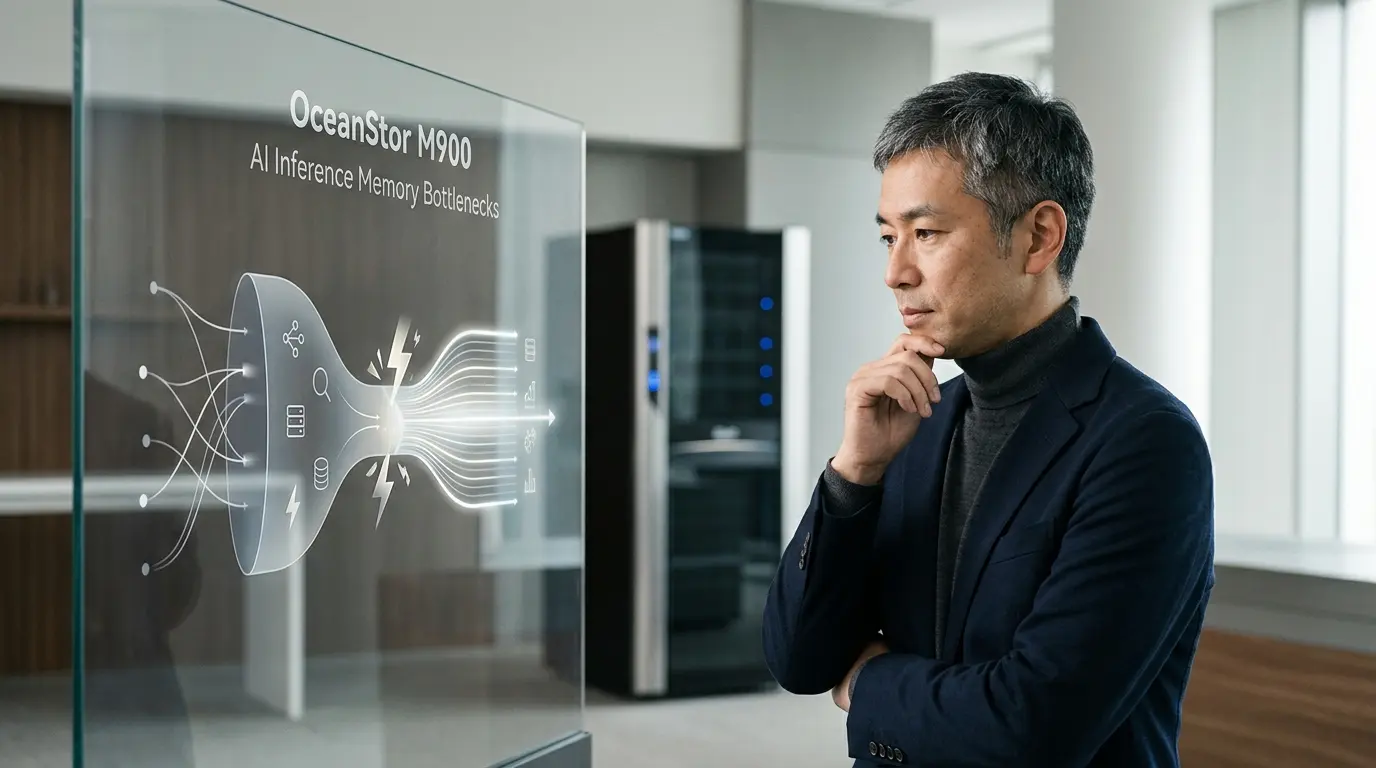
The rapid evolution of artificial intelligence has hit a physical wall. As large language models balloon toward 10 trillion parameters, the memory required to process million-token context windows is completely overwhelming traditional on-chip memory and DRAM.
At HUAWEI CONNECT 2026, Huawei tackled this exact bottleneck by unveiling the OceanStor M900 Context Memory Storage, a purpose-built infrastructure designed to accelerate AI inference in hyperscale environments. You can read the full technical details in Huawei's official announcement.
Agentic AI applications now routinely handle complex, multi-turn reasoning tasks. Every step generates massive amounts of Key-Value (KV) cache data that must be stored and instantly recalled. Legacy architectures simply cannot scale to meet this demand cost-effectively. The M900 changes the game by shifting the industry away from a purely compute-centric mindset toward a deeply integrated compute, network, and storage collaboration.
Powered by a high-speed UnifiedBus interconnect, the system creates a globally shared, tiered KV cache pool. This expands the available memory per Neural Processing Unit (NPU) from mere gigabytes to full terabytes, allowing a single cluster to scale up to a staggering 64 petabytes of capacity.
| Performance Metric | Legacy DRAM and On-Chip Setup | OceanStor M900 Architecture | Direct Operational Impact |
| Max Cluster Capacity | ~2 to 4 TB per node | 64 PB globally shared pool | Eliminates context truncation in 1M+ token windows |
| Data Access Latency | 1 to 2 milliseconds (CPU forwarding) | 60 microseconds (one-hop NPU to SSD) | Halves Time to First Token (TTFT) for end users |
| Storage Endurance | Standard 1 to 3 Drive Writes Per Day | Up to 24 DWPD via adaptive lifecycle management | Extends hardware lifespan by 16x, slashing OPEX |
| Protocol Overhead | High (multiple translation layers) | Zero (native KV semantics) | Doubles overall token throughput per cluster |
The hardware design is just as radical as the capacity numbers. The M900 is the industry’s first architecture to integrate the CPU, network controller, and NAND controller into a single unit. This enables a direct, one-hop connection between the SuperPoD’s NPU and the solid-state drives. By completely bypassing traditional protocol conversion and CPU forwarding, access latency plummets to 60 microseconds while delivering 40 terabytes per second of aggregate bandwidth.
Running massive AI models is notoriously expensive, making operational efficiency just as critical as raw speed. The M900 addresses this with KV-aware adaptive storage technology. The system intelligently predicts data lifecycles, routing information across different storage media based on its immediate computational value. This smart distribution extends SSD endurance by a factor of 16, dramatically cutting media replacement costs and long-term operational expenses.
The transition to agentic AI requires infrastructure that can handle continuous, complex reasoning without choking on memory constraints. By fundamentally rethinking how data flows between processors and storage, Huawei is laying down a highly efficient blueprint for the next generation of hyperscale data centers.

byDavid Porter
Popular news

Anthropic Secures Thirty Two Billion Dollar Queensland Data Centre Deal for Claude

Zuckerberg Rejects AI Slowdown Calls Amid Industry Safety Debate

Crusoe Secures Nearly Four Billion Dollars to Scale Factory Built AI Data Centers

Amazon Secures Generac Stake in Massive Eight Billion Dollar Generator Pact

Spain Registers First End-to-End Autonomous AI Data Breach

MIT and Suffolk Unveil How AI is Reshaping Construction Productivity
Latest comments
Loading