Google Home Speaker arrives in Europe: your AI assistant moves from phone to living room
NewsFriday, 19 June 2026 at 05:00
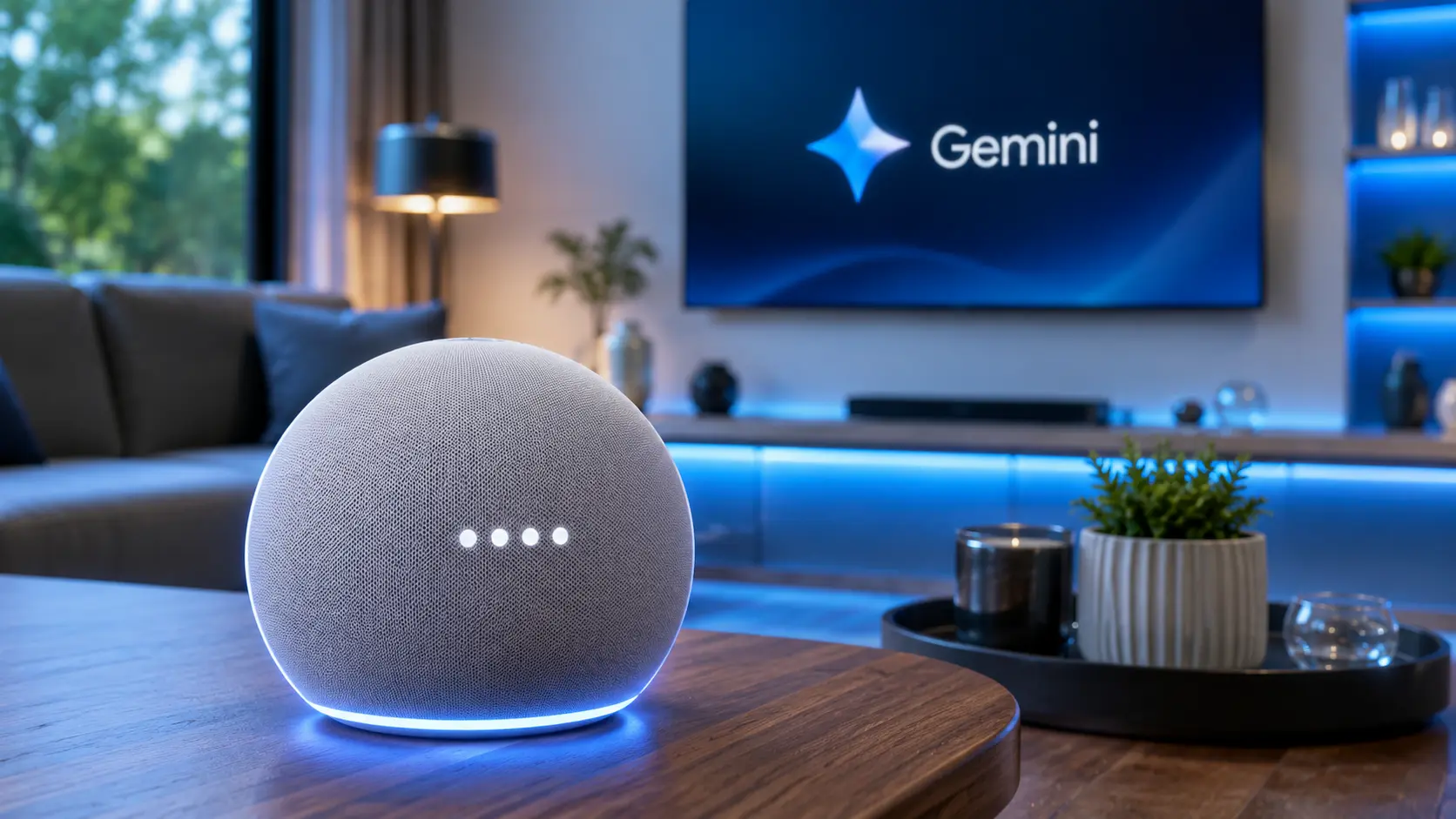
Google will launch its new Home Speaker in Europe on June 25. Priced at 119.99 euros, it’s the first Google device built entirely around Gemini—the AI model gradually replacing the classic Google Assistant. It’s a clear next move in the smart home battle, with AI taking center stage.
This debut is more than a new speaker release. It shows how big tech is weaving AI deeper into everyday consumer products. After smartphones, search, and chat, Gemini is now moving decisively into the living room.
According to Google, the Home Speaker is the first smart speaker purpose-built for the generative AI era. It arrives June 25 in the Netherlands, Belgium, and other European markets. Preorders are already open.
Google phases out Assistant in favor of Gemini
The new Home Speaker is Google’s first piece of hardware with Gemini at the core of the user experience.
Conversations feel more natural than with the traditional Google Assistant. Gemini handles longer prompts, multiple requests at once, and follow-ups within the same chat. That means you don’t have to keep saying “Hey Google” to continue.
It sounds minor, but it changes how people interact with voice assistants.
Until now, smart speaker chats followed a rigid pattern: give a command, get a reply, start over. Gemini aims to replace that with a continuous, context-aware conversation.
Google calls this feature Gemini Live. You can interrupt, dig deeper, or switch topics without a new wake phrase. A paid subscription is required for this feature.
The launch fits Google’s broader plan to make Gemini the default assistant across phones, smart displays, speakers, and other connected devices.
Beyond playlists: smarter, context-aware AI
For years, smart speakers were mostly for simple tasks like playing music, setting timers, or checking the weather.
Google wants to push that model further.
With Gemini, the Home Speaker can handle complex, multi-step requests. Ask it to dim the lights, adjust the thermostat, and start a specific playlist—together.
Gemini also tracks context. If you ask for a recipe, then follow up with “How many calories is that?”, it understands what “that” refers to—no extra explanation needed.
Gemini ties into the broader Google Home ecosystem as well.
If you have Nest cameras or video doorbells, you can ask about events captured on video. For example: when a package was delivered or what activity was detected in the backyard. Gemini analyzes the footage and summarizes it in natural language.
The smart speaker is evolving from a voice remote into the home’s AI hub.
AI subscriptions take center stage
Notably, part of the new AI feature set sits behind paid plans.
Google is introducing two premium tiers within Google Home Premium. The Standard tier unlocks Gemini Live, advanced automations, and 30 days of video storage. The pricier Advanced tier adds deeper AI analysis of camera footage and natural-language search across video history.
The strategy underscores how AI is becoming a recurring revenue engine.
Smart speakers used to be about hardware; the value is shifting to software and AI services. Selling a speaker brings a one-time payment, while AI subscriptions drive monthly revenue.
It mirrors what’s happening with ChatGPT, Microsoft Copilot, and other AI platforms.
Hardware gets a serious refresh
Beyond AI, Google has upgraded the hardware.
The new Home Speaker has a spherical design, 107 mm in diameter and 86.6 mm tall—positioned between the old Google Home Mini and the larger Nest Audio.
Google says the driver is twice the size of the Nest Mini’s, with bass that’s 2.5 times stronger. It also supports 360-degree audio for even room-wide sound.
You can pair two Home Speakers for stereo, or link one with a Google TV Streamer for spatial surround audio. Existing Nest speakers, displays, and other Google Cast devices remain compatible.
A striking new touch is the LED ring on the bottom of the speaker. It lights up when Gemini is listening, drafting a reply, or acting on a command. There’s also a physical switch so users can fully disable the microphone.
Big Tech’s smart speaker battle reignites
The Home Speaker arrives just as the smart assistant market starts moving again.
For years, innovation in smart speakers was modest. Most devices relied on similar voice tech and offered near-identical features.
Generative AI is changing the game.
Google aims to stand out by building Gemini directly into the hardware. Meanwhile, Amazon is developing a new Alexa powered by generative AI, and Apple is investing heavily in AI features for Siri and the HomePod lineup.
The new race isn’t about the speaker itself—it’s about the intelligence behind it.
For consumers, that means smart speakers are evolving into personal digital assistants that can execute tasks, reason, summarize, and understand context.
Why it matters
The new Home Speaker shows AI shifting from a standalone chatbot to a permanent layer in consumer hardware.
Today, users still open a dedicated AI app. Tech companies expect AI to be continuously present across smartphones, cars, TVs, cameras, and smart homes.
Google is using the Home Speaker as one of the first devices to make that vision real.
That turns the speaker from a music player into a gateway to an AI system connected to the rest of the home. The June 25 launch could mark a key moment in the next phase of the AI market: a shift from screen-based AI to AI that’s always present in the physical environment.

Popular news

Anthropic Secures Thirty Two Billion Dollar Queensland Data Centre Deal for Claude

Zuckerberg Rejects AI Slowdown Calls Amid Industry Safety Debate

Crusoe Secures Nearly Four Billion Dollars to Scale Factory Built AI Data Centers

Amazon Secures Generac Stake in Massive Eight Billion Dollar Generator Pact

Spain Registers First End-to-End Autonomous AI Data Breach

MIT and Suffolk Unveil How AI is Reshaping Construction Productivity
Latest comments
Loading