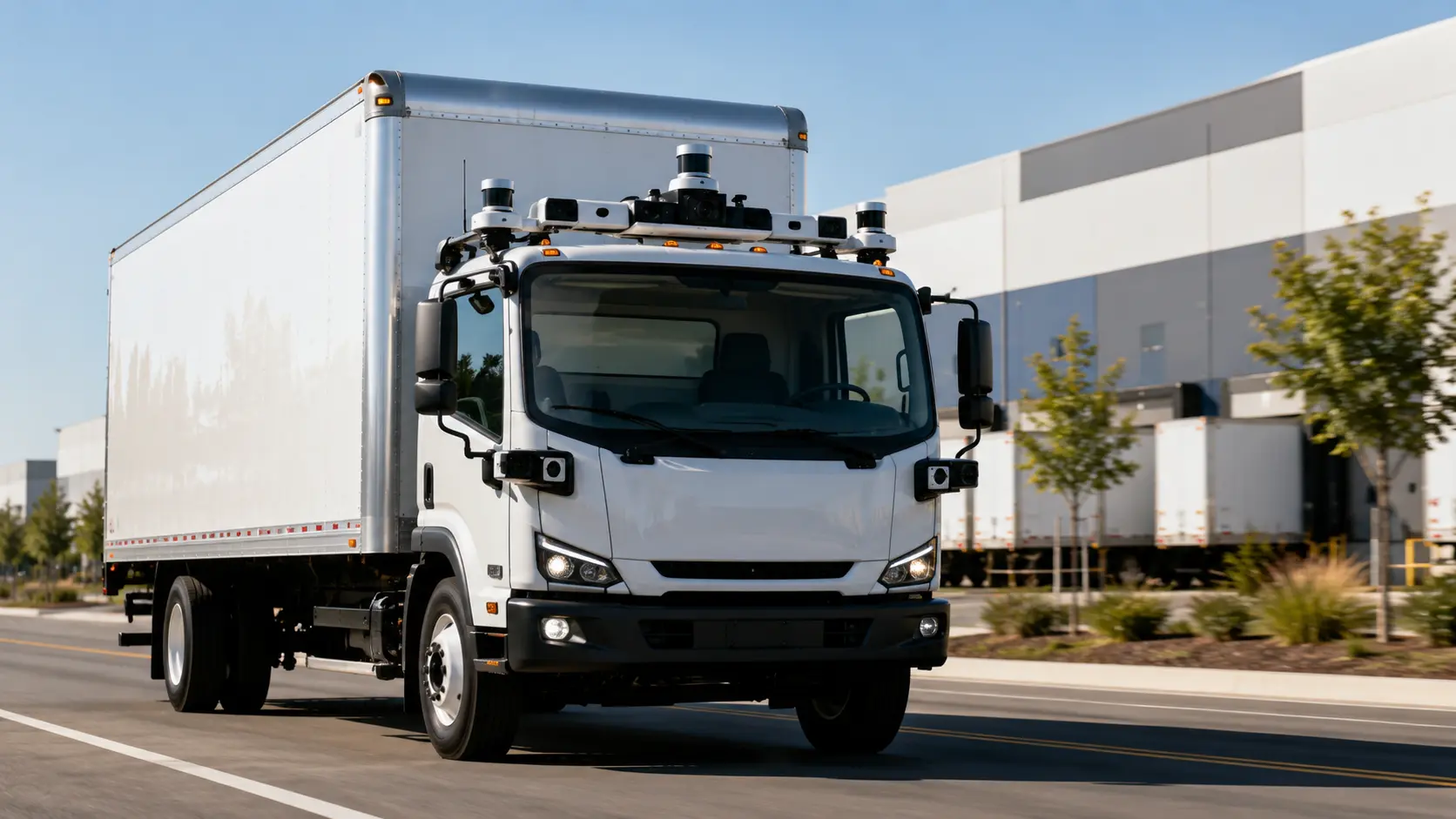
Gatik has raised $200 million to scale its commercial fleet of self-driving trucks. The funding follows what the company describes as 85,000 fully driverless orders and more than $600 million in contracted revenue—signaling a shift in autonomous trucking from tech trials to real logistics. The company announced the round in a press release.
The Series D is led by Qatar Investment Authority (QIA) and Koch Disruptive Technologies. Millennium Management, ARK Invest, and Intact Private Capital also joined. QIA separately confirmed its participation, saying the new capital will accelerate Gatik’s commercial scale-up.
Gatik runs driverless trucks on existing supply chains
Gatik isn’t chasing trucks that roam nationwide. It targets the “middle mile”: fixed, high-frequency routes between distribution centers and stores.
That constrained operating domain makes commercial deployment easier than trucks that must handle every highway, destination, and traffic scenario. Routes can be deeply pre-mapped, and vehicles repeatedly return to the same hubs.
According to Gatik, its driverless trucks now run daily for major retailers and grocers in Texas, Arizona, Arkansas, and Canada—without a human driver or safety operator behind the wheel. QIA also states Gatik is operating fully driverless vehicles within existing customer networks.
TechCrunch frames this as a new phase for the company. Gatik moved beyond small pilots and now operates dozens of fully driverless trucks commercially across multiple markets. It also signed a multi-year deal with PepsiCo, hauling Frito-Lay products between DCs and stores.
85,000 driverless orders and $600 million are Gatik’s claims
The headline numbers come from Gatik itself. The company says it has completed 85,000 fully driverless orders with 99% on-time performance, and cites more than $600 million in contracted revenue. Reuters reports these figures explicitly as company-provided.
Contracted revenue doesn’t mean Gatik has already booked $600 million. It reflects the value of signed commercial agreements to be delivered over time.
There’s also a notable discrepancy in today’s sources. QIA’s separate announcement cites more than 100,000 fully driverless orders, while Reuters and Gatik’s own funding release state 85,000. Without further explanation, 85,000 is the most conservative figure to use—and should be treated as a company claim.
Why autonomy is breaking through on the middle mile
Gatik’s strategy highlights where autonomy may scale sooner than fully driverless consumer cars. Rather than covering every possible trip, the company automates a predictable slice of the logistics chain.
That model brings three practical advantages: routes repeat frequently, distribution centers offer a more controlled setting, and customers have a direct economic incentive for predictable capacity.
It’s fundamentally different from a robotaxi, which must pick up and drop off riders across countless locations. A middle-mile truck can run the same link hundreds or thousands of times.
For retailers, that can make automation attractive before autonomy is universally capable. The upside isn’t just lower labor costs; it’s longer vehicle utilization and more predictable capacity planning.
New capital to grow fleet and market coverage
Gatik plans to use the $200 million to expand its commercial operations, technology, infrastructure, and headcount. The company told Reuters it’s targeting more than 100 driverless trucks by the end of 2026.
That scale-up will be a tougher test than the funding number. Autonomous vehicles can perform well in small fleets, but moving to dozens or hundreds introduces new operational challenges. Maintenance, remote support, weather, charging, and integration with existing distribution systems all need to remain reliable.
Gatik says its latest vehicles now run on surface streets and highways and can handle light rain and snow. The company does not disclose full fleet size or a complete customer list.
Investors bet on autonomy as logistics infrastructure
Participation from Qatar Investment Authority and Koch Disruptive Technologies adds a strategic layer. QIA explicitly frames autonomous freight as infrastructure that can make global logistics more efficient and reliable.
For the autonomy sector, the yardstick for success is shifting. For years, the focus was test miles, demos, and permits. In commercial freight, revenue, delivery reliability, fleet size, and real routes executed are becoming the metrics that matter.
Gatik is a clear case study. The $200 million matters because investors are writing bigger checks after the company says it’s running driverless commercial routes.
Next comes scale. If Gatik can extend current routes to hundreds of vehicles without compromising safety, reliability, or cost, the industry gets a concrete economic test for autonomous AI. The question stops being whether a truck can drive itself—and becomes whether a fully driverless logistics network can operate structurally cheaper and more reliably than the alternative.

Latest comments
Loading