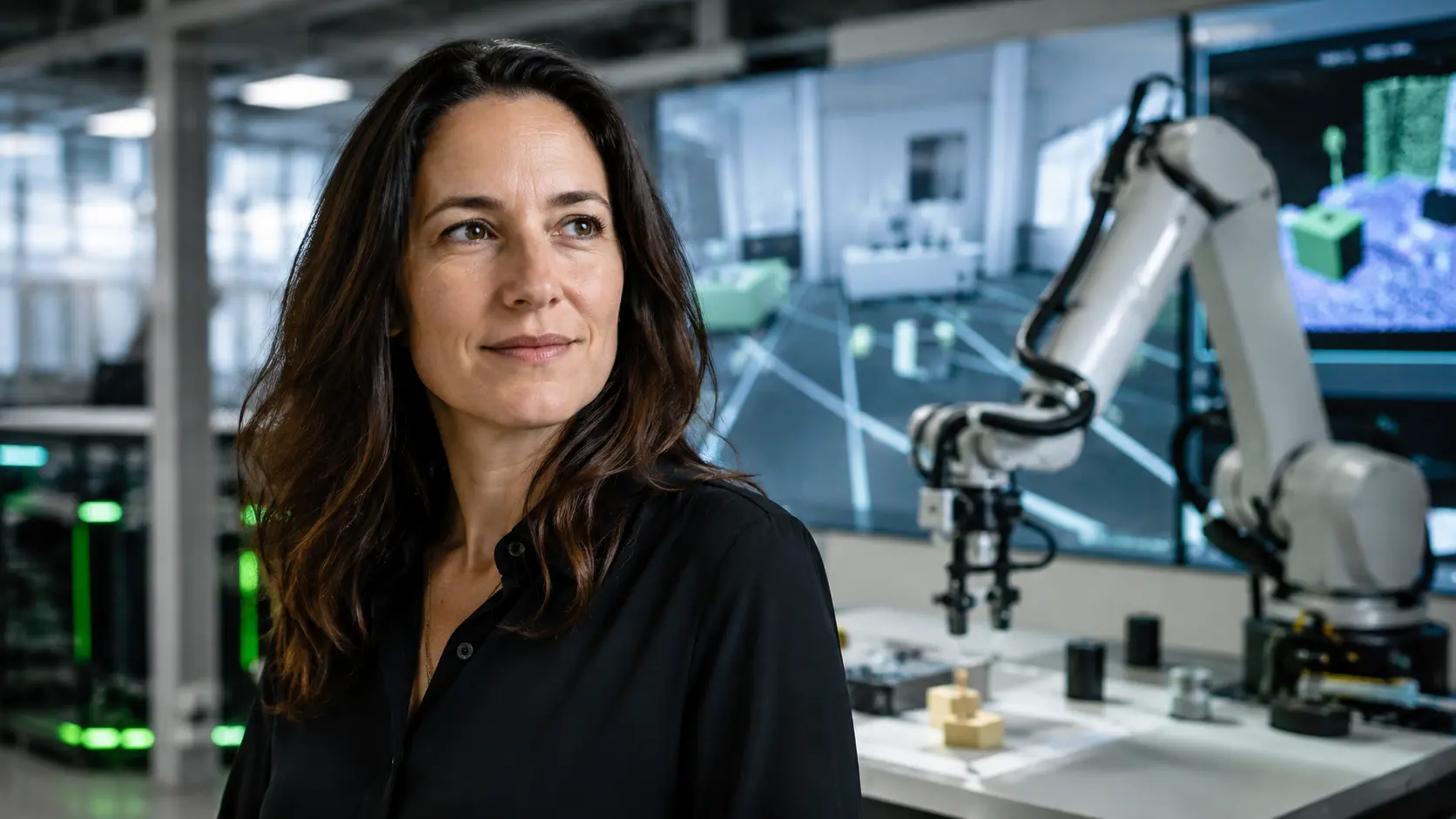
Former Nvidia vice president and AI researcher Sanja Fidler on Wednesday launched Veeda AI, a startup aiming to build so‑called world models—AI systems that simulate the physical world so robots can practice endlessly. Media reports peg the seed round at more than $90 million. Veeda has confirmed its investors but did not disclose an amount in its public launch.
Veeda goes public
The first verifiable public moment is The Logic’s report on Wednesday, August 19, at 5:00 p.m. CET. Twelve minutes later, Fidler introduced Veeda on LinkedIn, naming Khosla Ventures and Radical Ventures as investors and unveiling co-founders Zan Gojcic and Huan Ling.
The Logic first reported the seed round exceeds $90 million; SiliconANGLE later cited it as $90 million. Veeda’s own announcement lists no figure. Treat the size as media reporting, not a company-confirmed number. No valuation has been disclosed.
The news is Veeda’s public debut and the funding reported by The Logic. The concept of world models isn’t new—Nvidia, Google DeepMind, and Yann LeCun’s startup are exploring similar ground.
A training ground for physical AI
Language models learn patterns from text. A world model learns how an environment changes when an agent acts. If a robot lifts a box, pushes a door, or drops an object, the model should predict what happens next.
Veeda describes its goal as building “the Matrix” for physical AI: scalable virtual worlds where robots learn by interacting. In such simulations, a robotic arm can try the same task thousands or millions of times, make mistakes, and test new behaviors without damaging real machines or risking people.
That tackles a core scaling problem. Training in factories, warehouses, or homes is expensive and slow—requiring robots, locations, operators, and safety protocols. Digital environments can run faster and in parallel. The hard part: simulations must mimic physics and edge cases closely enough. If not, robots learn behaviors that fail in the real world.
Ambition first, product later
Veeda says it’s developing multimodal foundation world models that learn from sensor and environment data. The company hasn’t yet shown a public product, independent benchmarks, or a robot demonstrably performing a task better thanks to its models. “Matrix” is an ambition, not proof that the simulation is fully realistic.
Veeda is not, as far as known, building its own humanoid robot. It’s focused on underlying models and training environments that others can use—sitting at the intersection of AI research, simulation software, and robotics infrastructure.
Veeda has teams or offices in Toronto, Zurich, Mountain View, and Singapore, and is hiring researchers and engineers. Fidler brings experience from Nvidia in 3D computer vision, simulation, and embodied AI. Co-founders Gojcic and Ling also have backgrounds in 3D and generative AI.
The data race shifts to robot training
Language models feasted on the web’s massive text troves. Robots don’t have an equally vast, ready-made corpus of safe real-world experience. That’s why companies are investing in synthetic data, digital twins, and virtual training grounds.
AI Wereld previously covered Luma AI’s push to scale world models. Figure AI and Brookfield are building a massive physical training site for humanoid robots. Veeda is taking a largely virtual route.
The funding underscores how much capital is flowing into this missing training layer. The real test is whether Veeda’s simulations are accurate enough to help real robots learn measurably faster. The launch is new; the technical breakthrough still needs to be proven.

Latest comments
Loading