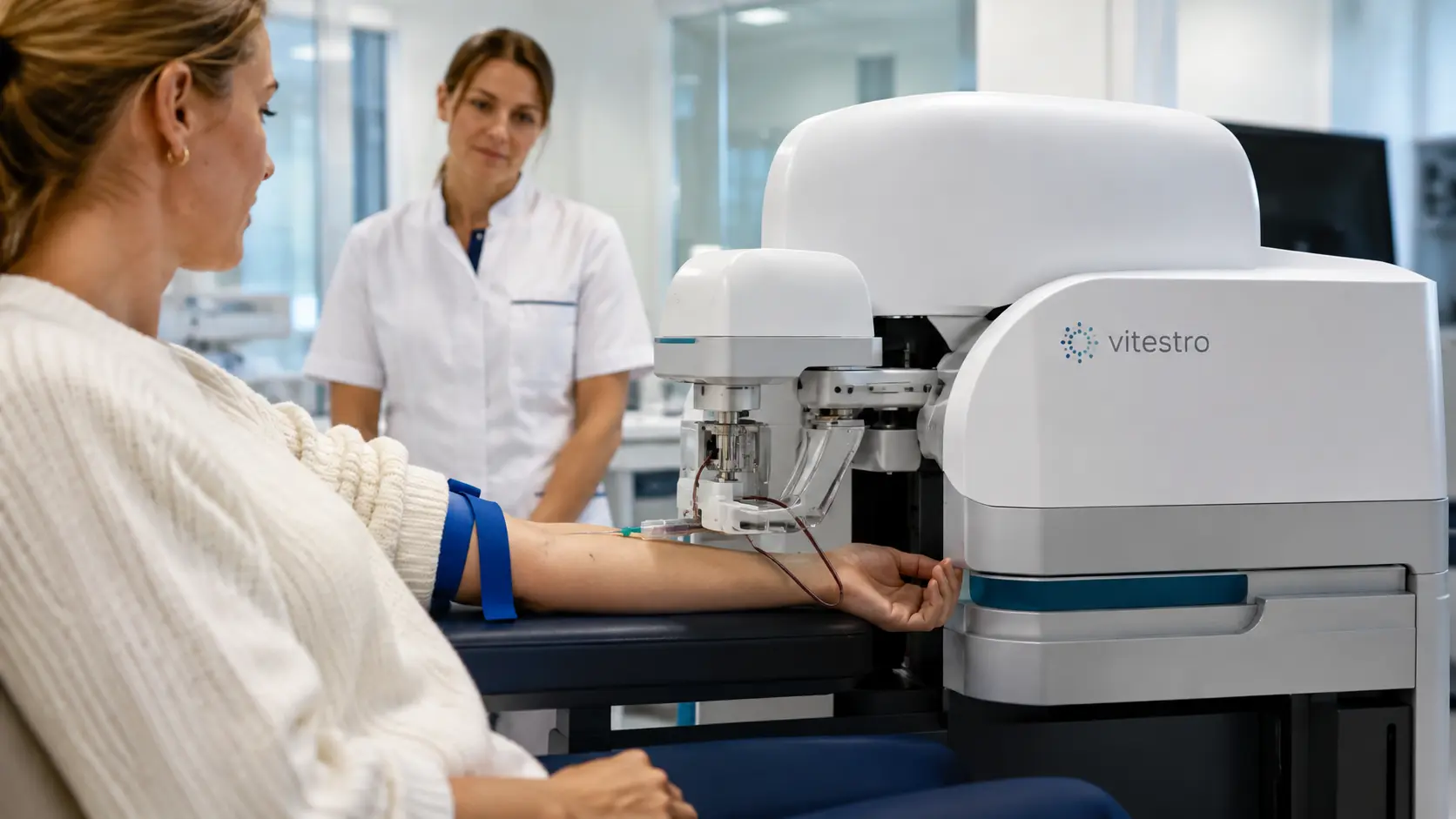
The U.S. Food and Drug Administration (FDA) has authorized market entry for Aletta, a robot from Utrecht-based Vitestro that can draw blood from an arm on its own. The decision was issued Wednesday, August 19, and is, according to the FDA, the first U.S. authorization for a standalone device that performs a blood draw without manual intervention during the stick. The system isn’t entirely hands-off: a supervisor trained in phlebotomy must start each session and remain available to intervene.
What this FDA decision actually changes
Aletta isn’t brand new. The robot already carries a CE mark for clinical use in the European Union. OLVG Lab, St. Antonius Hospital, Result Laboratorium, and Amsterdam UMC participated as Dutch sites in the ADOPT study and are cited by Vitestro as first or early adopters. The news today is U.S. market authorization.
The FDA granted authorization via the De Novo pathway. This route is intended for a new type of medical device with low to moderate risk for which no comparable U.S. predicate exists. Legally, “authorized” or “market authorization” is therefore more accurate than saying the FDA has “approved” the device in the usual way.
The authorization covers blood draws in adults in an outpatient setting. The FDA has not yet provided a date when U.S. hospitals or draw centers can actually order or deploy Aletta.
How the robot finds the right vein
The patient places an arm in the device. Aletta combines near-infrared imaging with ultrasound and Doppler ultrasound to map veins and distinguish arteries. If the system cannot find a suitable vein, it won’t attempt a stick.
When a draw is feasible, Aletta automates nearly the entire procedure. The device applies the tourniquet, prepares the skin, inserts the needle, swaps collection tubes, removes and discards the needle, and then applies a bandage. Excess movement triggers an automatic needle disconnect and halts the draw. Other sensors can pause the procedure and alert the supervisor if they detect an unsafe situation.
That blend of imaging, decision-making, and robotics makes Aletta relevant as an AI system, but it’s not a general-purpose care robot. It’s built for a single, well-defined task: routine venous blood draws.
A human stays in charge
Vitestro describes Aletta as autonomous blood collection, but patients are not left alone with the machine. A trained phlebotomy professional must start every session and remain available. Under U.S. instructions for use, one staff member may monitor up to three Aletta devices at once.
The supervisor verifies, among other things, the order and fill of the collection tubes. That matters, because a technically successful stick doesn’t automatically mean every lab sample is collected correctly. In short, the system automates the physical draw, not the full medical responsibility around it.
According to the FDA, when Aletta chose to proceed with a stick, its success rate was comparable to or better than that of trained professionals. The device was tested on people with different skin tones, health conditions, and hard-to-find veins. Device-related adverse events were reported as uncommon and mild. That’s no guarantee every draw will succeed or be painless.
A standout Dutch breakthrough
Vitestro is based on Europalaan in Utrecht. The company positions Aletta as support for high-volume draw sites, where staffing shortages and heavy patient flow can be a challenge. U.S. authorization enables a commercial launch in the States, but neither the FDA nor Vitestro has announced a sales or rollout date.
The move also stands out because phlebotomy is often seen as difficult to automate. In a recent Microsoft overview, the phlebotomist role even topped the list of jobs relatively resistant to generative AI. Aletta shows how specialized robotics can still automate a physical task—while keeping human oversight in place.
For Dutch patients, the FDA decision doesn’t change much immediately: Aletta already had European authorization. The real significance lies in validating a new device category and the potential to scale beyond Europe.
Latest comments
Loading