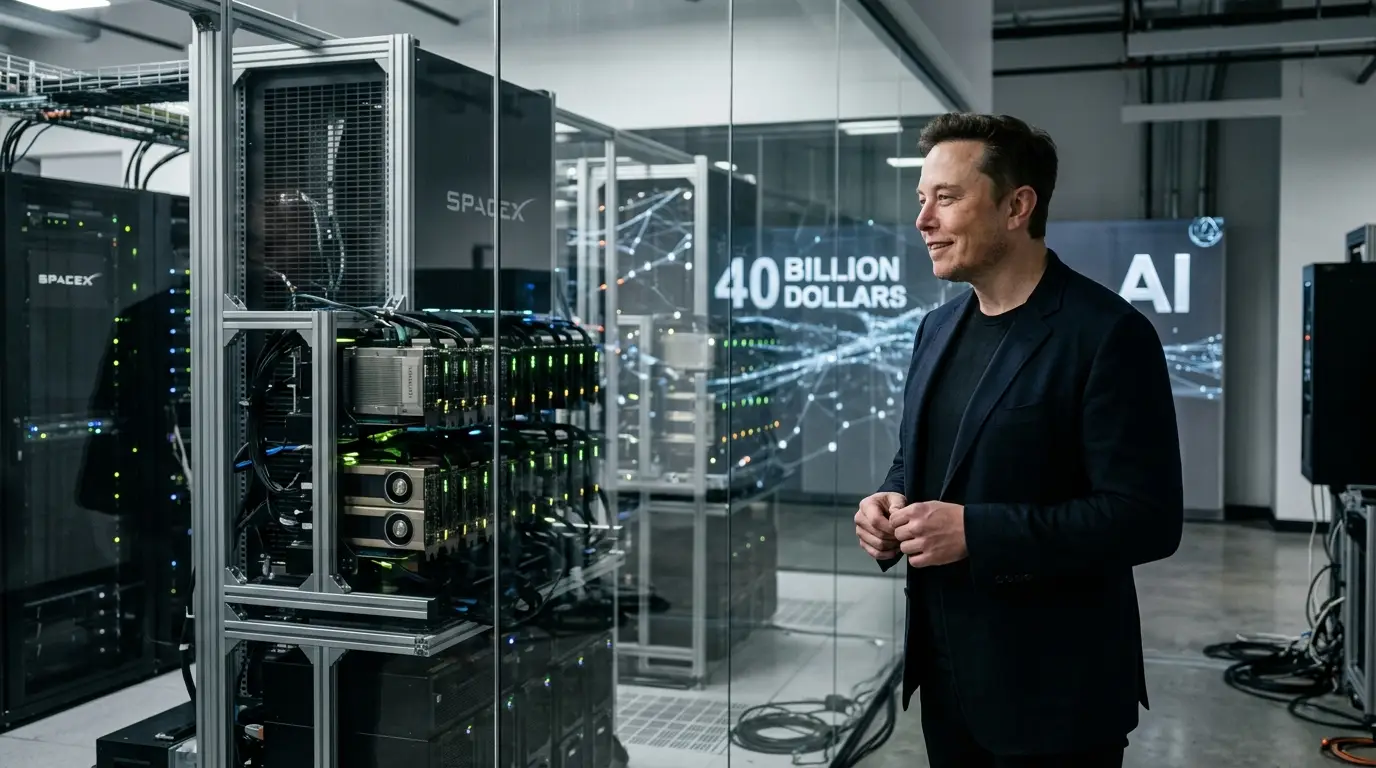
Elon Musk recently announced that SpaceX has secured 40 billion dollars in funding dedicated to graphics processing unit infrastructure for artificial intelligence workloads. This massive financial commitment marks one of the largest single investments in AI compute infrastructure to date.
The Tesla and xAI chief executive also issued a stark warning about the survival prospects of underfunded artificial intelligence companies. He compared their mortality rate to guppies, highlighting the brutal consolidation phase currently reshaping the tech industry. You can read the original report on Emergent.
The Scale of SpaceX GPU Investment
Officially confirmed in late 2026, this 40 billion dollar commitment positions the aerospace company as a major player in the artificial intelligence infrastructure race. The funding will support massive graphics processing unit cluster deployments. This move extends the capabilities of the company far beyond its traditional rocket and satellite operations.
The aerospace giant has increasingly diversified its technological portfolio. By channeling billions into silicon and server farms, the company aims to control the foundational layers of artificial intelligence development. This vertical integration mirrors strategies employed by other top tier technology firms seeking to minimize reliance on third party cloud providers.
GPU scarcity continues to constrain artificial intelligence development across the entire sector. Leading chips from major manufacturers command premium prices and extended lead times. Access to compute has emerged as the critical bottleneck for training and deploying large scale artificial intelligence models. Industry leaders recognize that robust hardware is essential for next generation innovation. According to official documentation from NVIDIA, accelerated computing platforms built on advanced GPU and networking architectures are necessary to reimagine data centers for the age of artificial intelligence. These full stack solutions integrate specialized processors and high bandwidth interconnects to handle the rigorous demands of modern machine learning tasks.
The Guppy Level Extinction Warning
The colorful warning about startup mortality reflects the growing capital intensity of competitive artificial intelligence development. Training frontier models now requires hundreds of millions to billions of dollars in compute costs alone. This creates insurmountable barriers for new companies lacking deep pocketed backers.
Underfunded artificial intelligence companies will likely fail quickly in an environment dominated by well resourced players with dedicated infrastructure. While thousands of startups raised funding during the recent boom, only a handful have secured the compute resources necessary to train models competitive with offerings from major tech giants.
Infrastructure Market Overview
| Component Category | Primary Function | Industry Impact |
| Processing Units | Execute complex parallel computations | Drives model training speed |
| Networking Fabric | Connects compute nodes seamlessly | Enables massive cluster scaling |
| Memory Architecture | Manages high bandwidth data flow | Reduces inference token costs |
| Security Layers | Protects tenant data and access | Ensures compliant AI operations |
This strategic shift guarantees that compute access remains the primary competitive moat for well funded players. The artificial intelligence market will continue to favor entities capable of sustaining immense operational expenses while operating within an increasingly consolidated technological environment.

byDavid Porter
Popular news




Latest comments
Loading