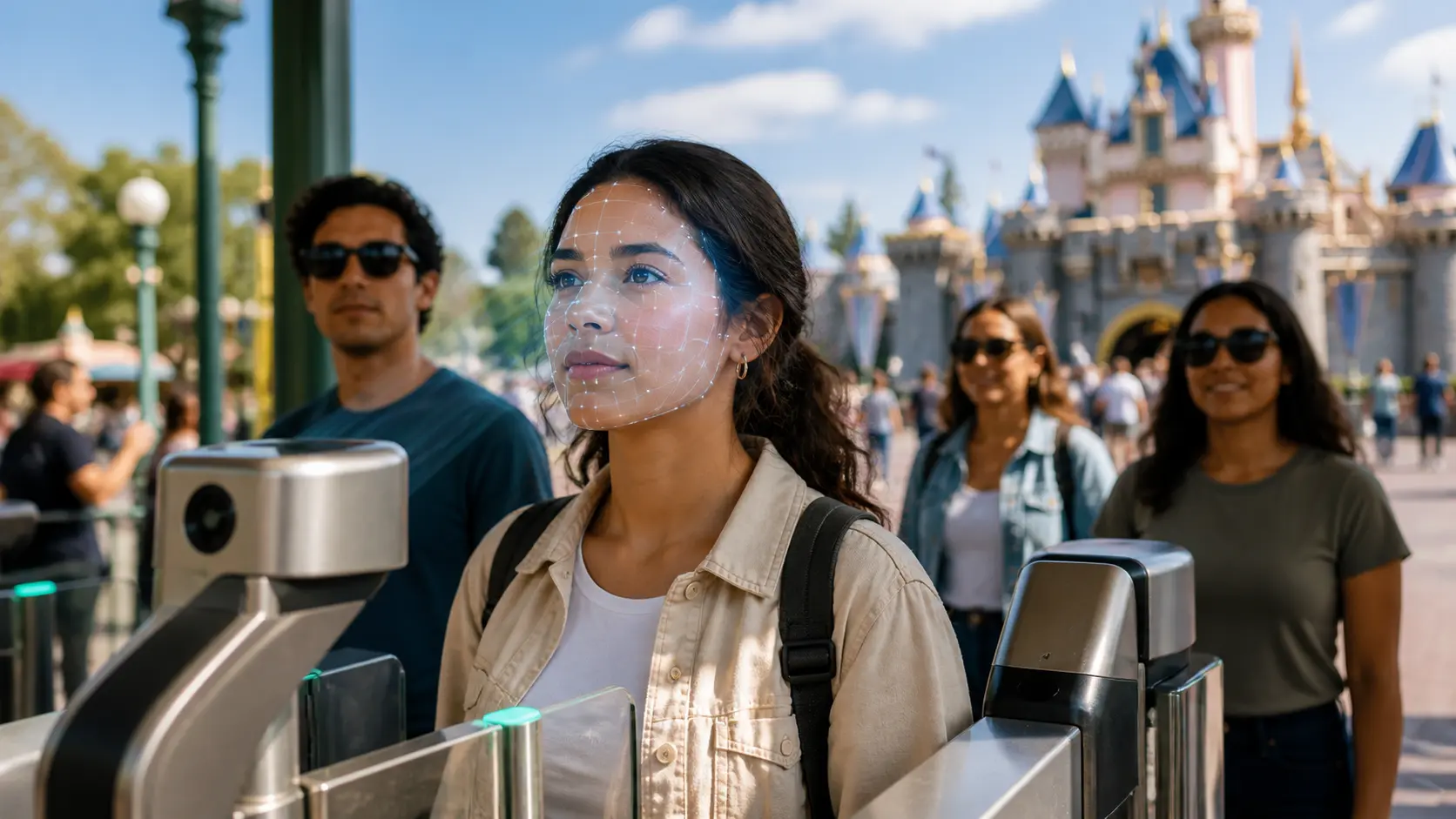
Disneyland Resort is currently testing facial recognition at park entrances, according to recent announcements from The Walt Disney Company. The aim: let guests enter faster and more efficiently using biometric ID. It’s a clear sign that artificial intelligence is becoming more visible in public and semi-public spaces—while regulation lags behind.
The shift is unmistakable: technology once reserved for airports and border checks is moving into leisure settings. That thrusts privacy, surveillance, and data protection back into the spotlight—also in Europe.
What exactly is Disneyland doing with facial recognition?
Disneyland uses facial recognition to identify guests at entry points. The system scans a face and links it to a ticket or reservation, reducing the need to show physical tickets.
This is a form of biometric AI. Biometrics refers to measurable physical traits like faces, fingerprints, or irises. AI systems analyze these traits and compare them to stored data.
The advantages are clear:
- Faster flow at entrances
- Less ticket fraud
- More personalized guest experiences
But there’s a serious trade-off: collecting and storing biometric data carries significant privacy risks.
Why this goes beyond a theme park
Facial recognition at Disneyland isn’t an isolated trial. It signals that AI surveillance is being normalized in everyday contexts.
The core question is simple: if visitors accept facial recognition in a theme park, how big is the leap to malls, stadiums, or even public spaces?
This shift directly touches European law, such as the EU AI Act, which regulates AI based on risk.
Where does this fit under the EU AI Act?
The EU AI Act classifies facial recognition as “high risk” or even “prohibited” in some cases—especially for real-time surveillance in public spaces. This is an experiment in California, not Europe (at least not yet).
Disneyland’s system operates outside Europe, but the ripple effects are wider:
- European companies watch these moves closely
- Technology often rolls out internationally
- Consumer expectations shift globally
The EU’s goal with the AI Act is to keep this tech from silently becoming the norm without clear guardrails.
From convenience to complacency: the real risk
The biggest risk isn’t just the tech—it’s how quickly people get used to it.
When AI offers convenience—faster access, shorter lines—users more readily accept the data collection behind it. That’s “function creep”: technology quietly expanding into new uses without explicit consent.
Disneyland is a live test case. What starts as an optional feature can become standard practice.
What this means for AI in public spaces
Disneyland’s facial recognition trial shows commercial players are moving faster than lawmakers. Innovation happens in real time; regulation often trails by years.
Expect to see:
- Biometric ID becoming normalized
- Mounting pressure on legislators
- Big Tech playing a larger role in public infrastructure
The challenge for Europe and the Netherlands is clear: how do you keep control of AI without stifling innovation?
Read also
Conclusion
Facial recognition at Disneyland is more than a tech upgrade. It’s a tipping point for how AI moves from controlled settings into everyday life.
The central question remains: who draws the line between convenience and surveillance?
As long as frameworks like the EU AI Act are still evolving, companies like Disney set the pace. That makes this debate more urgent than ever for policymakers, businesses, and citizens in the Netherlands.

Popular news

Anthropic Secures Thirty Two Billion Dollar Queensland Data Centre Deal for Claude

Zuckerberg Rejects AI Slowdown Calls Amid Industry Safety Debate

Crusoe Secures Nearly Four Billion Dollars to Scale Factory Built AI Data Centers

Amazon Secures Generac Stake in Massive Eight Billion Dollar Generator Pact

Spain Registers First End-to-End Autonomous AI Data Breach

MIT and Suffolk Unveil How AI is Reshaping Construction Productivity
Latest comments
Loading