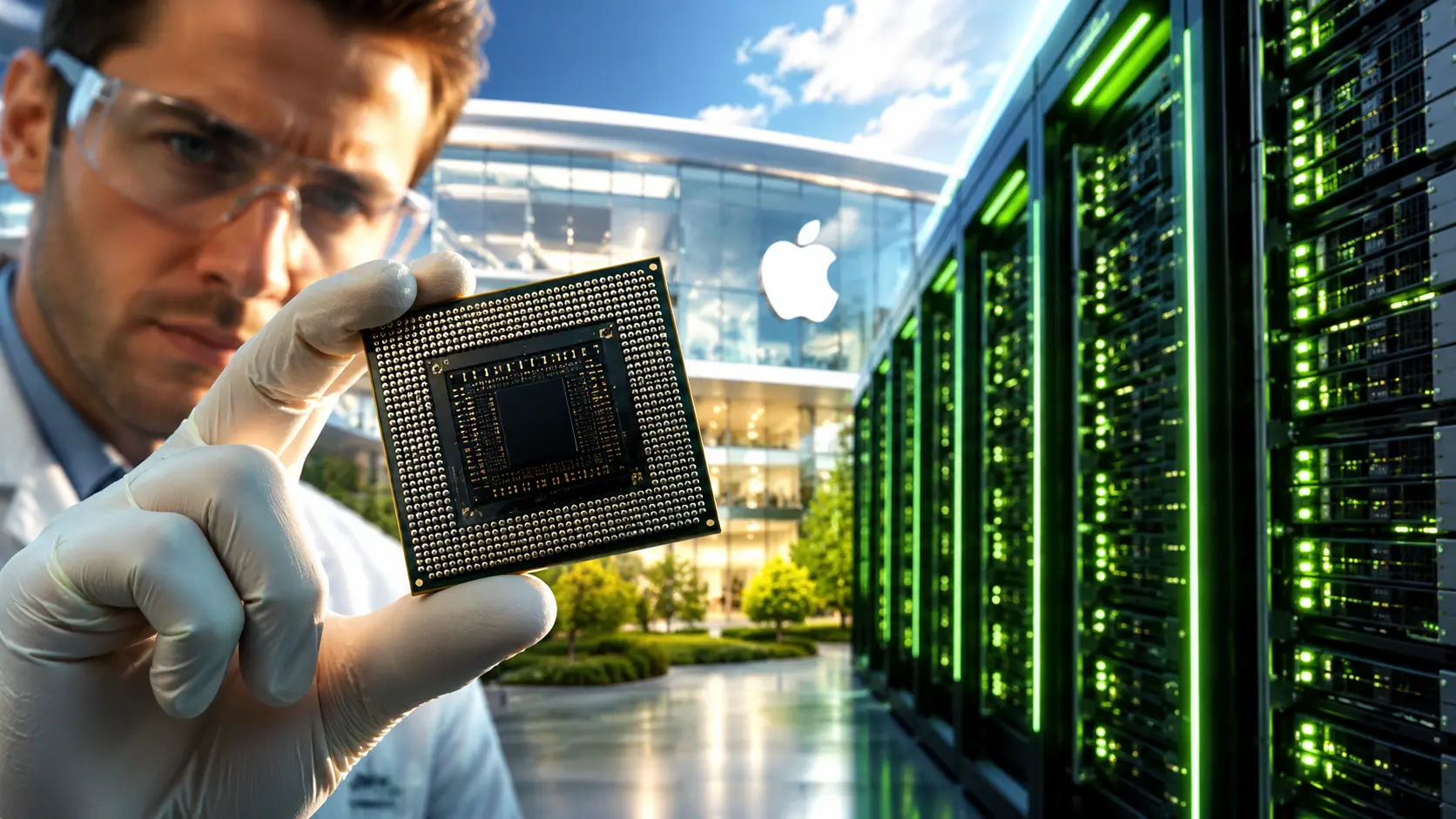
Apple is exploring acquisitions of specialized AI chip companies to bolster its own artificial intelligence infrastructure. According to The Information, confirmed by Reuters, the company has been in talks for months with investment banks and semiconductor startups about potential deals. It signals a break from Apple’s traditionally cautious M&A playbook as it tries to accelerate in the global AI race.
The timing is sensitive. Apple has poured resources into its own chips in recent years, yet remains reliant on Nvidia GPUs running via Google Cloud for heavy AI workloads. That highlights how hard it is to build competitive AI hardware—even for a company renowned for its successful Apple Silicon processors.
Why Apple wants AI chip makers now
Apple aims to speed up development of in-house AI server chips. Today’s AI stack partly runs on customized M2 Ultra processors, but they fall short for the largest generative AI models.
Sources told The Information that Apple tried running Google’s Gemini models on its own servers for the revamped Siri, only to find its internal hardware couldn’t efficiently handle the biggest models. In the end, Apple had to lean on Nvidia hardware inside Google Cloud—a striking move for a company that historically seeks tight control over its tech stack.
Delays hit Apple’s own AI chip
The acquisition push appears tied to delays in Apple’s internal chip roadmap.
A new AI server chip codenamed Baltra was originally slated for 2026 but has reportedly been pushed back. Apple is also developing more powerful AI processors based on future Ultra chips, yet those are still years away. Bloomberg previously reported Apple ultimately wants a much stronger server chip with performance closer to Nvidia’s Blackwell platform.
Apple signals appetite for bigger deals
Historically, Apple has mostly snapped up smaller tech firms for a few hundred million dollars. Major acquisitions are rare.
That pattern seems to be shifting.
Early this year, Apple acquired Israeli AI company Q.ai for nearly $2 billion—its largest deal since Beats Electronics. CFO Kevan Parekh also indicated during earnings that Apple is moving away from its long-standing goal of staying “net cash neutral.” Analysts see room for larger strategic buys.
Reprising a proven playbook
A big chip deal wouldn’t be unprecedented.
In 2008, Apple bought chip designer PA Semi for roughly $278 million. That relatively small acquisition became the foundation for Apple Silicon, the processor family now powering nearly all Macs, iPhones, and iPads.
Today’s hunt echoes that strategy: not buying fabs, but acquiring specialized design teams and IP to accelerate in-house technology.
Nvidia remains critical—for now
Despite the investment push, Apple can’t ditch Nvidia yet.
While Apple excels at power-efficient chips for phones and laptops, AI infrastructure demands very different architectures. Large language models need massive memory, ultra-fast chip-to-chip interconnects, and specialized software—areas where Nvidia dominates.
The fact that parts of the new Siri still rely on Nvidia underscores the chipmaker’s hefty lead.
Broadcom partnership stays in play
Alongside potential acquisitions, Apple is doubling down on key partnerships.
Last week, Apple and Broadcom extended their collaboration through 2031. Broadcom has long designed custom chips for Apple, and the renewed deal suggests a multi-track approach: build in-house, partner strategically, and—potentially—buy.
Analysis: Apple hits the gas on AI
The reports point to a fundamental shift in Apple’s AI strategy. After years of relying primarily on internal development, speed now seems to trump tradition.
It’s a logical pivot. Rivals like Microsoft, Google, Meta, and Amazon are pouring tens of billions of dollars annually into AI infrastructure. Meanwhile, Nvidia has become the indispensable supplier for nearly every major AI platform.
By acquiring specialized chip firms, Apple can secure critical technology and experienced design teams. That could shave years off development and trim reliance on outside vendors.
Whether Apple announces a major deal remains to be seen. But one conclusion is hard to ignore: the AI battle won’t be won by models alone—it will be decided by the chips that run them.

Latest comments
Loading