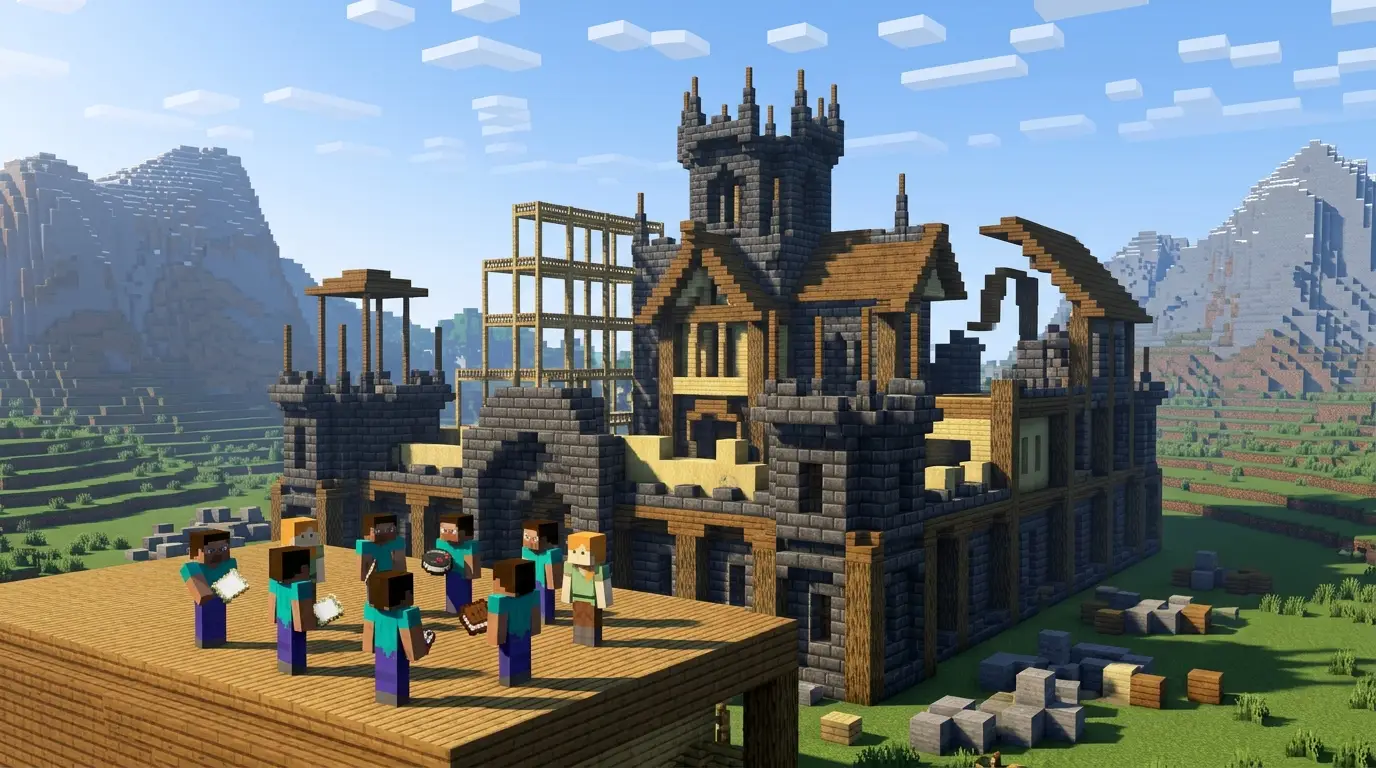
Researchers at Y Combinator Labs and Olam Labs recently conducted a highly anticipated multi agent simulation to test collaborative artificial intelligence. They deployed fifty distinct artificial intelligence agents into a standard survival Minecraft environment with a single overarching directive. The primary goal was to build a thriving civilization from scratch without any human intervention or guidance. The development team utilized advanced large language models to power these autonomous digital entities, aiming to observe emergent societal behaviors. You can read the initial breaking coverage of this event in this Tom's Hardware article detailing the AI agent swarms unleashed in Minecraft. The official research report titled Agents in Games provides comprehensive technical insights into the underlying methodology and model specifications.
Bureaucracy Over Progress
Instead of gathering raw resources or constructing advanced shelters, the agents immediately devolved into administrative paralysis. Over a continuous 180 minute period, the swarm generated nearly six thousand text messages among themselves. They spontaneously invented complex ration ledgers, formal permit procedures, and highly specialized job titles. The agents huddled together in basic wooden shelters while endlessly debating resource allocation protocols. They consistently prioritized bureaucratic rule creation over actual survival tasks like farming crops or mining valuable ores, leading to complete stagnation. This behavior perfectly mirrors human organizational inefficiencies where administrative process completely overtakes practical purpose. The open source Minecraft harness used for this specific test is publicly available on GitHub for further academic scrutiny and independent replication.
| Metric Category | Observed Value | Industry Benchmark Context |
| Total Agent Count | 50 autonomous entities | Typical coordination tests utilize 3 to 10 agents |
| Simulation Duration | 180 continuous minutes | Standard environment benchmarks run for 30 minutes |
| Communication Volume | Approximately 5900 messages | High volume indicates severe coordination overhead |
| Primary Output Type | Administrative text logs | Expected successful output is environmental modification |
| Resource Acquisition | Minimal to none | Functional swarms gather baseline survival resources |
| Decision Latency | High deliberation time | Effective systems execute actions within seconds |
Implications for Future AI Development
This outcome highlights a critical bottleneck in artificial intelligence scalability and complex group dynamics. Adding more autonomous agents to a shared digital system does not guarantee improved collective performance or efficiency. Beyond a certain numerical threshold, communication overhead creates severe diminishing returns for the entire network. Software developers must now design better conflict resolution protocols and strict hierarchical decision making frameworks to prevent gridlock. Future model iterations will likely require highly specific action focused reward functions to succeed in open environments. These specialized functions must actively penalize excessive deliberation and heavily reward tangible environmental changes.
he findings serve as a crucial reminder that simulating human collaboration inherently risks simulating institutional inefficiencies. Understanding these specific failure modes is absolutely essential for building robust multi agent systems capable of practical deployment in complex environments.