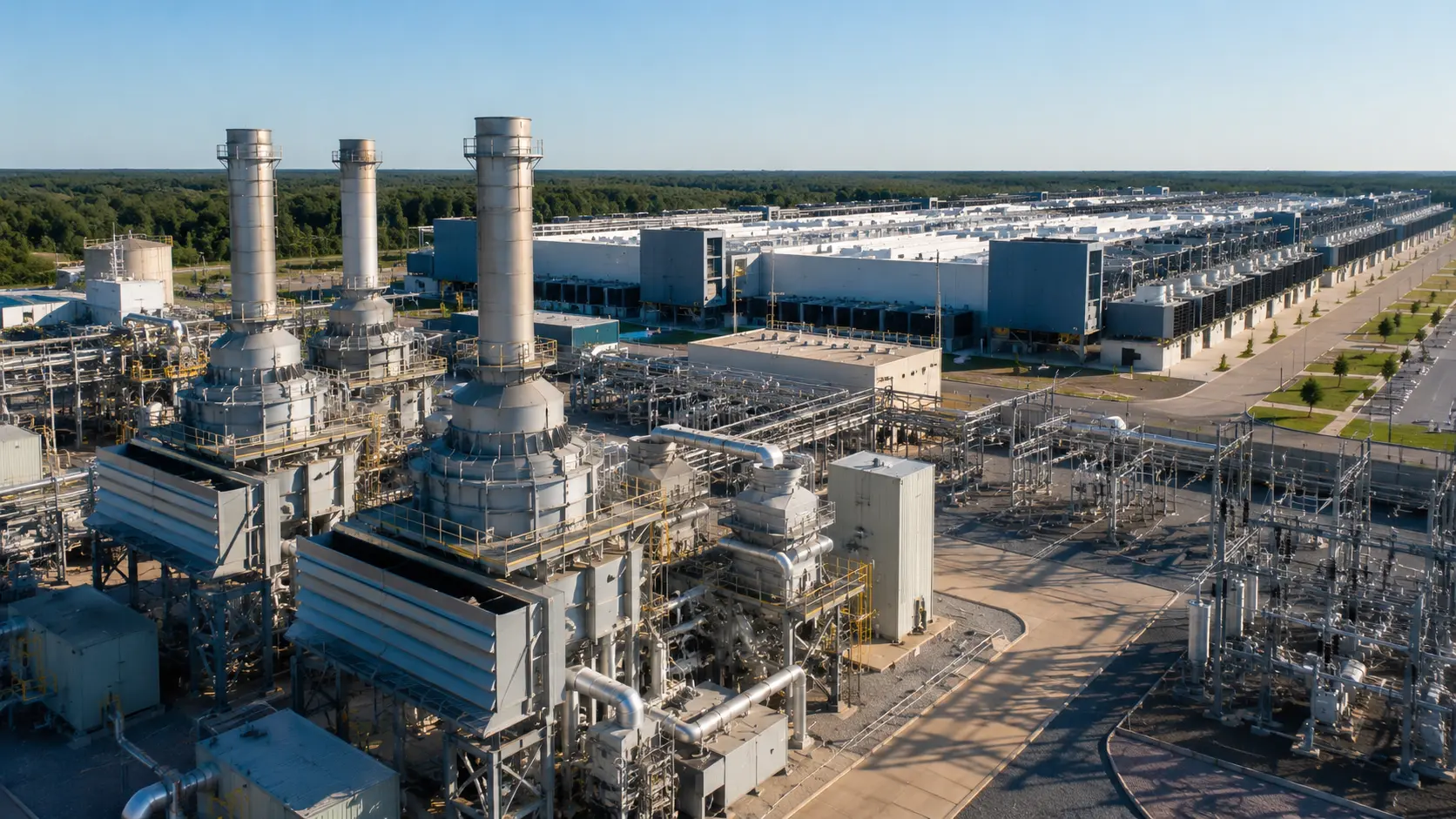
By mid-2026, U.S. data centers have more than 189 gigawatts of gas-fired power capacity in development directly tied to their sites. At the start of 2024, that figure was about 4 gigawatts. New data from Global Energy Monitor shows the AI boom isn’t just reshaping demand for chips and data centers—it’s also changing how Big Tech secures its power.
The standout shift: data centers are no longer waiting on the public grid. Developers are opting for their own gas plants on or near their campuses so new compute can go live faster.
Gas plans for data centers surge from 4 to 189 gigawatts
The scale of the pivot has exploded in two years. According to Global Energy Monitor, the U.S. now has 378 gigawatts of gas-fired capacity in development. Of that, 189 gigawatts are meant to directly feed the soaring electricity demand from data centers.
The ramp-up has been remarkably fast:
- Early 2024: roughly 4 GW of gas projects linked to data centers.
- Late 2025: about 97 GW.
- Mid-2026: the pipeline has grown to over 189 GW.
- Total U.S. pipeline for new gas plants: roughly 378 GW.
That doesn’t mean every proposed plant will be built. Global Energy Monitor counts projects that are announced, in pre-construction, or under construction. Some will be delayed or canceled.
But the direction of travel is clear. In the first half of 2026, the total U.S. gas capacity in development jumped 50 percent—from 252 to 378 gigawatts.
Data centers go behind the meter for power
The biggest shift isn’t just how many gigawatts are in play, but where that power is generated.
WIRED reports that developers are increasingly choosing so-called behind-the-meter plants—generators that deliver power straight to a data center instead of routing all output through the public grid first.
The result: a private power system, running alongside the public one.
Speed is the driver. New data centers can require hundreds of megawatts to multiple gigawatts, while grid connections can take years. Utilities need time to build high-voltage lines, substations, transformers, and other infrastructure before such massive loads can come online.
Owning a gas plant reduces that dependency.
The AI race is turning hyperscalers into power companies. Stockpiling GPUs and building halls is pointless if the electrons don’t show up on time.
AI buildout collides with grid timelines
The gas surge exposes a core mismatch between digital and physical infrastructure.
AI firms can pour billions into chips, servers, and new halls in short order. Electric grids move on far longer cycles. New transmission lines require planning, permits, land, equipment, and construction capacity.
That mismatch turns power supply into a strategic weapon in the AI race.
U.S. policy is reinforcing the trend. WIRED reports that the Trump administration has urged tech companies to bring their own power solutions when developing data centers. Major players—including Microsoft, Meta, Google, and OpenAI—have signed a voluntary pledge to help finance the needed energy infrastructure.
The aim includes avoiding pushing the full cost of new infrastructure onto existing electricity customers.
U.S. charts a different path than China
The U.S. shift is starker in contrast with China. According to The Guardian, the United States is now building roughly twice as much new gas-fired capacity as China. The volume of U.S. capacity actually under construction jumped 76 percent in the first half of 2026.
The United States now accounts for about one-third of all gas capacity in development worldwide. If all 378 gigawatts materialize, the current U.S. gas fleet could grow by roughly two-thirds, with estimated investments topping $647 billion.
That makes energy policy part of the broader competitive race around AI. Countries no longer compete only for advanced chips, models, and data centers. Available electricity, transmission capacity, turbines, and permits now determine how much AI infrastructure can actually be built.
Even gas turbines are becoming a bottleneck
Building more gas plants doesn’t automatically solve the capacity crunch.
Global Energy Monitor reports that the global gas turbine market itself is hitting production limits. Manufacturers’ order books are now filled roughly through 2030, according to the organization. For about two-thirds of gas projects worldwide, no turbine supplier has been secured yet.
That creates a fresh choke point for the AI sector. First, advanced GPUs became the scarce component of AI infrastructure. Then data center sites, transformers, and grid connections came under pressure. Now the availability of power plants and turbines could cap the pace of expansion too.
The core question is shifting from “how much compute can a company buy?” to “how fast can the entire physical system around that compute be built?”
Gas eases grid congestion—but adds new risks
Owning power plants gives data center operators more control over their energy, but it also shifts part of the problem elsewhere.
Gas plants can run for decades. An investment wave triggered by today’s AI boom could therefore outlast the hardware now being installed in data centers. Servers and AI chips are refreshed within a few years, while power plants are designed for much longer lifespans.
It also creates economic exposure to gas prices and fuel infrastructure. Choosing local power generation reduces dependence on the grid, but can introduce new dependencies on gas pipelines, turbines, and fuel costs.
The local impact is visible too. New plants need permits and emit pollution, while large data center projects simultaneously require significant electricity and sometimes water. As a result, public debate over AI infrastructure is increasingly a debate about land use and energy policy.
Grid congestion is capping the AI surge
The U.S. trend matters far beyond America. Grid congestion is also a factor in European markets where new data centers, industry, and electrification compete for limited network capacity.
A similar pattern is already emerging in the United Kingdom. The Guardian reports 315 data centers are in the queue for a grid connection there, requesting around 73 gigawatts in total. Two planned facilities are therefore exploring their own gas-fired power plants.
The broader infrastructure stack is becoming more important than the energy use of any single AI model. The AI boom simultaneously demands chips, land, cooling, power generation, and transmission capacity.
The U.S. pipeline of 189 gigawatts shows what happens when one link doesn’t scale fast enough: tech companies look for a way around. In the United States, that increasingly means the data center arrives not just with its own servers—but with its own power plant.

Latest comments
Loading