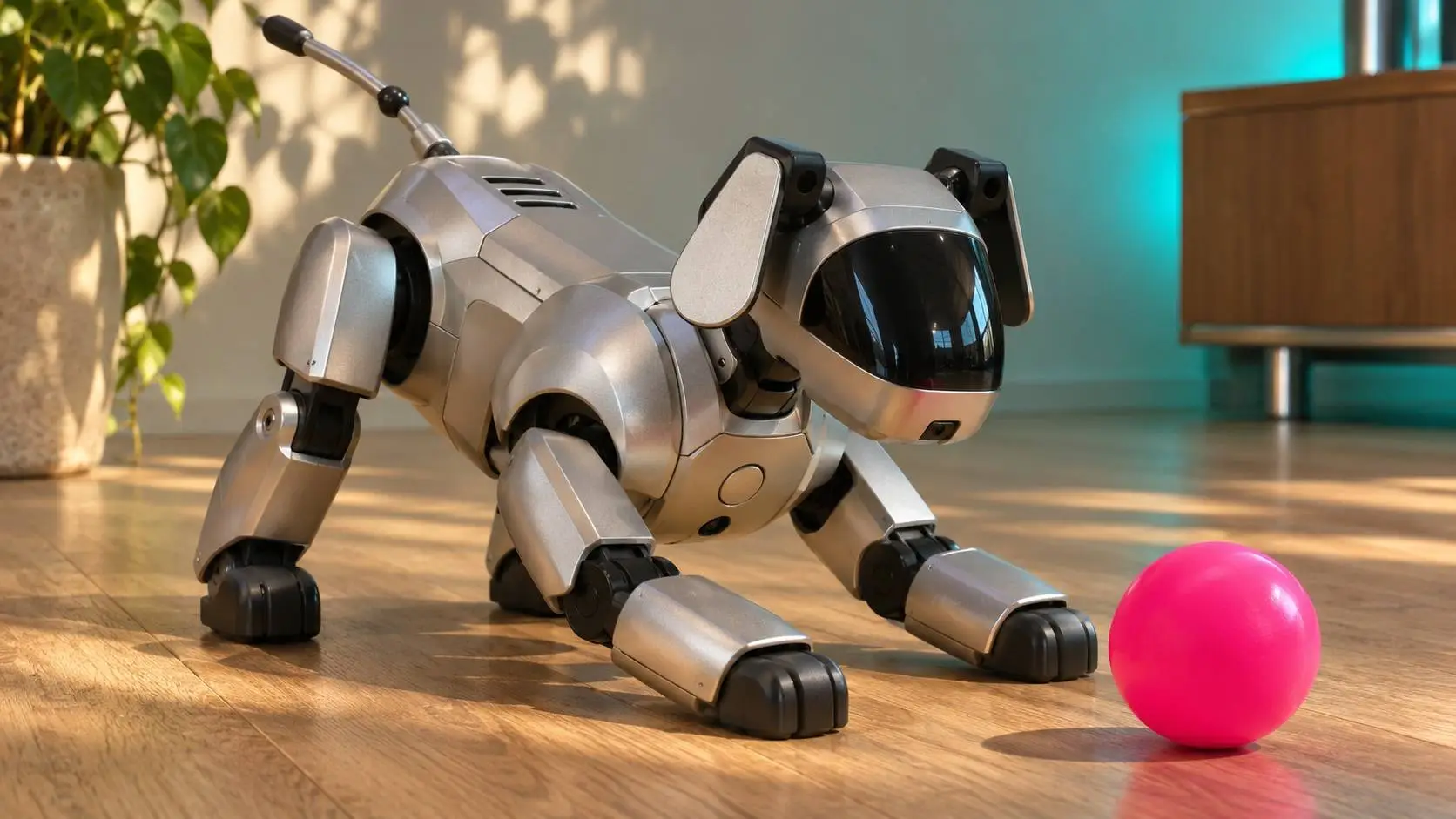
A silver AIBO-style robot dog crouches toward a pink ball on a sunlit wooden floor. AI-generated editorial illustration by AI World Today.
Sony’s first AIBO could find a pink ball, respond to tones, and change how often it used some moves. The silver robot dog went on sale in 1999. It looked like a pet, and its sensors and preset moves shaped what it could do.
Sony also said it could learn. To see what that meant, it helps to go back to the first model. The ERS-110 came with a toy, a sound controller, and a set of ways to respond to life on the floor.
A small run at a high price
Sony announced the ERS-110 on May 11, 1999. It took orders from June 1 and planned to ship the first units in early July. Sony set aside 3,000 for Japan and 2,000 for the United States. The US price was $2,500 before tax.
The full run sold out. Sony later said it took 20 minutes in Japan and four days in the US. The company went on to offer a special edition. The first sale proved Sony could find buyers for thousands of robot pets at that price. A small run gave little sense of how many more might have sold.
What AIBO could sense
The ERS-110 manual lists a touch sensor on the head, two microphones, a color camera, and a distance sensor. The robot could use those parts to react to touch, pick up certain tones, and follow its ball. Owners could switch between modes for free play, set moves, or games.
A sensor gives the robot a clue. A camera can see the color of an object in front of it. A touch sensor can pick up contact on the head. The software has to decide what to do with those clues. Lighting, distance, and where the owner stands can all affect what reaches the sensors.
For a simple example, put two objects of the same color on the floor. To a person, one looks like a toy and the other like a sock. A system that starts by looking for color may need more detail to tell them apart. That is the kind of gap that can come up when a machine has to act on the cues it gets.
Sound worked within a set of rules, too. The first model used a sound controller that sent tones. An owner could follow the control guide and know which signal to send. This gave the robot a way to hear a command before the later model added support for some spoken words.
How praise and scolding shaped its moves
The manual describes ways to praise or scold the robot. Signals from the owner could affect which of its moves it used again. AIBO could change with use inside the range of behavior Sony had built for it.
Think of a toy with three ways to respond after a game. A signal from the owner could make one of those ways show up more often the next time. The exact rules in AIBO were its own. The example gives a sense of how the effect of a lesson can be real even when the next move is one of a set the toy already has.
A room also gives a robot a lot to deal with. The ball can roll behind a chair. A person can reach down from a place the robot can’t see. Each of those changes may call for a different response from the same set of moves. That is part of what makes a pet-style machine feel less like a toy with a single on switch.
Why Sony wanted it to act like a pet
In a 2001 paper on digital creatures, AIBO researcher Masahiro Fujita described a project built for fun. The team wanted the way the robot moved and responded to look true to life. A machine on a factory line has a set job. The test for a pet-style robot also has to do with whether people want to keep playing with it.
When AIBO paused or went off on its own, an owner might say it was shy or stubborn. The owner read a mood into the action. The same move could look different in another setting, or to someone who had just taken the robot out of its box.
The test of a lifelike move was also different from the test of a button. If an owner presses a switch and the same light comes on each time, that can be a sign of good design. A pet robot that makes the same gesture on every turn may feel less like a pet. The aim of the product shaped which kinds of change were worth building in.
What owners said in early AIBO forums
Batya Friedman, Peter Kahn, and Jennifer Hagman studied 6,438 posts in a 2003 study of online AIBO forums. They found people could talk about the robot as a piece of tech and as a kind of companion. The sample included posts about more than one model. A single person could also write more than one post.
The two ways of talking fit together in play. An owner could know how the robot picked up a touch and still say the dog liked to be petted. The forum study gives us a record of how people described those moments. For readers today, those posts also give a glimpse of what it was like to live with the product after the launch.
Check the model before judging a demo
Sony’s October 2000 launch notice for the ERS-210 lists later features. The new model could learn its name, pick up some simple spoken words, and take photos with the right software. If you see a clip of an AIBO doing those things, check which model is in the clip and what software it runs.
The first AIBO is worth looking at on its own. Sony took some of the questions from the early years of AI and put them into a product a customer could try at home. A ball and a few sensors gave buyers a way to see what a machine could sense, how it could react, and how much of its character they supplied.
For some of the work that came before the robot dog, see the earlier history of AI and robotics. Other milestones are in our AI history collection.

Popular news

Tencent releases Hy4 weights with new terms for large AI hosts
Claude computer use reaches Team and Enterprise in beta

Proposed Claude-assisted Riemann proof passes independent checks

AWS gives HyperPod models one gateway across clusters
Cognition launches Devin Bots to manage multiple coding sessions