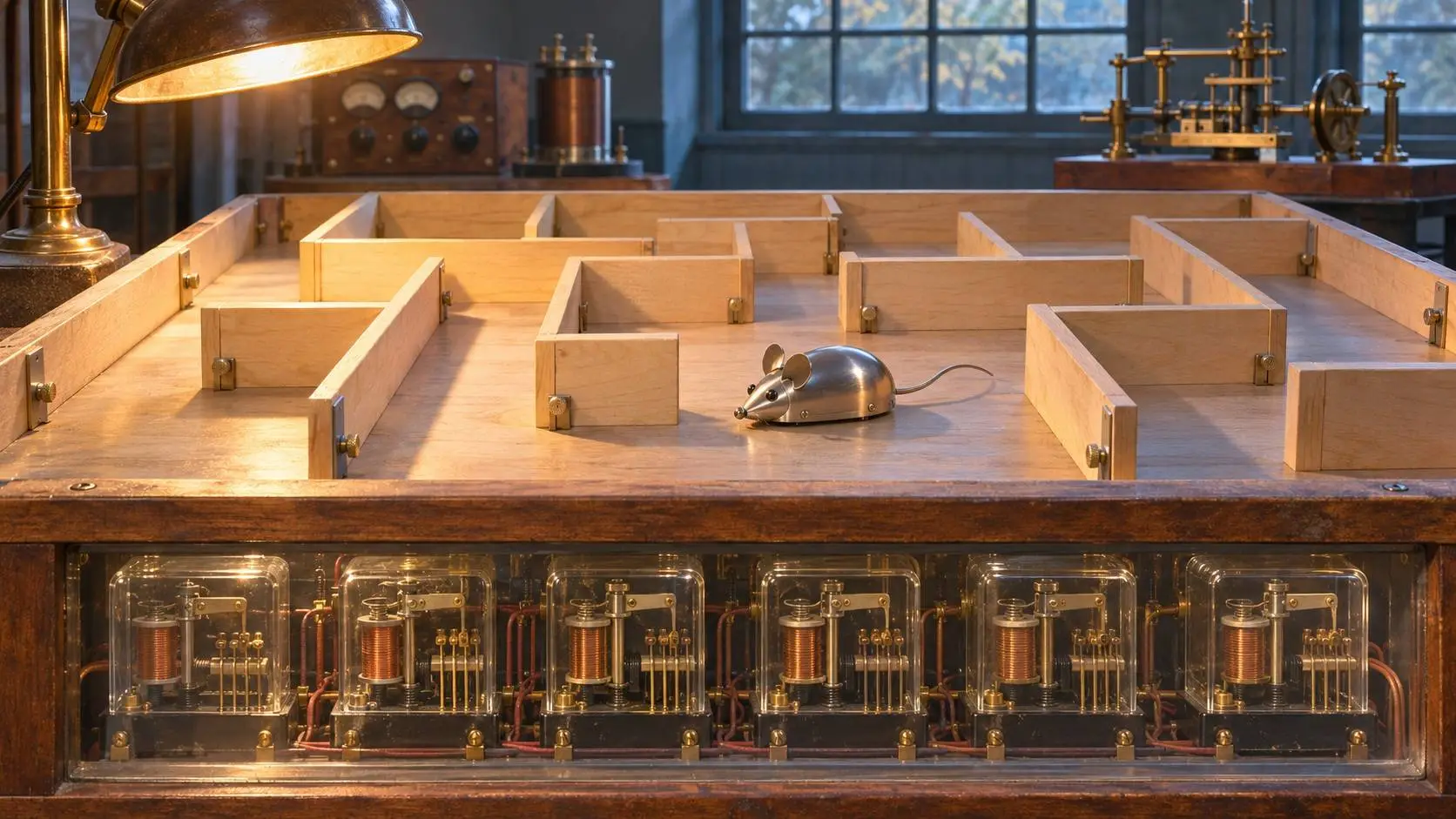
A small metal mouse sits in a tabletop wooden maze, with glass relays visible below the rim. AI-generated editorial illustration by AI World Today.
In 1950, Claude Shannon built a small metal mouse that could find its way through a maze. On a later run it could follow a route it had found. The switches that held the route sat beneath the board. The mouse was the part you could see.
The MIT Museum’s account dates the device to 1950. It is called Theseus, after the figure who finds his way through a maze in Greek myth. Although the mouse was small, the space in which it moved and the parts beneath that space made up most of the machine.
What sat below the maze
Shannon’s original account of the maze solver shows a board with 25 squares and walls that could be moved. A magnet below the surface drew the metal mouse across the top. The motor and the parts that chose where to move were below the board as well.
Shannon used relays, which are switches that can be worked by an electric current. A relay can change its state when it gets a signal. A group of relays can also hold a state. The machine can use that state to keep track of something it learned on a past move.
This was an area Shannon knew well. MIT’s account of his career describes his work on using logic to design circuits out of switches. The mouse gave people a way to watch some of that work in action. For more on the ideas behind it, see our history of the roots of computing before 1950.
How the machine made a first run
Put the mouse on a square in a layout it has yet to learn. The machine can try a direction. If it meets a wall, it can use that fact to try a different way. It goes on through the maze until it can reach the goal. When it finds a path, the switches can store directions that will help with a later run.
The ZKM record of Bell Labs’ 1952 film describes a show of both parts: the trial and error and the run that uses what the machine has learned. The film shows an invention from two years before. That is why you may see both dates in accounts of Theseus.
The fact that it can change its route is the part to watch. A maze with a fixed route could be built so that the mouse always makes the same set of moves. In Shannon’s setup, a new wall could block the way. The device could react and store a path that worked for that setup.
The walls also made it easy to put the claim to a test. A person could first watch the mouse take a known route and then close off one of the squares. The next run would show where the old directions stopped working. A reader can look for that kind of change when someone shows a machine that claims to learn.
Try the idea with two copies of a maze
Draw a maze on two sheets of paper. Try to solve it on the first sheet. When you find a good path, add arrows to the squares on the second sheet. Now start the maze again. Look at the second sheet when you reach the same turns. You can get to the end with much less trial and error.
The second sheet helps in a precise way. It tells you which way to go from squares that you marked. It gives you no directions for parts you’ve yet to reach. Shannon’s device could use parts of a route it had seen before when it came across those parts on a new run. In both cases, it pays to ask where the clues are stored.
Try moving a wall on one part of the maze. Some of the old route may still work. Where the wall blocks it, you need a new way through. Now start from a different square. You may still find a turn you have marked. Those two changes can show different things about how a system uses what it has stored.
What the small maze let Shannon test
Theseus had a fixed set of squares and a target. It could try a move and get a clear sign if it hit a wall. That made it easy to see what had changed between one run and the next. You could count steps, watch how the mouse dealt with a moved wall, or see how long a new route took.
A room would be a new sort of problem. A moving toy, a pet, or a chair leg could get in the way. To try the same idea there, a team would need a way to sense those things and decide which of them it could move around. The maze lets us see how much the choice of test helps shape what a machine can do.
Where the memory really was
When people watch the film, the small mouse can look as if it knows the way. The stored state is in the box, along with the drive. This detail lets a reader trace the full sequence from a wall on the board to a choice made by switches to a mouse that turns.
Later learning systems used other ways to hold what they had found. Some used numbers that shift after each mistake. Some stored game states or examples from earlier runs. Theseus is easy to take in because the thing it learns is close to what you can watch it do. You can see the path that worked.
There is also a clue in what it leaves behind. The switches can save a useful choice without saving a film of the whole run. A stored choice has a small job. It helps the machine move from a square it knows toward the goal, even when the mouse took a different path to that square.
MIT announced that it had acquired Shannon’s inventions in 2007. A small object in a display still raises a good question for anyone who hears that a machine can learn. What can it keep from one try to the next, and how does it put that to use? For more examples, see our early history of robotics and the AI history collection.

Popular news

Good Morning AI | Anthropic slips, Claude reviews code and Tidal sets a cutoff

AI stocks slide again as Nvidia falls and Ambarella sinks 20.6%

GTA 6 on PC at 10 FPS? Inside the AI-Assisted Race to Port It

Tencent opens the AI models behind WeChat’s product search
Google’s Humanity’s First Exam Tests AI Reliability