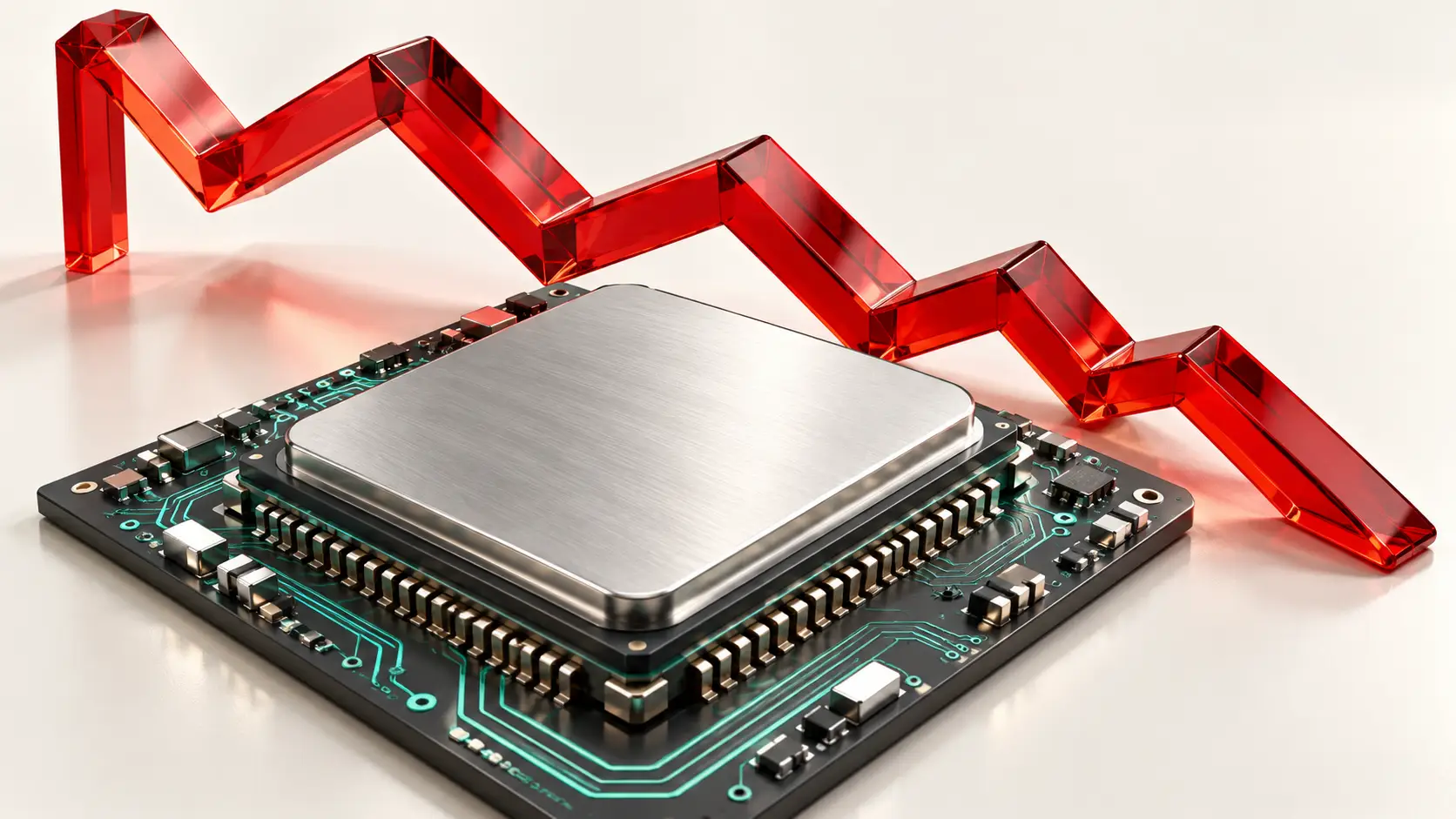
Meta's weekly share-price decline puts the cost of building AI at the center of today's podcast. Strong revenue growth is giving companies more money to invest, while investors weigh the scale of that spending and the time needed to earn a return.
Elsewhere, researchers test messages hidden inside drawings, Google expands Gemini's business tools, Britain announces a new AI Biosecurity Lab, and a French literary competition asks writers to document their work with AI.
Listen to today's episode
Daily News #5 brings together the week's market figures, practical product news and two very different experiments in AI's capabilities and creative role.
Find the podcast on Spotify, Apple Podcasts and Amazon Music, or visit the AI World Today podcast archive.
Meta's growth comes with a substantial investment bill
Between the regular closes on October 16 and October 23, Meta shares fell 9.4%. ASML's Amsterdam-listed shares declined approximately 4.7%. These are weekly price changes in each stock's trading currency.
Meta's third-quarter results show the tension behind the discussion. Revenue reached $64.6 billion, up 26% year over year. The company expects full-year capital expenditure of $135 billion to $145 billion, including finance-lease principal payments. That is a company-wide forecast rather than a separately disclosed AI budget.
Quarterly free cash flow was negative $2.12 billion, although Meta remained profitable on an accounting basis. Reuters linked Thursday's sell-off to concerns about investment returns and financing the next phase of AI infrastructure.
The market reaction shows why revenue growth alone cannot settle the debate. Investors also assess what it costs to produce that growth and how future expansion will be funded.
Claude recovers messages hidden in drawings
Researchers with the Singapore AI Safety Hub Fellowship asked Claude Fable 5.1 to encode short messages inside images. A fresh session then received the rendered picture, without the original text, source code or an agreed decoding method.
The research report describes pictures in which features such as object heights carry letters. The receiving model was explicitly prompted to investigate possible hidden information.
According to the current experiment repository, researchers counted 39 of 50 messages as recovered with image-analysis tools, compared with six without tools. The scoring allowed approximate matches. One counted case involved deriving the encoding while a safety classifier withheld the final plaintext.
These are reported results from a small, guided experiment. They do not establish how reliably an assistant would detect hidden messages during ordinary use. They do raise a useful design question: how should a system distinguish information it discovers from instructions it is authorized to follow?
Google brings more business tasks into Gemini
Google's small-business announcement, published October 20, describes a dedicated business landing page for marketing, financial analysis and connected services.
Owners can supply brand material, including colors, fonts and a website, so Gemini can retain a visual style for later designs. Google also names integrations with services including Canva, Shopify, Xero and Google Workspace.
The company says spreadsheets, receipts and purchasing records can become charts and interactive financial models. For a small business, that could make it easier to explore changing costs or prepare questions for an accountant.
Google describes a global rollout in the days following its announcement, without a complete country-by-country breakdown of integration availability. Owners should check their accounts and verify generated figures against the underlying records. Google's own guidance cautions that responses can contain errors and should not be treated as professional financial advice.
Britain announces an AI Biosecurity Lab
The UK government announced the AI Biosecurity Lab on October 24, backed by £100 million in public funding. Its initial goals include earlier detection of biological threats and faster development of vaccines, treatments and other medical countermeasures.
OpenAI and Anthropic are contributing support valued at up to £200 million between them. This includes computing and model credits, model access and technical support. The Treasury announcement distinguishes that support from government spending.
The planned lab will operate as an independent nonprofit, with Google DeepMind and Basecamp Research also named as research partners.
The announcement establishes an institution and its intended mission. Demonstrating its value will require tested capabilities that help researchers and public agencies respond to real threats.
Prix Pascal asks writers to show their AI process
The Prix Pascal is a privately organized French literary competition whose first edition accepts French-language fiction and nonfiction from entrants internationally.
Entries include a starting concept, a manuscript and a technical account of the AI process. The competition rules also restrict manually inserting pre-existing human-written text beyond that initial concept, making this a specific production experiment with detailed conditions.
Judges will assess literary qualities, originality and the handling of human–AI collaboration. Entries opened this week, with submissions due by the end of November.
The process documentation could make the discussion more concrete for readers. Knowing that AI was involved says little about who chose the premise, shaped the structure or rejected a weak passage. Finished manuscripts, accompanied by an account of how they were made, offer something more substantial to evaluate.
This episode is narrated by an AI voice.




Loading