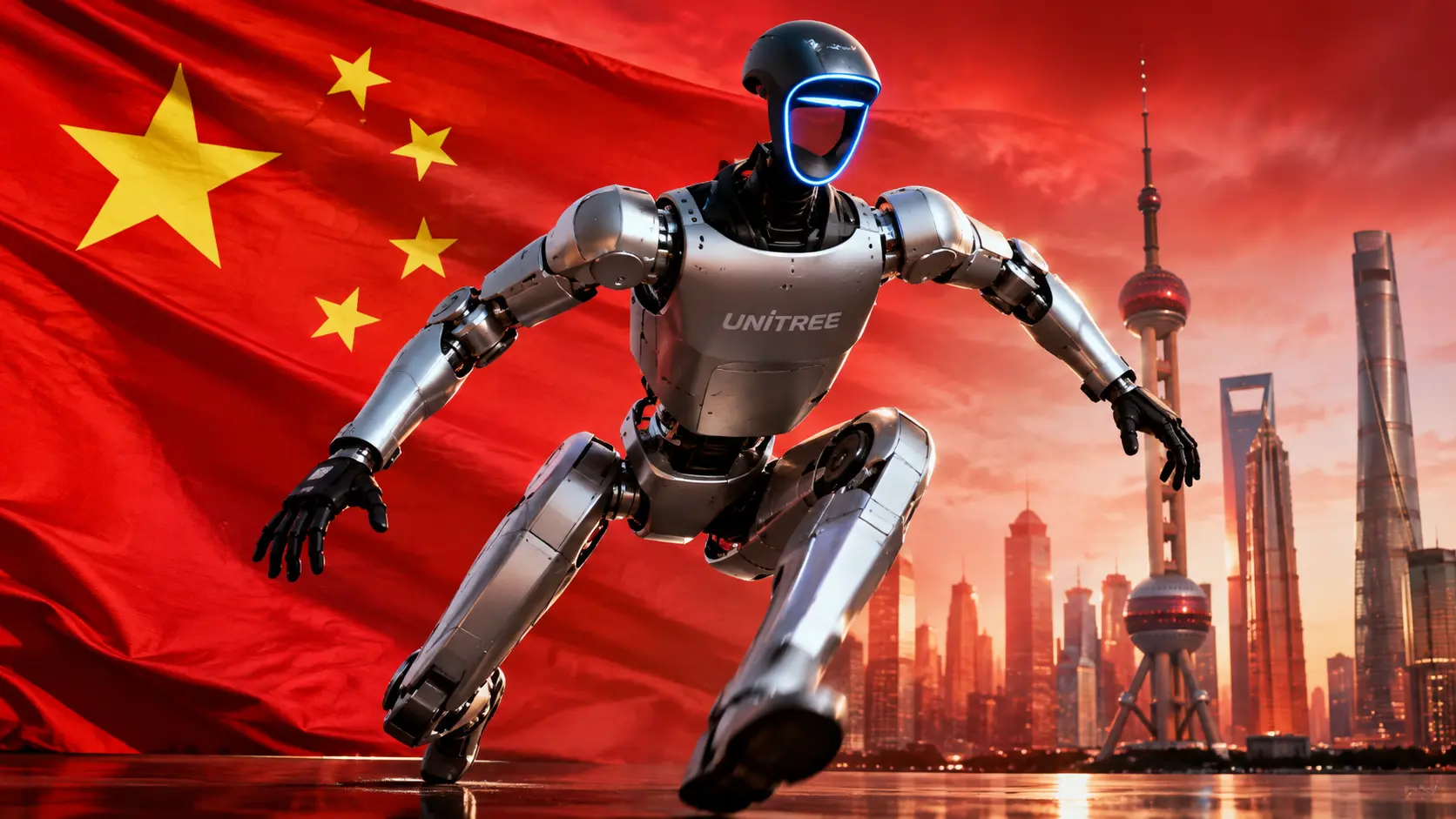
Chinese firm Unitree Robotics this week unveiled a new humanoid robot that, according to the company, hits a top speed of 12.66 meters per second. Nicknamed “Superman” for now, the bot edges past the recorded peak speed of sprint icon Usain Bolt, measured at roughly 12.42 meters per second. Reuters confirms Unitree showcased the machine just ahead of its Shanghai stock market debut.
That headline needs context. Superman hasn’t proven it can beat Bolt’s official 100-meter time. The 12.66 meters per second is a measured peak speed, while Bolt’s 100-meter world record still stands at 9.58 seconds. The real story: a humanoid robot can now move, at maximum burst, faster than the fastest measured human sprinters.
How fast is Unitree’s new robot, really?
A speed of 12.66 meters per second translates to about 45.6 kilometers per hour. In its first demo, Unitree also paired that pace with a standing two-meter vertical jump.
Reuters reports Unitree spent just over three months building the new machine. The company suggests performance could improve as the hardware and control software mature.
Business Insider likewise cites a 12.66 meters per second top speed, while stressing the claim hasn’t been independently verified. That caveat matters: the figures currently rest on Unitree’s own data and demo footage.
Why compare it to Usain Bolt at all?
The Bolt comparison highlights how quickly humanoid mechanics are advancing. Robots that struggled with stable walking a few years ago are now landing flips, dance moves, and rapid sprints.
But a higher peak speed doesn’t make a better sprinter. A full race demands acceleration, stability, reaction time, and the ability to sustain speed over 100 meters. Unitree’s demo doesn’t yet prove Superman wins on all those fronts.
That gap between burst speed and race performance is crucial. Bolt’s 9.58-second world record from 2009 remains a human athletic milestone and isn’t displaced by Unitree’s result.
Why does “Superman” matter technically?
Superman’s significance is in high-speed, high-power locomotion for humanoids. This tech could eventually matter in factories, warehouses, hazardous sites, and other physical workplaces.
Unitree has been at this for a while. It sells multiple humanoid platforms and previously developed the H1 and H2. The H2 stands about 1.82 meters tall, weighs roughly 70 kilograms, and has 31 degrees of freedom—independently controlled joint motions. Unitree says it uses powerful joint actuators and algorithms to execute dynamic movement.
Superman appears to push even harder on extreme physical output. That makes it notable for embodied AI: systems that don’t just process information but engage the physical world through a body.
Dazzling demos aren’t the same as useful robots
The next hurdle isn’t simply running faster. Companies need to prove humanoids are reliable and economical in the real world.
Reuters notes, after the 2026 World Robot Conference, that China’s robot sector faces mounting pressure to show commercial traction. Demos impress, but large-scale deployment in real workplaces remains limited.
For customers, other metrics beat a sprint time: hours of fault-free operation, safe collaboration with people, autonomous problem-solving, and clear economic value.
Superman’s sprint is therefore a showcase of what the hardware can do today. The tougher challenge lies in the intelligence that decides what a machine can accomplish with that physical capability.
Unitree’s well-timed reveal
The timing is no accident. Unitree is set to list on Shanghai’s STAR Market. Reuters reports the IPO raised about 6.1 billion yuan, roughly 905 million dollars, amid exceptional investor interest.
Unitree has become one of China’s most prominent makers of legged robots. It builds both quadrupeds and humanoids and is positioning itself as a supplier of general-purpose robots.
That strategy fits a broader Chinese push in robotics and physical AI. Manufacturers are racing not just on AI models, but on motors, sensors, batteries, control stacks, and production scale.
Superman is a striking calling card. That a humanoid can briefly outrun Bolt’s peak speed is symbolic more than anything else. The real test is whether this rapid progress translates into robots that, outside controlled demos, can work autonomously, safely, and affordably in the wild.

Latest comments
Loading