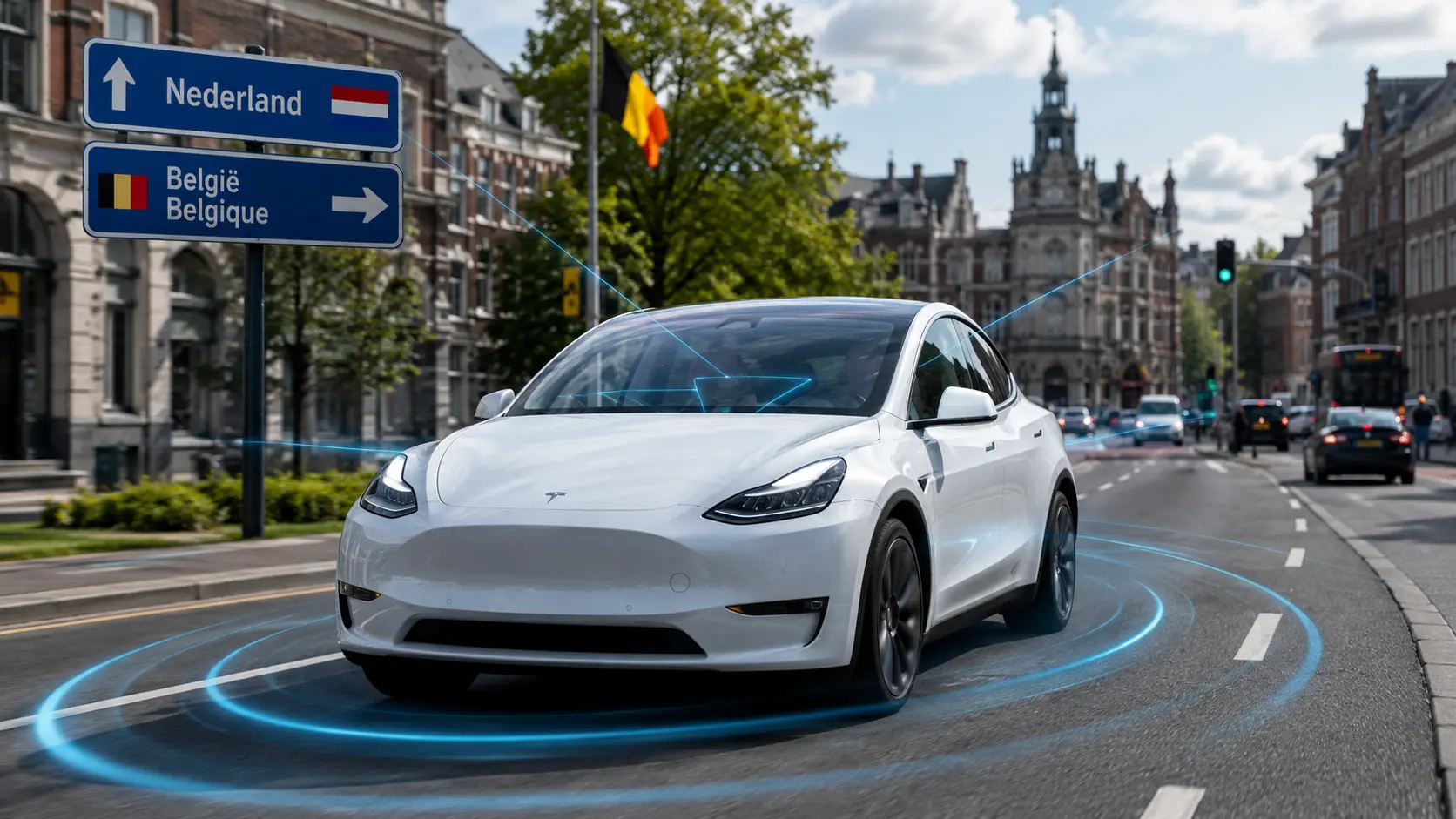
Tesla can now roll out its advanced driver-assistance system Full Self-Driving (Supervised) in Belgium. The Belgian approval comes just two months after the Netherlands became the first EU country to give the green light. It’s another key win for Tesla in Europe, where strict rules have long slowed the adoption of advanced driving aids.
Flemish Mobility Minister Annick De Ridder announced Wednesday that Flanders and the federal government accept Tesla’s provisional European type approval. The decision was made in consultation with federal Mobility Minister Jean-Luc Crucke. After administrative formalities are completed, the Dutch authority RDW will be officially notified of Belgium’s approval.
What does the approval allow?
This does not permit fully autonomous driving on Belgian roads. It applies to Full Self-Driving (Supervised), which can handle many driving tasks on its own, but the driver remains fully responsible at all times.
Tesla’s software can:
- Steer on highways and local roads
- Change lanes automatically
- Recognize traffic lights and stop signs
- Navigate roundabouts and complex intersections
- Perform parking and low-speed maneuvers
The driver must stay alert and be ready to intervene instantly—hence the explicit “Supervised” label. Authorities in both the Netherlands and Belgium stress that the driver remains legally responsible for the vehicle.
The Dutch decision broke the EU deadlock
Tesla’s European FSD expansion began in April 2026, when Dutch regulator RDW became the first in the EU to grant provisional approval for public-road use. That move set a precedent other member states can follow under EU homologation rules.
Belgium moved quickly. In early May, Minister De Ridder said Flanders would review the Dutch documentation to fast-track approval—arguing innovation shouldn’t be needlessly blocked, as long as safety remains paramount.
Before the final go-ahead, Tesla ran roughly 5,000 kilometers of tests on Belgian roads to prove the system performs reliably in local traffic conditions and infrastructure.
Belgium still flags caveats
Despite the milestone, the Belgian government notes several watch points. Minister De Ridder cites driver–system interaction, alignment with Belgian traffic scenarios, and the need for ongoing monitoring.
Those concerns mirror broader European scrutiny of advanced driver assistance. Regulators want to prevent drivers from overestimating the tech and becoming less attentive.
EU approvals gather momentum
Belgium adds to the growing list of European countries allowing Tesla FSD (Supervised). Alongside the Netherlands, Estonia, Lithuania, and Denmark have also granted approval. According to Reuters, Belgium is the fifth EU country to officially sign off.
Strategically, this matters for Tesla. The company is pouring resources into AI, computer vision, and neural networks to make cars increasingly capable on their own. Europe has long been a tough market due to complex rules and fragmented national requirements.
The recent green lights suggest European regulators are gradually gaining confidence in this generation of AI-powered driver assistance—provided human oversight remains intact.
Is Tesla FSD worth the money?
Approval lands as more Dutch Tesla drivers gain real-world experience with FSD (Supervised). Early trials show the system can impress on roundabouts, in stop-and-go traffic, during lane changes, and in complex scenarios.
Price remains contentious. In the Netherlands, Tesla currently charges about €99 per month for access. That raises a sharper consumer question: how much is an AI co-pilot worth if it still requires full human supervision?
Why it matters now
Belgium’s decision is more than a new feature for Tesla owners. It shows how fast AI is moving from pilots to everyday use on public roads.
While AI once lived mostly in chatbots and software, it’s increasingly making decisions in the physical world. Cars are the most visible example. The rollout of Tesla FSD across more European countries could preview how AI will take on a larger role in mobility, logistics, and transport in the years ahead.
Popular news



Latest comments
Loading

