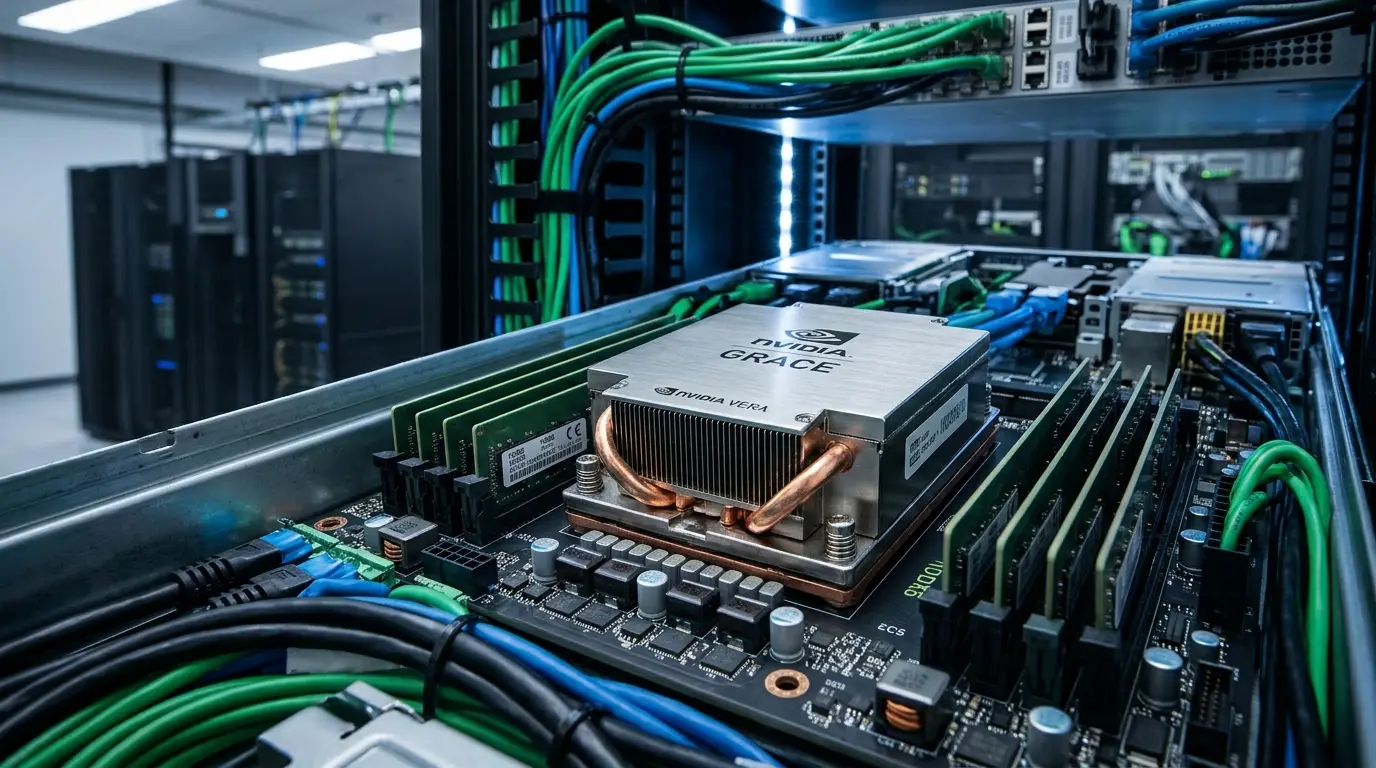
Recent independent testing highlights the capabilities of the new Nvidia Vera CPU in enterprise environments. The processor was evaluated against established x86 competitors including Intel Granite Rapids AP and AMD EPYC Turin. Results indicate a strong showing for Nvidia in specialized server workloads. This evaluation provides data center architects with concrete metrics for next generation infrastructure planning.
Architecture Designed for Agentic AI
The Vera processor relies on 88 custom Olympus cores. This design targets agentic AI and reinforcement learning tasks specifically. Each core includes 2 MB of dedicated L2 cache. The chip integrates a unified 164 MB L3 cache across a single monolithic compute die. This layout minimizes data duplication and optimizes single threaded performance under heavy loads. Developers can review the official architectural breakdown on the NVIDIA Vera CPU developer blog. The focus remains on maximizing throughput for complex AI factory operations.
Benchmark Results Against x86 Rivals
Testing focused on SPEC CPU 2026 metrics and real world data center scenarios. The Vera CPU performed approximately 1.5 percent ahead of dual AMD EPYC 9755 processors in specific integer workloads. It also maintained an 8.6 percent lead over dual Intel Xeon Granite Rapids AP configurations in similar tests. Across the geometric mean of all evaluated benchmarks, the Vera architecture delivered nearly 11 percent better performance than competing advanced designs. These numbers position the chip as a viable alternative for high performance computing clusters seeking to diversify their silicon vendors.
| Specification | Nvidia Vera CPU | AMD EPYC Turin | Intel Granite Rapids AP |
| Core Architecture | 88 Olympus Cores | Up to 192 Zen 5 Cores | Up to 128 Granite Rapids Cores |
| L2 Cache Allocation | 2 MB per core | 1 MB per core | 2 MB per core |
| Total Unified L3 Cache | 164 MB | Up to 384 MB | Up to 504 MB |
| Peak Memory Bandwidth | 1.2 TB/s via LPDDR5X | Up to 600 GB/s via DDR5 | Up to 500 GB/s via DDR5 |
| Primary Optimization | Agentic AI and HPC | General Cloud and Enterprise | General Cloud and Enterp |
Memory Bandwidth Advantages
A major differentiator for the Vera platform is its memory subsystem. The processor supports up to 1.2 terabytes per second of sustained memory bandwidth using LPDDR5X technology. This figure represents roughly double the raw bandwidth available to contemporary x86 server processors. Nvidia also claims a 40 percent reduction in maximum memory latency compared to existing x86 alternatives. You can verify these memory specifications on the official NVIDIA Vera CPU product page.
This bandwidth advantage directly benefits AI agents that require rapid access to large datasets without bottlenecking the compute fabric. Faster tool execution and predictable latency reduce wait times for complex computational tasks. Data center operators evaluating hardware upgrades now have concrete performance metrics to consider alongside traditional x86 offerings. The shift toward specialized silicon reflects broader industry trends. Companies are prioritizing workload specific efficiency over raw core counts. The Vera approach demonstrates that architectural optimization can offset numerical disadvantages in core quantity.

Popular news

Happy Halloween! Startup promises faster AI powered by human brain cells

AI Conversations Aren’t Private: OpenAI Reported More Than 200 Potential Threats of Violence to Police in Three Months

Dream Technologies Secures 17 Million Dollars in Seed Funding

Wabi Secures 55 Million Dollars For Consumer AI Assistant Growth

AI giants back a shared training opt-out for websites

Crux Labs Secures Six Million Dollars To Align Enterprise AI With Human Judgment
Latest comments
Loading