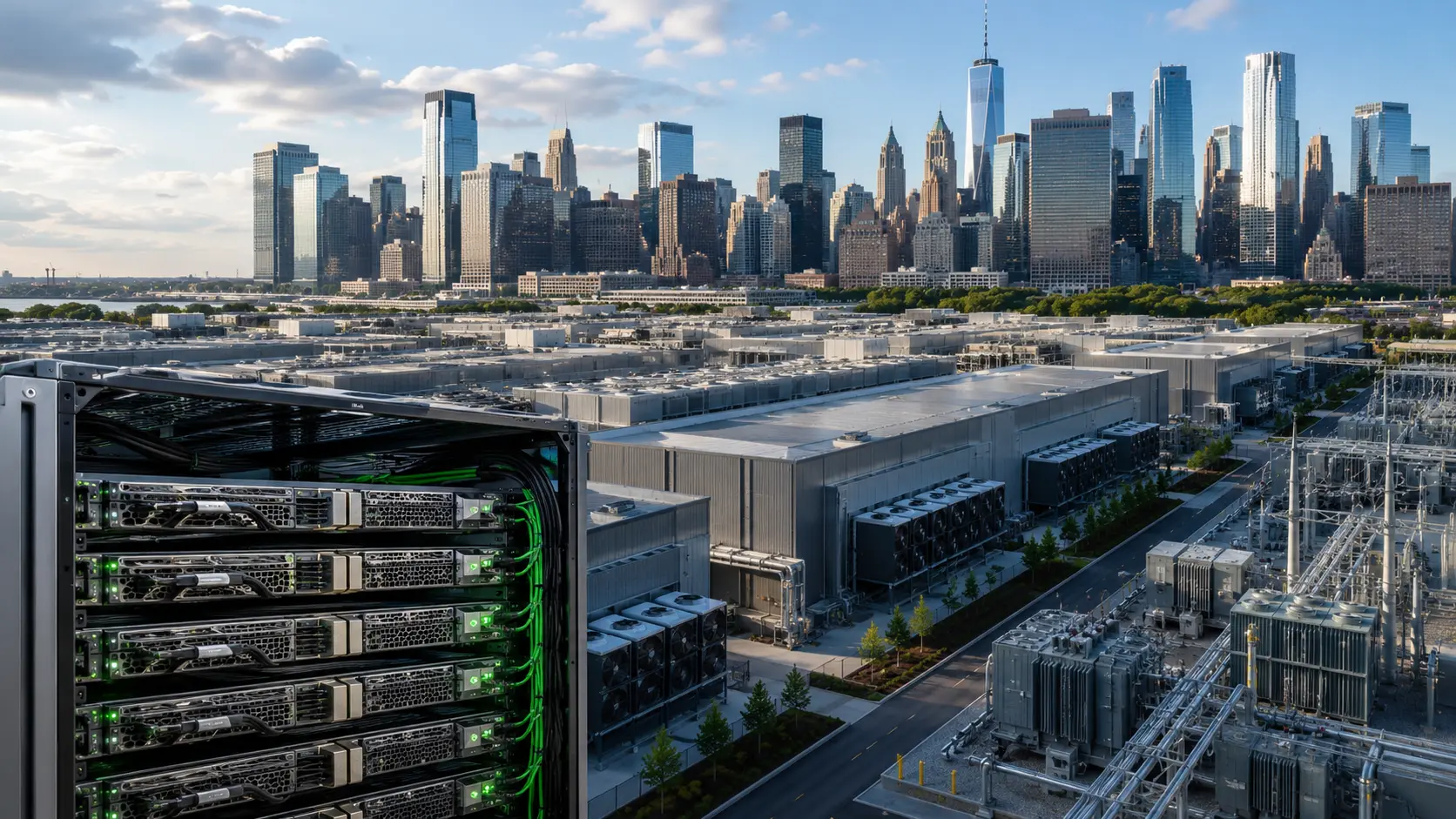
Nvidia is teaming up with six financial heavyweights to build financing platforms aimed at raising more than $500 billion for AI infrastructure.
Apollo, BlackRock, Blackstone, Brookfield, Goldman Sachs, and KKR are involved. The capital would fund data centers, compute systems, and energy supplies built around Nvidia hardware and technology.
The $500 billion figure is a target, not a pre-filled fund. The parties haven’t disclosed individual commitments, final terms, or a complete timetable.
CEO Jensen Huang says Nvidia may provide guarantees or other financial support in certain structures. That backing could cover up to 25 percent of the financing—potentially as much as $125 billion at the program’s maximum size, according to Reuters.
Why Nvidia is courting asset managers
Nvidia sells the processors and networking gear that power modern AI data centers. But chips are only a slice of the total bill.
Large builds require land, buildings, cooling, transformers, grid connections, backup generators, and high-speed networks. The biggest campuses can run into the tens of billions of dollars.
Even tech giants can’t fund every project from their own balance sheets. For smaller cloud providers and AI startups, raising that kind of money is even harder.
Nvidia’s initiative aims to plug large investors directly into companies and governments building AI capacity. Financing can be structured around long-term usage of the infrastructure.
For asset managers, data centers can offer steady cash flows from leases and usage contracts. The flip side: the sector’s fortunes hinge on future demand for AI services.
Not a classic $500 billion fund
The headline number might suggest Nvidia and six financiers are instantly putting up $500 billion. That’s not the setup.
These are multiple financing platforms designed to attract outside investors over time. Debt, guarantees, and standalone investment vehicles may all be part of the mix.
That means a given amount of equity could be leveraged to finance a much larger pool of projects.
Who will access the money isn’t set yet. Nvidia names developers, enterprises, governments, and cloud providers as potential users.
Projects will likely center on infrastructure built with Nvidia systems. That not only helps customers raise capital—it also indirectly supports demand for Nvidia’s own chips.
Nvidia could guarantee up to $125 billion
Nvidia says it can backstop up to a quarter of certain deals. A guarantee doesn’t mean immediate cash out the door.
It could, for example, agree to absorb part of the risk if a project underperforms. That can encourage banks and investors to lend on better terms.
As long as projects perform, guarantees cost little. If demand softens or a customer can’t meet obligations, Nvidia could be on the hook for a share of the losses.
It’s a powerful but not risk-free move. Nvidia is using its balance sheet and market clout to catalyze far larger pools of external capital.
In doing so, the company is evolving from a chip supplier into a financial linchpin of the AI boom.
The rise of a circular AI economy
Tighter financial ties across the AI stack raise eyebrows.
Nvidia sells chips to clouds and AI developers. At the same time, it invests in some of those customers or helps them secure financing—money they often use to buy more Nvidia hardware.
That creates a loop where supplier, investor, financier, and customer become deeply intertwined.
That doesn’t mean demand is artificial. Enterprises and governments genuinely want more compute. The structure can accelerate projects that might otherwise stall.
But it does blur how much demand comes from end users paying for AI services versus demand sustained by continual new financing.
If AI revenues grow slower than expected, data center operators could struggle to service their debt—spreading stress to investors, banks, and suppliers.
Wall Street’s new bet: data centers as an asset class
Apollo, BlackRock, Blackstone, Brookfield, Goldman Sachs, and KKR collectively manage vast sums of capital. They invest on behalf of pension funds, insurers, and other institutional players.
These firms are already deep in infrastructure, real estate, and energy. AI data centers fuse elements of all three.
A data center partly resembles commercial real estate, but it also requires massive, reliable power. Its value further depends on technical gear that can become outdated far faster than a typical building.
The latest processors often deliver far better performance and energy efficiency than prior generations. A facility that looks attractive today could need costly upgrades within a few years.
Investors must gauge more than a tenant’s ability to honor a lease. They also need to judge whether the facility, its power connection, and its hardware can stay competitive over time.
AI spending set to top $730 billion
Nvidia expects global investment in AI infrastructure to exceed $730 billion this year. The company believes that figure will keep rising as businesses, governments, and cloud providers scale up larger models and more AI services.
That outlook favors Nvidia, which earns money from the processors, networking systems, and software used across many of these deployments.
But growth can’t go on forever without real revenue from practical uses. In the end, data centers must be paid for by customers using AI for search, coding, ads, enterprise software, research, and other services.
The financing program pulls some demand forward. Customers can build infrastructure now and pay it back over a longer period.
That speeds deployment—but also raises the stakes if the expected future revenue doesn’t materialize.
Power is becoming as critical as chips
Even with $500 billion on the table, physical limits remain. New data centers need staggering amounts of electricity.
In many regions, projects face multi-year waits for grid connections. Transformers, turbines, and specialized construction components are also in short supply.
Communities and local governments worry about energy prices, water use, noise, and added strain on the grid.
Nvidia can arrange financing, but that doesn’t guarantee permits or hookups. Success will hinge on close coordination with utilities, local authorities, and infrastructure developers.
Above all, the initiative shows how big the ambitions have become. AI is no longer funded like a standard software play. The industry increasingly resembles telecom, energy, and other capital-heavy infrastructure markets.

Latest comments
Loading