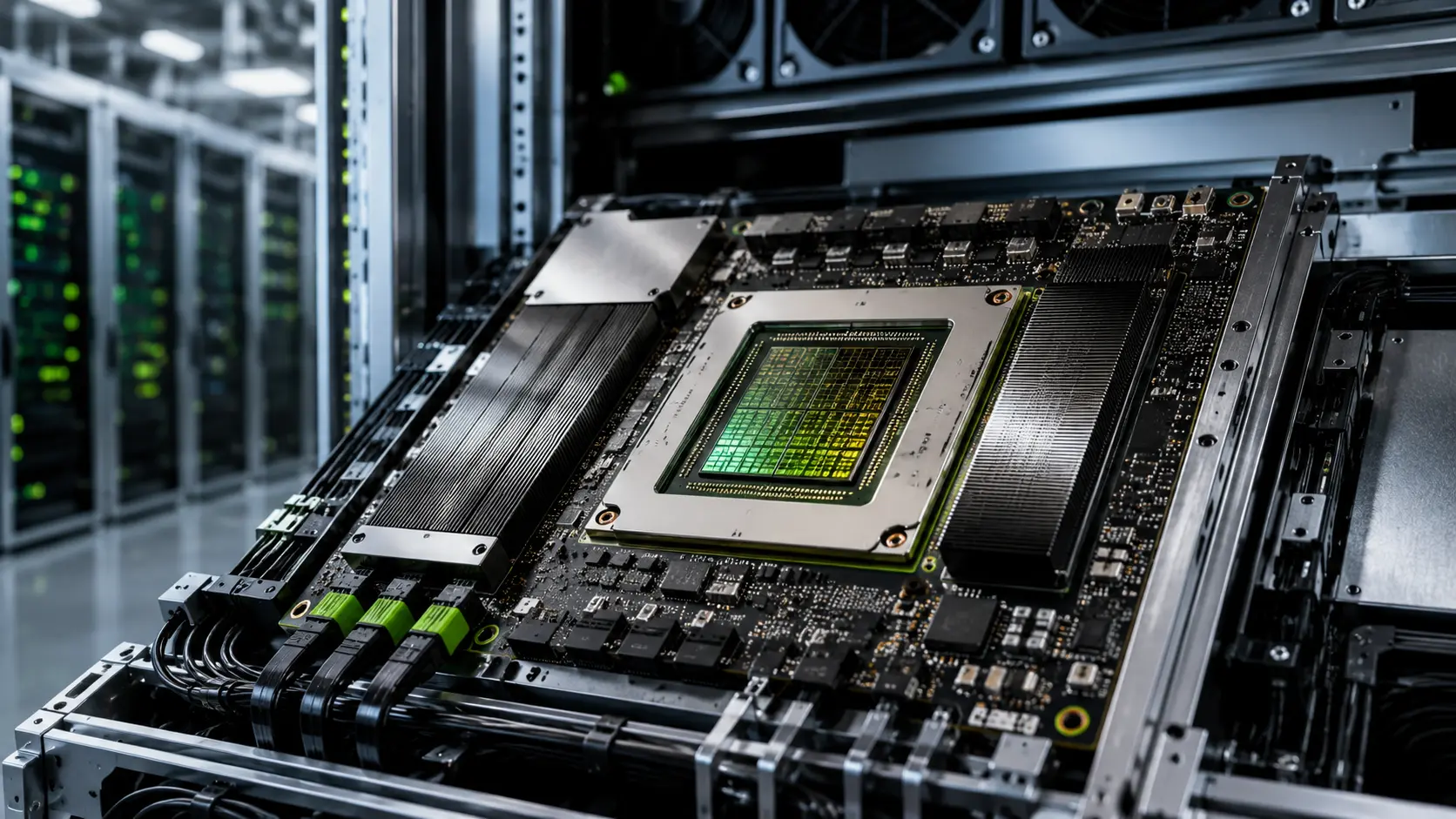
Nvidia has announced that its Groq 3 LPX accelerator is now in full production—turning the previously teased Groq technology into hardware ready to deploy at scale. Nvidia is pairing Groq 3 with its Vera Rubin platform and, notably, isn’t betting on a single AI chip type. Instead, it’s mixing processors, each optimized for a different slice of AI inference.
That production milestone matters. AI companies are pouring money and power into inference—the act of running trained AI models. AI agents in particular can chew through vast numbers of tokens, making speed, energy use, and cost per token critical.
What is Nvidia Groq 3 LPX?
Groq 3 LPX is a specialized accelerator built for high-speed AI inference, complementing Vera Rubin NVL72 inside Nvidia’s stack. It targets the decode phase of inference—the part where a language model generates its answer token by token.
Nvidia outlined the architecture earlier this year and initially guided for availability in the second half of 2026. That’s why today’s “full production” label is the real headline: Nvidia now says it’s ready to ship the tech at scale.
According to Nvidia, a fully configured LPX rack can include up to 256 Groq 3 LP30 processors. The system delivers:
- 315 PFLOPS of FP8 inference compute;
- 128 GB of SRAM;
- 40 petabytes per second of SRAM bandwidth;
- 640 TB/s of scale-up interconnect bandwidth;
- up to 256 chips per rack.
SRAM is ultra-fast memory located much closer to the processor than the memory large AI systems typically rely on. Packing in lots of SRAM with extreme bandwidth is meant to slash latency while generating tokens.
That makes Groq 3 fundamentally different from “just another Nvidia GPU.”
Nvidia splits one AI workload across multiple chips
The bigger shift is how Nvidia plans to run inference. Rather than pushing every stage of an AI request through the same processor type, Nvidia combines different architectures inside one AI infrastructure.
Vera Rubin NVL72 remains the heavy GPU workhorse. Groq 3 LPX slots in where ultra-fast, predictable token production matters most. Nvidia calls this a heterogeneous inference architecture.
That split grows more important as AI systems get more complex.
A basic chatbot takes a question and returns a single answer. An AI agent, under the same instruction, may run dozens or hundreds of model calls, use tools, fetch data, spin up sub-agents, and feed earlier outputs back into the model.
As a result, the key question shifts from “how powerful is this chip?” to “how much useful AI work can a data center deliver per watt and per dollar?”
Groq fits squarely into that shift.
From Groq tech to a Nvidia product
Mass production also shows how quickly Nvidia has folded tech from its Groq deal into its own infrastructure strategy. Groq made its name with specialized Language Processing Units—LPUs—tuned for fast, predictable inference.
Groq 3 LPX now becomes an explicit part of the Vera Rubin ecosystem.
Nvidia also says the first deployment is set. Cloud company Nebius will be the first provider to run Groq 3 LPX in its AI infrastructure, with systems going live later this year. After that, Groq itself plans to use the hardware for its inference cloud.
Strategically, this matters. Nvidia isn’t just selling an accelerator—it’s tightening its grip on the infrastructure behind AI services, from GPU compute and CPUs to networking, software, and specialized inference processors.
Why AI inference is the next big chip battle
Inference is surging because AI models need continuous compute after training to actually do anything. Every ChatGPT-style reply, generated image, code action, or agent step spins up new calculations.
With agents, that demand can skyrocket.
Nvidia cites OpenRouter data suggesting agentic workloads can process around 15 times more tokens than simple chat prompts. An agent doesn’t just run one prompt—it may execute a chain of interlinked tasks.
That changes the economics for cloud providers.
A small edge in energy use or tokens per second looks trivial for one user. At the scale of millions of users and always-on AI agents, the same delta can dramatically impact power bills, data center capacity—and ultimately the price of an AI service.
That’s why Nvidia is pushing “performance per watt” and “cost per token” as the key yardsticks for AI infrastructure.
Nvidia claims up to 30x more AI work per megawatt
Nvidia released new internal measurements showing Vera Rubin NVL72 delivers up to 30 times higher agentic inference throughput per megawatt than GB300 NVL72. The test used AgentX workloads with fixed agentic coding sessions, including long contexts, tool calls, and sub-agents.
That headline number needs context.
The results were measured by Nvidia and, according to the company, are pending review by SemiAnalysis. The 30x gain was achieved on a specific DeepSeek V4 Pro workload and at a defined performance level of 160 tokens per second per user. It cannot be read as “Rubin is 30 times more efficient” across all AI applications.
Nvidia also touts up to 35x lower cost per million tokens versus GB300 NVL72 under its test conditions. That, too, is a vendor benchmark—not yet an independently validated, general cost advantage.
The shift in focus is as important as the flashy figure: Nvidia is optimizing its new stack explicitly for agentic AI, where throughput, latency, power, and cost matter as much as raw compute.
What does Groq 3 mean for Nvidia’s competitive edge?
Groq 3 gives Nvidia a specialized inference architecture alongside its dominant GPU platform. That could be critical if dedicated chips prove more efficient than general-purpose GPUs for certain AI workloads.
And that’s exactly where competition is heating up.
Cloud providers are increasingly building their own AI chips to reduce reliance on external accelerators and cut inference costs. Nvidia’s answer isn’t just faster GPUs—it’s a broader system that integrates multiple processors, networking, and software into a single platform.
Groq 3 makes that strategy tangible.
The chip doesn’t need to replace the Rubin GPU. Nvidia can instead pair both architectures so each processor handles the slice of an AI workload it runs most efficiently.
For customers, that may matter more than which individual chip boasts the highest theoretical FLOPS.
The real test starts in the data center
With mass production, Groq 3 LPX shifts from roadmap promise to an operational Nvidia product. The question now isn’t when the hardware ships, but how it performs once cloud providers deploy it at scale.
More than a single accelerator’s sales are on the line for Nvidia.
If AI agents do demand far more inference capacity, energy, latency, and cost per token become the hard limits on AI’s growth. Nvidia’s bet is to meet that demand with specialized chips inside a unified architecture.
Groq 3 LPX underscores where Nvidia thinks the next phase of the AI chip war will be fought: not just in training ever-larger models, but in running them as fast and as cheaply as possible.

Latest comments
Loading