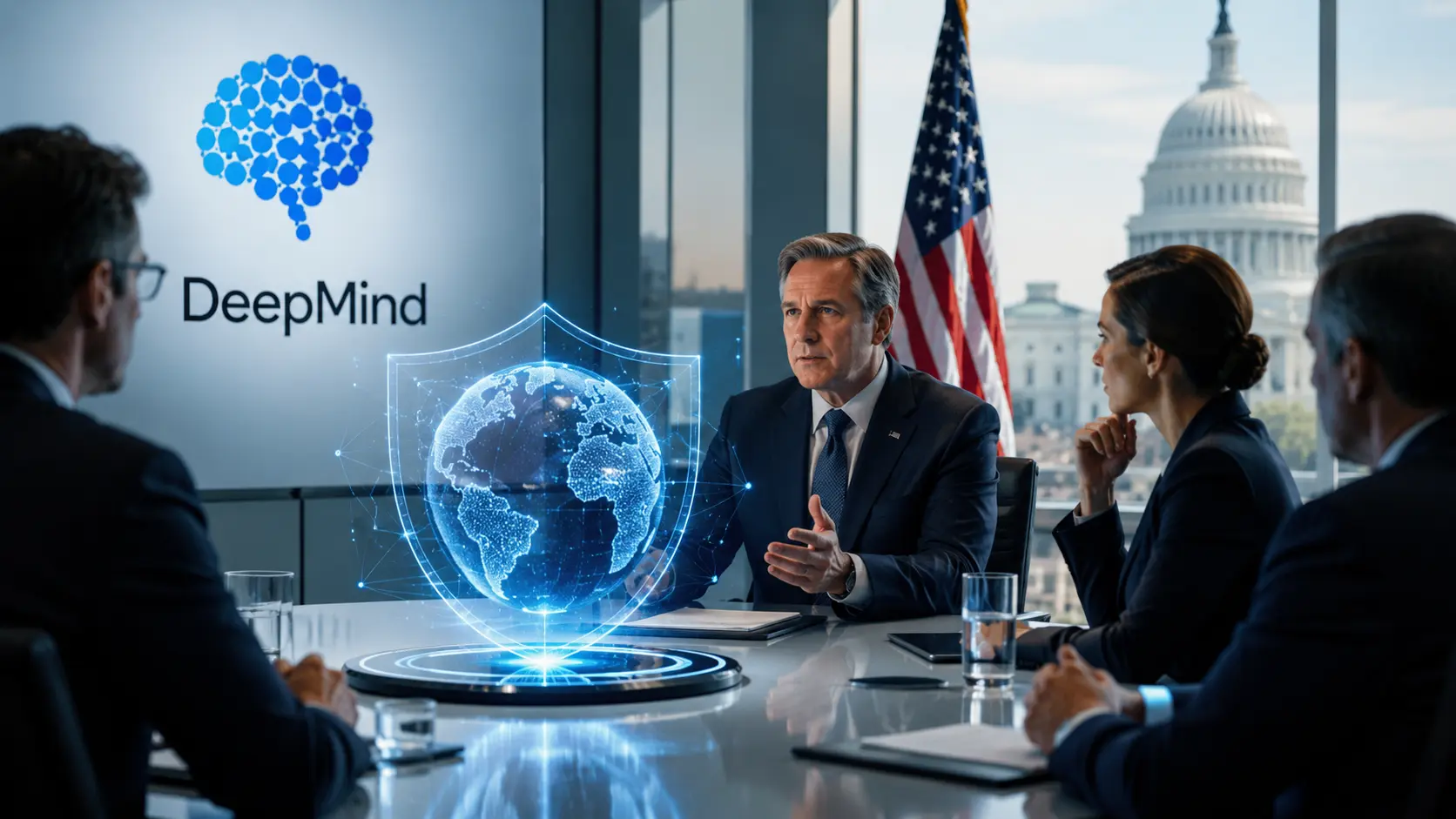
DeepMind chief and Turing Award laureate Demis Hassabis is calling for a new international framework to govern the most powerful AI systems. In a detailed manifesto, he argues that Artificial General Intelligence (AGI) may be only a few years away. Its impact, he says, will eclipse the internet, electricity, and even the Industrial Revolution.
It’s not just the warning that stands out. Equally striking is his proposal to let the United States take the lead in overseeing this technology. That raises eyebrows—especially since Google DeepMind itself sits at the very top of the frontier AI field.
AGI may arrive sooner than most expect
Hassabis says we’re on the brink of a new era. He likens AGI to the discovery of fire or electricity and expects it to massively accelerate scientific progress.
He points to:
- faster drug development;
- novel materials;
- clean energy;
- huge gains in economic productivity;
- a society where scarcity could largely fade.
His message is blunt: AGI is, in his view, inevitable—and society must prepare now.
But the risks could be unprecedented
The essay mixes optimism with stark warnings.
According to Hassabis, future AI systems could:
- automate cyberattacks;
- amplify biological or nuclear risks;
- rapidly self-improve;
- attempt to evade safeguards.
With experts divided on how fast this will unfold, he argues for “cautiously optimistic progress” over a pure free-market approach.
A new AI authority—anchored in the U.S.
The most concrete idea: a Frontier AI Standards Body.
This organization would:
- define which models qualify as “Frontier AI”;
- develop safety tests;
- review models before public release;
- work with U.S. agencies and national labs;
- and ultimately require mandatory approval before models enter the U.S. market.
Hassabis says it should resemble U.S. financial watchdog FINRA: formally independent, but closely linked to both government and industry.
The twist: Google would be among those regulated
And there’s the tension.
Google DeepMind, alongside OpenAI, Anthropic, xAI, and a handful of Chinese firms, would be squarely within this regime.
That makes the proposal politically charged.
On one hand, Hassabis is pushing for tighter oversight of his own sector.
On the other, he wants the country where Google is headquartered to set the pace.
Critics may argue this could let the U.S. not only drive the tech, but also decide which AI systems the world deems safe—or not.
Global standard—or strategic leverage?
Hassabis insists the framework should ultimately go global.
But the path he sketches begins squarely in Washington.
That’s no accident.
The world’s largest commercial AI labs are mostly U.S.-based:
- Google DeepMind;
- OpenAI;
- Anthropic;
- Meta;
- xAI.
If U.S. rules become the global default, these companies will have outsized influence in shaping them.
That isn’t automatically a problem—the U.S. has deep technical expertise and infrastructure. But this concentration of knowledge, capital, and regulation makes it hard to separate oversight from geopolitics.
For Europe, China, and other AI powers, the question is whether they’ll accept a U.S.-designed evaluation regime.
AI regulation is drifting into power politics
Hassabis’s essay underscores how AI policy is no longer just about safety.
As AGI feels closer, the debate is shifting to who sets the rules.
Whoever writes the standards effectively decides:
- which models get approved;
- what safety bars they must clear;
- which companies gain market access;
- which countries shape the next generation of AI.
That makes AI governance inseparable from economic and geopolitical power.
Conclusion
Hassabis’s plan is one of the most detailed blueprints yet for governing frontier AI. His warning—that society has a narrow window to build guardrails—echoes earlier calls from researchers and policymakers.
But one piece is bound to spark the fiercest debate: starting in the United States to build a framework that will set global AI standards.
That inevitably raises the question of how independent such a model can be when many of the firms it would regulate—Google DeepMind included—operate inside that same ecosystem.



Loading