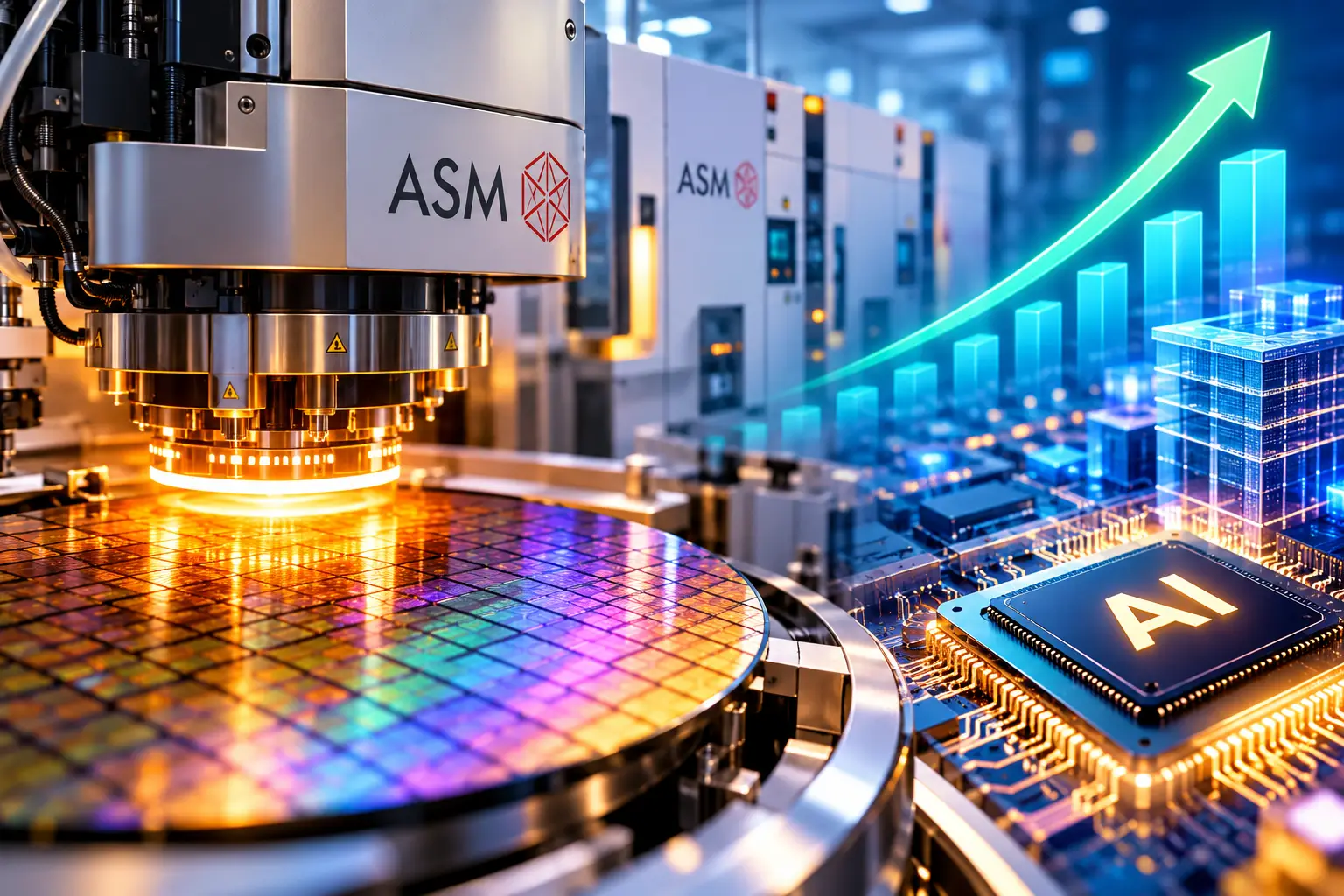
ASM International expects revenue to exceed €5.7 billion as soon as next year. The Dutch chipmaking-equipment supplier had set that figure as a target for 2030. Demand for AI-chip equipment is bringing that goal forward by three years, the company says.
Based in Almere, ASM makes machines that help chipmakers deposit ultra-thin layers of material. The company reported record third-quarter revenue of €1.16 billion, up 45 percent from a year earlier.
Revenue target arrives three years early
The revised outlook appears in ASM’s quarterly results. It is a forecast based on constant exchange rates, so the company has not yet reached its revenue target.
Most of the growth came from customers making advanced processors. Sales of equipment for memory chips also increased. For the fourth quarter, ASM expects revenue of about €1.23 billion, plus or minus 5 percent.
The board also approved a share buyback of up to €300 million, allowing ASM to return surplus cash to shareholders. An earlier €150 million buyback ended in September. The company will announce further details before the new programme begins.
The announcement follows a turbulent spell on the stock market. In the previous trading week, ASM fell about 7 percent, while ASML and Besi also declined. That weekly roundup came before the latest results.
Why ultra-thin layers matter
Atomic layer deposition, or ALD, is a key part of ASM’s offering. The process builds up a layer of material one step at a time, repeating chemical reactions until it reaches the desired thickness.
In its technical guide to ALD, ASM says the process allows precise control over layer thickness, even on surfaces with complex shapes. That uniform coverage is valuable as chip components become ever smaller.
Chipmakers are also building more components in three dimensions. Materials must therefore coat vertical structures and fit into narrow openings. In an explanation of 3D chips, ASM describes how this is creating more uses for ALD.
For the equipment maker, growth is not just about how many chips a factory produces. More complex chip designs can require additional steps using ASM’s machines. A new manufacturing generation can therefore create more work even before a customer increases chip output.
Services and maintenance add to growth
ASM also earns revenue from parts and services for machines already installed at customer sites. Its investor presentation shows that this revenue grew 31 percent in the third quarter at constant exchange rates. Sales of new equipment rose 48 percent.
The company plans to expand its services business, including through agreements focused on machine performance rather than one-off parts or maintenance work. ASM aims for these agreements to account for more than half of its parts-and-services revenue by 2030.
Suppliers could set the pace
CEO Hichem M’Saad told Reuters that ASM has visibility into customer plans through 2028. Some customers have already shared plans extending to 2030. M’Saad said ASM has enough production capacity, but parts of its supply chain are under pressure.
That makes the availability of components a key condition for growth. ASM’s own capacity alone will not determine how many machines it can deliver. Suppliers must also be able to ramp up production on time.

Popular news

EU Leaders Meet in Dublin to Decide Who Pays for Europe’s AI Computing Power

Anthropic Bankers Push IPO Pricing Above Initial Range to Reach 1.5 Trillion Valuation

Google DeepMind’s AlphaGenome 2 predicts what DNA variants do in specific cells

Anthropic Says Automated Coding Tools Are Dismantling Nvidia Software Moat

US Data Brokers Supply Half Billion Dollars In AI Training Environments To Chinese Labs